

In laboratories across the world, researchers’ ideas are limited by their access to cutting-edge instrumentation. Modern science pushes the boundaries of possibility more than ever before and the need for instrumentation that can realise the promise of research proposals is clear.
Nowhere is this more obvious than in the explosive interest in 3D Electron Diffraction (3D ED/microED) — a technique capable of solving structures that have resisted analysis for decades. Indeed, the evidence from published papers is clear that in the short time since the commercialisation of electron diffractometers in 2021, electron diffraction is in high demand and producing papers for previously unsolvable problems.
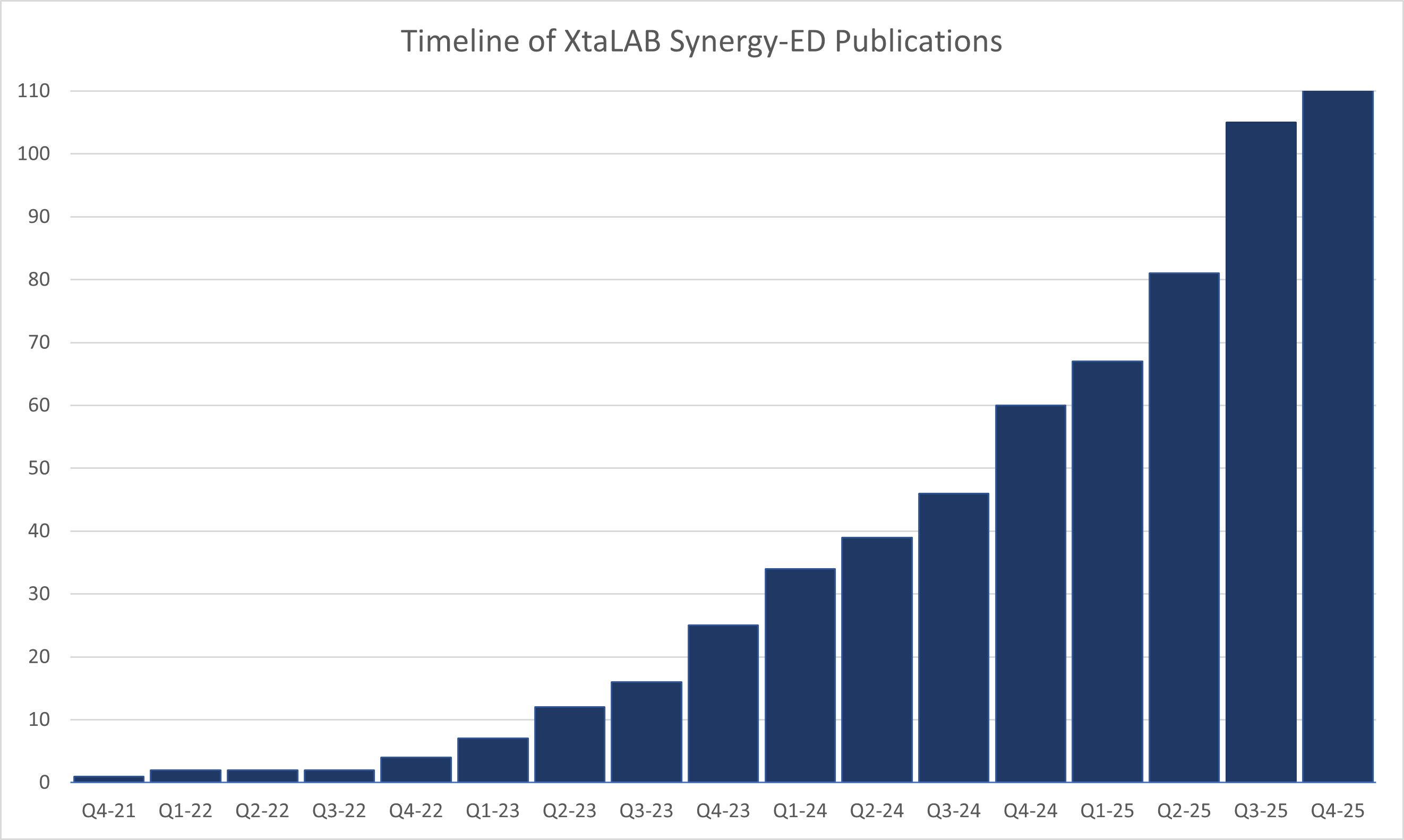
Figure 1: Publications from XtaLAB Synergy-ED are rising exponentially since the instrument was first installed in a customer lab in 2022.
Yet winning funding for a dedicated electron diffractometer is not typically straightforward. Whether you work in the US, Europe, China, or Japan, the challenges look deceptively similar: strained research budgets, grant reviewers who fail to recognize the stark difference between a dedicated electron diffractometer and a TEM or the vast differences in X-ray and electron diffraction, internal committees who doubt demand or performance claims, and funding bodies who reward ambitious science while punishing any hint of operational risk.
But here’s the truth that scientists who already own the XtaLAB Synergy-ED already know:
successfully acquiring funding requires a convincing story about why this instrument must be installed in your institution.
This guide takes lessons from real funding reviews, internal university politics, failed and successful proposals, business case frameworks, and first-hand accounts from institutions who succeeded in securing funding.
________________________________________
1. 3D ED/microED Is no longer optional
Across chemistry, materials science, pharmaceuticals, and structural biology, researchers increasingly face the same barrier: their crystals stubbornly refuse to yield a structure and grow only to a size that is too small for conventional X-ray diffraction. Even with intense synchrotron radiation, many samples refuse to diffract well enough for an unambiguous structural result leaving researchers without a path to a 3D structure.
3D ED/microED breaks that barrier.
The technique routinely solves:
- nanocrystalline small molecules
- fragile organic crystals
- pharmaceuticals and polymorphs
- beam-sensitive materials
- MOFs, COFs, zeolites, catalysts
- biomolecular nanocrystals
- inorganic and semiconductor materials
- environmental and geological microphases
For many real-world samples, the bottleneck is growing any usable single crystal, and considerable time and effort is put into optimizing crystallization conditions, often without success.
Any of us who have worked as a service crystallographer know the frustration our users experience trying to grow crystals for that one last structure that is holding up a publication. It makes it abundantly clear that a crystal structure, rich with 3D information, can be critical for finalizing a publication, for understanding physical properties or to understand a failed synthesis attempt and find a path forward.
Electron diffraction and its ability to overcome this bottleneck points to a future where structural analysis facilities will require both electron diffraction and X-ray diffraction to be considered competitive. At the very least, it is almost a certainty that the top-rated universities will offer electron diffraction and those that don’t, risk falling behind.
The scientific need is real, immediate, and growing — and this is a key funding lever.
________________________________________
2. Why a dedicated instrument Is essential (and reviewers need you to prove it)
Many funding bodies, charged with responsible dissemination of funds, begin from a sceptical position:
“Can’t you already do this on your existing equipment?”
This is where many proposals fail. Reviewers unfamiliar with the technique or with out-dated assumptions consider electron diffraction to be just another imaging mode provided by a TEM.
Your argument must therefore challenge this perspective and be crystal clear:
A TEM is not a 3D ED/microED instrument.
The requirements for diffraction and imaging are not the same and that creates a problem for the TEM facility.
- TEMs have long switching and stabilisation times between modes
- Electron-diffraction setups are not always optimally aligned
- Throughput is extremely low (often hours/sample)
- Beam conditions are not optimised for crystallography
- Access for diffraction is limited as it takes time away from the primary purpose of a TEM facility, i.e. imaging
- Data quality is inconsistent
- Facility staff cannot easily drop ongoing high-value TEM work to run diffraction experiments
- Many TEMs are simply not configured for 3D rotation data collection
As electron diffraction becomes increasingly recognized as technique that transcends scientific disciplines and can solve, as yet unsolved, crystallographic problems, a dedicated instrument becomes an essential tool to manage the influx of samples otherwise bound for TEM facilities:
- Routine throughput is only minutes per sample, not hours.
- The training curve is minimal for crystallographers, CrysAlisPro-ED offers a familiar interface, and results are easily obtainable on day one.
- The success rate is dramatically higher than TEM-based workflows.
This narrative, backed by quantified throughput expectations and real bottlenecks, is foundational to persuading reviewers and internal committees.
________________________________________
3. Why funding proposals fail
Across dozens of review comments and internal funding experiences, three failure themes keep showing up.
3.1 The user base is “promised,” not demonstrated
US NSF-MRI reviewers do not consider simply saying that “25 PIs will use this” as credible evidence.
They expect:
- Named PIs with active grants
- Concrete examples of research requiring 3D ED/microED
- Typical usage hours per year for each PI
- Preliminary data proving their need or case studies
- Cross-departmental demand
If one of these is vague, reviewers may consider the user base “aspirational” rather than demonstrable.
Solution:
Build a portfolio of real sample successes — even from vendor demonstrations or borrowed time. Document samples that failed on X-ray instruments (including synchrotron) or TEM but succeeded on 3D ED/microED. Obtain letters of support from stakeholders who need the instrumentation, explaining why they consider it essential to their research success. Don’t forget that Rigaku are always ready to measure test samples for you and your collaborators to help you provide the critical evidence needed for your proposal.
3.2 The operational plan lacks credibility
Reviewers want confidence that the instrument will not become a burden. After all, expensive equipment lying unused because of poor resourcing decisions represents wasted money.
They therefore scrutinise:
- staffing levels
- training pipeline
- maintenance plans
- sample submission processes
- external user logistics
- data management and storage
Weakness in any of these signals risk, and risk sinks instrumentation proposals.
Solution:
Borrow from successful core facility models. Describe planned user training and development, sample submission and data handling logistics, service contracts, and staff utilization with precision.
3.3 The proposal lacks a clear, forceful advocate
This is where narrative becomes decisive.
At one site in the United States of America, the turning point wasn’t just technical justification — it was that senior faculty (especially high-impact chemists) insisted the XtaLAB Synergy-ED was critical, not optional. They were vocal, unequivocal, and willing to confront internal funding committees directly.
At another, it was much the same.
Internal committees respond best to two things:
- strong champions
- clear evidence that those champions will actually use the instrument
This dynamic is universal — US, Europe, Japan, China etc.
________________________________________
4. Region-specific funding strategies
Now we turn to the heart of the global guidance: tailoring your funding approach to the expectations, culture, and review criteria of each region.
________________________________________
4.1 United States: Winning NSF-MRI, NIH S10, DOE and Internal University Funding
The US has the most complex — and politically sensitive — environment for instrumentation grants.
What US reviewers care about most
- Does the instrument fill a technical gap no other local facility can fill?
- Is the user base funded and real?
- Are operational logistics thought through?
- Is institutional commitment strong?
- Is there preliminary data across multiple departments?
- Can staff expertise support the system immediately?
- insufficient detail on external user access
- concerns that staffing is too thin
- lack of throughput projections
- no recharge rate model
- over-ambitious outreach without concrete plans
- too few data examples from potential users
- uncertainty about training capacity
Winning strategies in the US
A. Major-user strategy
For NSF and NIH, 3–10 major users must each have:
- funded grants
- specific aims requiring 3D ED/microED
- projected annual usage hours
B. Preliminary data is not optional
If a proposal shows only one successful dataset (common fault), reviewers may question broader feasibility.
C. Align to national priorities
Emphasise impact in:
- pharmaceuticals
- energy materials
- semiconductors
- catalysis
- structural biology
D. Lobby program officers
US scientists who win routinely do this.
Yale explicitly advised it after their MRI rejection.
E. Use rejection as leverage
When another US institutes MRI was declined, they used it to argue internally that external funding was no longer viable — and therefore an internal investment was essential.
F. Highlight democratization of access
3D ED/microED provides structure solutions without large crystals or synchrotron access — a compelling selling point in US review culture.
G. Leverage AI funding trends
Recent trends in US funding have favoured applications that have strong links to artificial intelligence. Funding proposals for electron diffraction projects which incorporate AI elements are therefore more likely to win funding.
________________________________________
4.2 Europe: Horizon Europe, ERC, National Research Councils
In Europe, the term 3D ED dominates, and the funding ethos differs sharply from the US.
What European evaluators emphasise
- alignment with mission-oriented programmes
- pan-European collaboration
- open access and FAIR data commitments
- interdisciplinary impact
- training networks and student mobility
- industrial relevance
- environmental sustainability
European reviewers are less concerned with usage hours and more focused on:
- societal benefit
- long-term scientific leadership
- integration with European research infrastructures
Winning strategies in Europe
A. Frame 3D ED as enabling transformative research across multiple consortia
Link to Horizon Europe clusters (health, digital, climate, industry).
B. Emphasise shared access models
A 3D ED facility that “serves the region” elevates competitiveness.
C. Highlight FAIR data and open science
Your data management framework is a major advantage here.
D. Demonstrate training excellence
Workshops, PhD mobility, visiting scholars, industry apprenticeships.
E. Connect to industrial modernization
3D ED is a frontline tool for Europe’s growing pharmaceutical and materials sectors where 3D ED is filling informational gaps other analytical techniques are simply unable to.
________________________________________
4.3 China: NSFC, Provincial Funds, Institutional Investment
Instrumentation funding in China is strategically driven and metrics-oriented.
What Chinese evaluators prioritise
- alignment with national strategic technology goals
- proven throughput and productivity
- publications per year
- significance to regional industrial clusters
- early-career training impact
- evidence the institution will support long-term operation
Winning strategies in China
A. Emphasise contribution to national strategic sectors
- biopharmaceuticals
- semiconductors
- green chemistry
- advanced materials
B. Quantify throughput explicitly
Chinese reviewers expect numerical projections:
- samples/week
- datasets/year
- expected publication output
C. Highlight workforce development
Training China’s next generation of structural scientists is a strong justification.
D. Demonstrate institutional commitment
Preferably long-term support for staff, service contracts, and facility space.
________________________________________
4.4 Japan: JST, JSPS, MEXT
Japan’s funding environment prizes precision, stability, and national complementarity.
What Japanese evaluators expect
- minimal risk
- clear complementarity to existing national facilities
- strong preliminary data
- robust, stable operations
- staff continuity
- integrated educational impact
- modest, credible claims
Winning strategies in Japan
A. Position 3D ED as filling a specific national capability gap
Japan has world-class TEM infrastructure — your story must be about what TEM cannot do.
B. Emphasise long-term institutional stability
Japan values:
- permanent staff
- clear governance
- stable funding for service contracts
C. Provide abundant preliminary data
Japanese reviewers rarely fund instruments without convincing prior demonstration.
D. Highlight incremental enhancements and reliability
3D ED/microED should be presented as strengthening — not disrupting — existing crystallographic workflows.
________________________________________
5. The playbook for a winning proposal (any region)
Here is the distilled, universal strategy that successful applicants follow.
5.1. Show why 3D ED/microED is essential — not desirable
Make the structural bottleneck undeniable – what is the cost of not having this technique in your institute?
5.2. Offer to establish a regional center
As a relatively new class of instrumentation, many of the first grants are being awarded to those who offer to establish regional centres, such as the UK’s National Electron Diffraction Facility (NEDF) to accelerate adoption of this new, ground-breaking technology. While adoption is still relatively low, this is a great angle to convince funding bodies you have a cost-effective way to bring electron diffraction to many institutes in your local area.
5.3. Build a coalition of high-impact, vocal supporters
Internal politics matter everywhere. With the right support, reviewers take notice.
5.4. Prove cross-departmental demand
Chemistry, materials science, biology, pharmacology, geology, environmental science. Grants which demonstrate higher value are more likely to succeed.
5.5. Provide preliminary data from multiple sample types
This is a critical credibility marker globally. The broader the evidence, the harder the value is to deny.
5.6. Present a watertight operational plan
Reviewers must see zero risk in staffing, maintenance, and data management.
5.7. Emphasise broader impacts strategically
Training, regional access, collaboration, industry engagement, workforce development. 3D ED/microED will be an important technique in the future, offering your facility as a source of expertise both in training scientists and in operational effectiveness positions your institute as a leader.
5.8. Tailor your argument to regional funding culture
Because a proposal that wins in the US would likely fail in Japan — and vice versa.
________________________________________
6. The final persuasive point: Why the Rigaku XtaLAB Synergy-ED is the right ask
The XtaLAB Synergy-ED is uniquely suited to funding success because its design eliminates the reviewer concerns that typically sink 3D ED/microED instrumentation proposals:
- dedicated, always-aligned instrument
- high throughput
- intuitive software (CrysAlisPro-ED) shared across Rigaku X-ray systems
- reliable automation
- low barrier to user training
- no need for TEM expertise
- well-established operational models
- globally successful installations with documented outcomes
When reviewers, committees, and funding bodies see that the instrument itself reduces risk and increases accessibility, they’re more willing to support it.
________________________________________
Conclusion: Your funding success hinges on the story you yell
3D ED/microED is no longer a niche technique — it is rapidly becoming an essential structural tool across the molecular and materials sciences. But the instrument will not fund itself. You must make the case clearly, forcefully, and strategically, tailored to the expectations of your region. Additionally, Rigaku is a global organisation with regional experts in sales, applications and service, if you need help with your proposal, don’t hesitate to contact your local sales organisation.
The institutions who secure a XtaLAB Synergy-ED do not simply submit a strong proposal; they construct a compelling narrative about scientific urgency, institutional readiness, and the transformative potential of 3D ED/microED.

Subscribe to the Crystallography Times newsletter
Stay up to date with single crystal analysis news and upcoming events, learn about researchers in the field, new techniques and products, and explore helpful tips.
Contact Us
Whether you're interested in getting a quote, want a demo, need technical support, or simply have a question, we're here to help.