
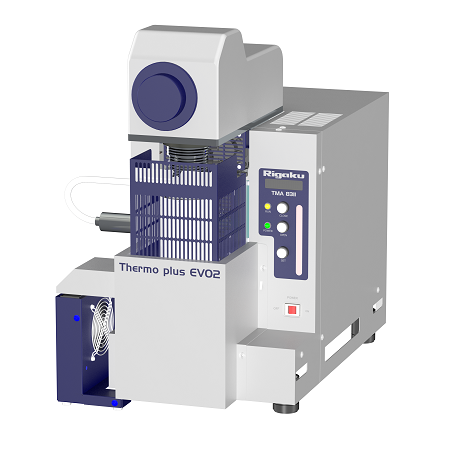
TMA
TMA (Thermomechanical Analysis) measures changes in the shape of a sample when it is subjected to non-oscillatory loads (such as compression, tension, bending) while being heated or cooled according to a temperature program. It is frequently used to measure the thermal expansion coefficient and softening temperature of materials.
Rigaku's TMA employs a differential expansion method that cancels out the thermal expansion and contraction occurring in the detection mechanism itself, ensuring accurate and reproducible measurements even for low-expansion materials and small samples. There are four measurement modes depending on the load conditions and sample shape: compression load, tensile load, penetration, and three-point bending. In the compression and tensile load modes, the expansion amount can be used to determine the expansion rate and expansion coefficient.
Products
TMA8311
TMA is the measurement of a change in dimension or mechanical property of the sample while it is subjected to a controlled temperature program.
Learn moreTMA8311/HUM
TMA/HUM measures change in dimension or mechanical property of a sample while subjected to a temperature regime under water vapor atmosphere with a constant relative humidity.
Learn moreTDL8411
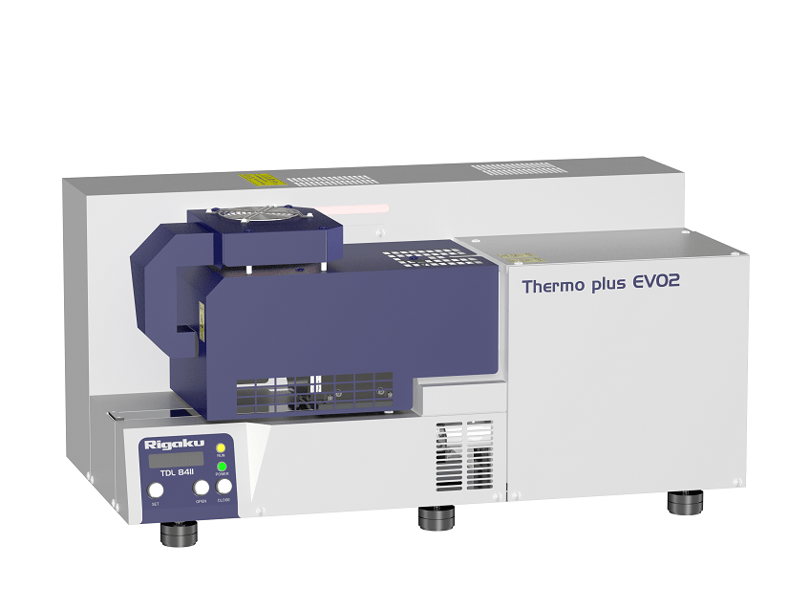
TDL detects changes in the amount of thermal expansion and contraction in a sample with high reproducibility, and automated measurements are also possible with the ASC.
Learn moreApplication Notes

Explore the example analyses to see which analytical technique is right for you.
-
TA5014 - Expansion of Powder Material, Polymethyl­methacrylate (PMMA)
-
TA5013 - Softening Measurement of Coated Steel
-
TA5011 - The Glass Transition and Softening for Glass Material
-
TA5010 - Simulation of Sintering Condition for Ceramics
-
BATT1024 - Thermal Stability Analysis of Separators via DSC and TMA
-
B-TA1094 - Degradation of Rubber Due to Outdoor Exposure (2) Evaluation of the Load Dependence of Deformation Characteristics Using TMA
-
B-TA1092 - Effect of Curing Time on Epoxy Adhesive Bond Strength Evaluated by TMA
-
B-TA1090 - Comparison of Adhesive Tape Resistance to Slippage using TMA
-
B-TA1088 - Expansion and Shrinkage of Fibers under Load Variation; Effect of Degradation
-
B-TA1087 - Expansion and Shrinkage of Fibers Induced by Humidity Changes
-
B-TA1074 - Load-dependent expansion and shrinkage of fibers
-
B-TA1070 - Thermal History Of Electrical Wire Insulating Sheath Polymer
-
B-TA1068 - TMA Measurement of Heat-Shrink Tubing
-
B-TA1054 - Expansion and Shrinkage of Polyimide Films Due to Changes in Humidity
-
B-TA1053 - Expansion of Polymer Films : Differences Due to Humidity
-
B-TA1052 - Expansion and Shrinkage of Cement Induced by Changes in Humidity
-
B-TA1051 - Degradation of Fluoroelastomers Deformation Induced by Changes in Applied Load
-
B-TA1049 - Changes in thermal expansion ratio caused by the degradation of fluoroelastomer
-
B-TA1031 - CTA Evaluation of Thin Al Sheet by TMA Tensile Loading Method
-
B-TA1026 - Thermal Analysis of PCB by TMA
-
B-TA1024 - Evaluation of O-ring by Low-temperature TMA
-
B-TA1004 - Softening of Coating Material by TMA
Contact Us
Whether you're interested in getting a quote, want a demo, need technical support, or simply have a question, we're here to help.