
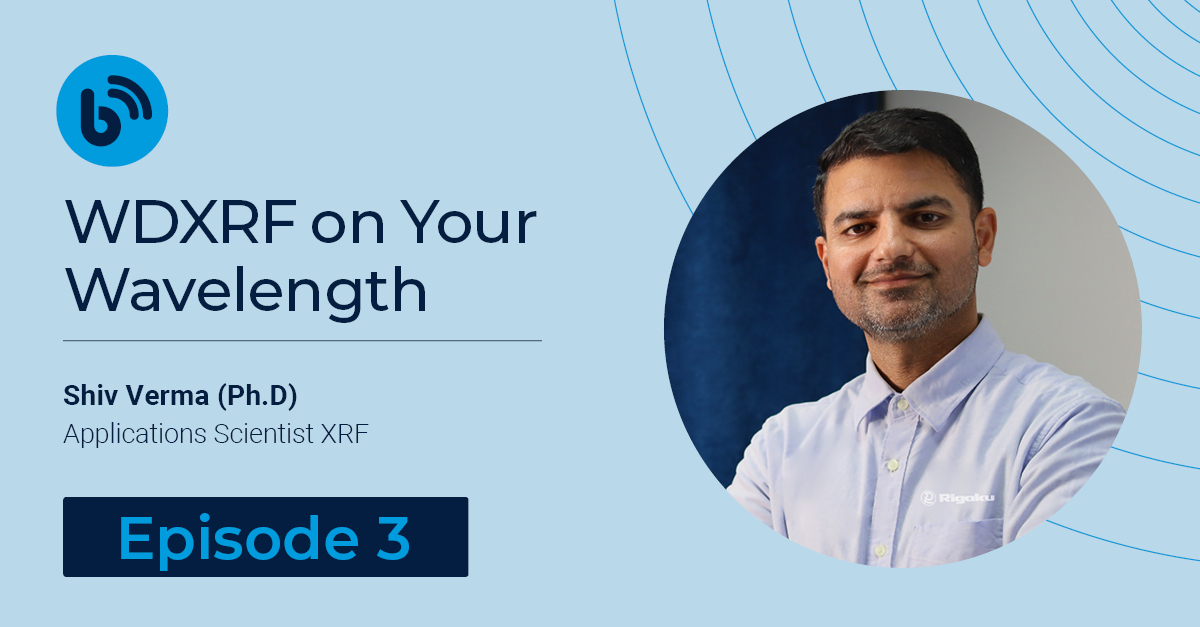

WDXRF on Your Wavelength Episode #3 Recap

Aug 10, 2026

Recap provided by Bridget Marriott 

In episode #3 of WDXRF on Your Wavelength, held on July 29, 2026, we took a deep dive into one of the most important, and often underestimated, factors in successful WDXRF analysis: sample preparation. Joined by one of our XRF Applications Scientists, Dr. Shiv Verma, we explored how sample preparation can have a major impact on analytical results. While instrument performance plays a critical role, the quality of analytical results often depends on how well a sample is prepared before it ever reaches the spectrometer.

You can watch the full recording here. If you're new to WDXRF (Wavelength Dispersive X-ray Fluorescence), it is a technique used to measure the elemental composition of materials.

During the discussion, we covered what sample preparation involves, how requirements vary across industries and materials, and why factors such as homogeneity, particle size, and contamination control can have a significant impact on data quality. We also discussed common preparation mistakes, ways to evaluate sample preparation methods, and how existing laboratory workflows can often be adapted for WDXRF applications. The key takeaway: reliable WDXRF results start with representative, consistent sample preparation, making it an essential part of the overall analytical workflow.

Episode Recap

Here are some of the key questions Shiv answered during the session:

Sample preparation for WDXRF encompasses all the steps taken to transform a raw material into a representative sample suitable for analysis. Depending on the material and application, this can include drying, crushing, grinding, blending, pressing, bead fusion, or simply preparing a flat, clean surface.

The ultimate goal is to ensure that the sample being analyzed accurately represents the larger material. Because WDXRF analyzes only a specific area of the sample, proper preparation is critical to obtaining accurate and reproducible results. While instrument performance is important, sample preparation is often the largest factor affecting WDXRF results. A well-prepared sample allows the instrument to perform at its full potential, while a poorly prepared sample can limit the quality of the results regardless of the instrument being used. 

The amount of sample preparation required depends heavily on the sample type and the level of accuracy needed. Some materials, such as metal alloys, glasses, and other relatively homogeneous materials, may require little more than cleaning the surface before analysis.

Other applications require significantly more preparation. For example, preparing fused beads may involve drying, grinding, selecting the appropriate flux, determining the correct sample-to-flux ratio, and optimizing fusion conditions based on the sample chemistry and elements of interest.

In general, the more heterogeneous the material, the more important sample preparation becomes. The goal is always to create a representative and homogeneous sample that can produce accurate and repeatable results. 

There is no universal sample preparation workflow for WDXRF. A mining laboratory analyzing ore, a cement plant monitoring production, and a metals manufacturer performing quality control may all use WDXRF, but their preparation processes can look very different.

In general, highly heterogeneous materials, such as geological samples, tend to require the most preparation. These materials often need steps such as drying, grinding, and blending to ensure the sample is representative and capable of producing consistent results. On the other hand, some materials can be analyzed with little or no sample preparation. Relatively homogeneous materials, such as manufactured metals, may already be in a suitable form for analysis and require minimal preparation before being placed in the instrument.

Ultimately, the preparation requirements are driven by the material itself, the desired level of accuracy, and the need to produce a representative sample. The goal is always to apply enough preparation to ensure reliable results without introducing unnecessary complexity into the workflow.

Homogeneity, refers to how uniformly the elements are distributed throughout a sample. A homogeneous sample has essentially the same composition regardless of which portion is analyzed. This is particularly important for WDXRF because the instrument analyzes only the material presented to it. If the sample is not homogeneous, different portions may produce different results even though they originated from the same bulk material. Grinding, blending, and proper sampling techniques are commonly used to improve homogeneity and ensure that the analyzed portion truly represents the whole sample. 

In many cases, yes. Laboratories already using analytical techniques such as ICP often have sample preparation procedures that provide a strong starting point for WDXRF. Initial preparation steps such as drying and grinding are often similar because both techniques benefit from consistent, representative samples.

However, WDXRF typically does not require the extensive chemical preparation commonly associated with other techniques, such as ICP. Because WDXRF is sensitive to physical characteristics such as particle size, homogeneity, and surface condition, some adjustments may be necessary when adapting an existing workflow. Many laboratories can leverage much of their existing sample preparation expertise while making targeted adjustments for WDXRF-specific requirements. 

Several sample preparation issues can negatively impact WDXRF results. Common mistakes include:

  • Insufficient particle size reduction, which can introduce variability between measurements.
  • Poor sample homogeneity, where different portions of the same material produce different results.
  • Cross-contamination from grinding equipment, presses, sample holders, or other preparation tools.
  • Inconsistent preparation parameters, such as varying pressing pressures or preparation procedures between samples.
Cross-contamination is often one of the most severe issues because it can introduce unexpected elements into the sample and directly affect analytical results. Maintaining clean equipment and following standardized preparation procedures are essential for producing reliable data.  

Particle size can significantly influence WDXRF measurements because it affects how X-rays interact with the sample. Large particles can create uneven elemental distributions and contribute to variability between measurements.

Differences in particle size may also introduce inconsistencies between calibration standards and unknown samples. As a result, particle size is often one of the most important factors considered during sample preparation. Reducing particle size and creating a more uniform particle size distribution generally improves homogeneity, repeatability, and overall analytical reliability.

While both sample preparation and instrument performance matter, sample preparation is often the dominant factor influencing WDXRF results. Many new users are surprised by how much sample preparation influences data quality. A well-prepared sample allows the instrument to perform at its full potential, while issues such as contamination, poor homogeneity, inconsistent particle size, or non-representative sampling can significantly impact analytical results.

Modern WDXRF instruments are generally very stable and reliable. When unexpected results occur, it is often worth reviewing the sample preparation process and re-preparing the sample before assuming there is an issue with the instrument. The best analytical performance is achieved when sample preparation and instrument performance are treated as parts of a single workflow. 

One of the best ways to evaluate a sample preparation procedure is through repeatability and reproducibility testing. A common approach is to prepare multiple samples from the same material and analyze them separately. If the results are consistent, the preparation method is likely producing a homogeneous and representative sample.

Significant differences between replicate samples may indicate issues such as inadequate grinding, poor mixing, inconsistent preparation practices, or insufficient sample homogeneity. Reproducibility studies can help identify opportunities to improve standard operating procedures and increase confidence in analytical results.


Join us next time!

WDXRF on Your Wavelength will be back every month with more answers, tips, and insights from Shiv. If you use WDXRF or are curious about it, we hope you’ll join us live next time!

The live event information is posted on our LinkedIn event page.

Do you have questions in the meantime? Drop your question in the comment section of the most recent episode. Shiv will answer them, or we might answer them live during the next episode.

Shiv Verma, PhD, is an XRF Applications Scientist at Rigaku Americas, bringing more than a decade of experience in elemental and compositional characterization. His expertise helps generate accurate, reliable data that organizations can trust, enabling better decisions around product quality, process control, and regulatory compliance. He specializes in X-ray fluorescence spectroscopy (EDXRF and WDXRF), ion beam analytical methods, and the development of Certified Reference Materials (CRMs) that support method validation, quality assurance, and traceability. At Rigaku, he supports customers through application development, performance optimization, and technical training, ensuring confident, day-to-day use of WDXRF spectrometers. With a Ph.D. in Physics and a background in advanced X-ray spectroscopy, he combines deep technical expertise with a hands-on approach, bridging fundamental science and real-world applications to turn complex measurements into accurate, actionable insights.

Subscribe to the Bridge newsletter

Stay up to date with materials analysis news and upcoming conferences, webinars and podcasts, as well as learning new analytical techniques and applications.
Contact Us

Whether you're interested in getting a quote, want a demo, need technical support, or simply have a question, we're here to help.