
What Is Wavelength Dispersive X-ray Fluorescence?

The WDXRF X-ray technique employs a high-power X-ray source to excite the characteristic (fluorescence) X-rays from the elements in a specimen. 

A sample is irradiated with X-rays causing emission of fluorescent X-rays from the material. The fluorescent X-rays are then diffracted with a crystal and observed with a detector. 

The defining aspect of a WDXRF spectrometer is the use of a crystal to achieve energy resolution. The wavelength (energy) of fluorescent X-ray is specific to an element and the X-ray intensity correlates with the element concentration. This allows qualitative and quantitative analysis. Higher energy resolution can minimize or eliminate peak overlap issues.

A sequential spectrometer measures  elements of interest one at a time with the automatic adjustment of crystals and X-ray optics. Sequential spectrometers offer analytical flexibility in process R&D and low-volume, high-product-mix manufacturing environments where measurement throughput is not of primary concern.

A simultaneous spectrometer is configured with multiple, dedicated channels to maximize measurement throughput in high-volume manufacturing environments where the elements of interest are not likely to change frequently.
Products| Application notes

X-ray Fluorescence

What is the instrumental setup?

The Rh/Pd target X-ray tube on the instrument irradiates the sample. The emitted fluorescent X-rays from the sample are then diffracted by a crystal (LiF200, PET, RX26, Ge) to select X-rays by wavelength. The intensity of the diffracted X-rays is then measured with a detector. P-10 gas is used for the flow proportional counter (F-PC) to detect X-rays with longer wavelengths (lighter elements). The scintillation detector is used for heavy elements.
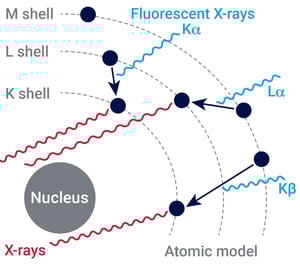
What is WDXRF atomic model

The instrument is equipped with a vacuum pump since measurements of solid samples are performed in vacuum atmosphere. Liquid samples are measured in helium.

  1. Primary X-ray photon strikes an inner shell electron.
  2. An inner shell electron is ejected as a photo electron.
  3. An electron shifts from outer shell.
  4. A fluorescent X-ray photon is produced.

Point: Various types of fluorescent X-rays are generated from one atom.

How does WDXRF work?

WDXRF spectrometry is a method used to separate and measure the characteristic fluorescent X-rays emitted from a sample. The technique employs an analyzing crystal to spatially spread the X-ray light, much like a prism spreads visible light into its component colors.
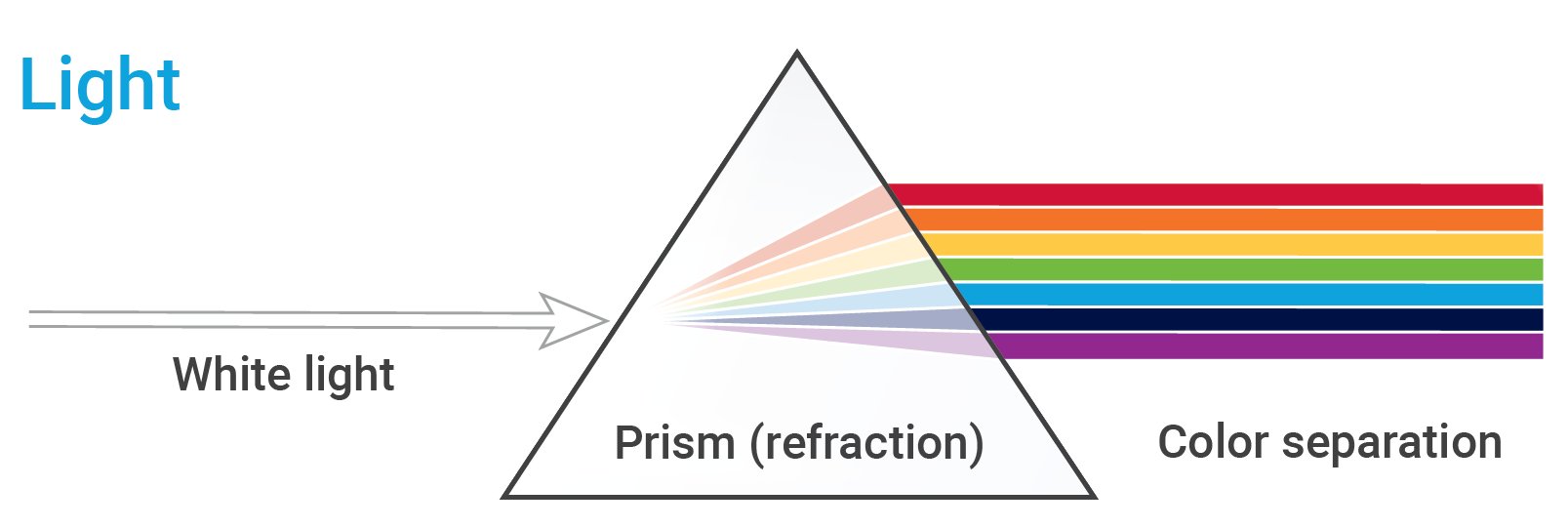
What is WDXRF figure 1

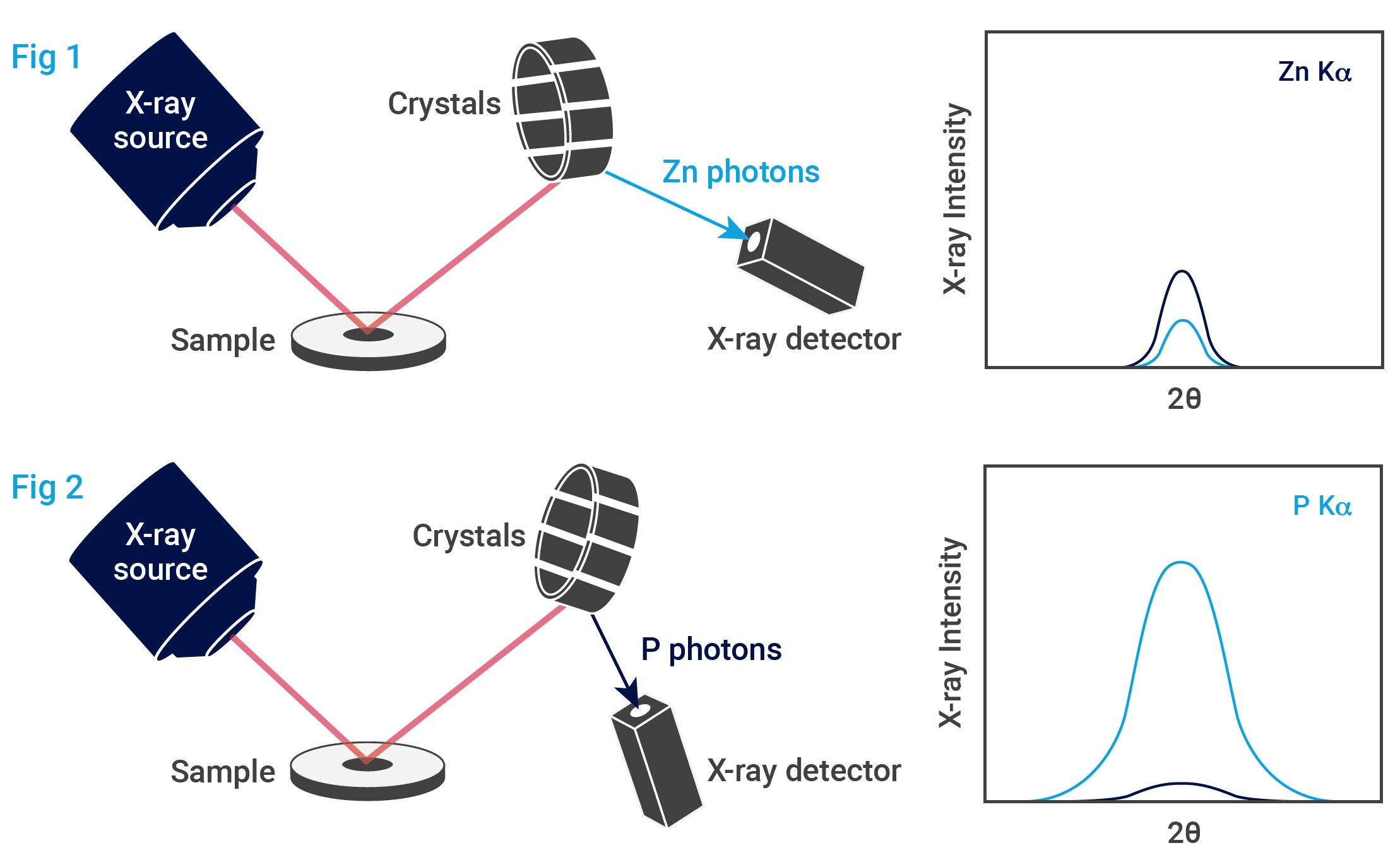
The wavelength of the impinging X-ray and the crystal’s lattice spacings are related by Bragg’s law and produce constructive interference when they satisfy the Bragg equation. The X-rays emitted by the sample are collimated by parallel metal blades (collimator) and irradiate an automatically selected analyzing crystal at a precise angle. X-ray light diffracted by the analyzing crystal is spatially spread out, so that characteristic photons may be collected by a detector positioned at a precise angle to record a X-ray intensity of a specific element.
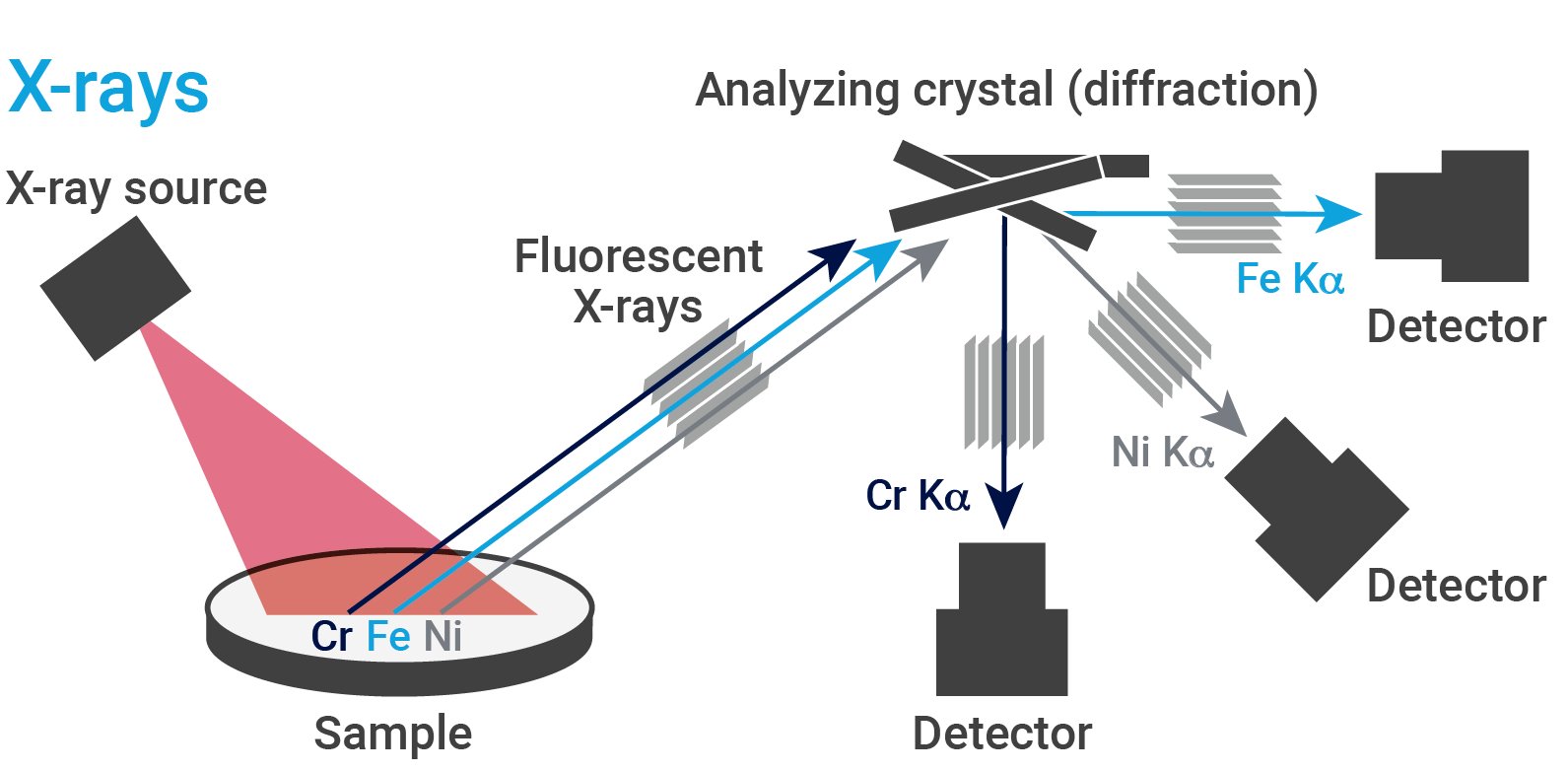
What is WDXRF figure 2

Point: X-rays with various wavelengths are dispersed by diffraction phenomenon with analyzing crystal.

X-ray optics

In WDXRF, the sample, analyzing crystal and detector are all mounted on a variable angle drive optical mechanism called a goniometer. As illustrated (Fig 1 & Fig 2), the goniometer precisely varies the angles so that the detector can record X-ray fluorescence from any element of interest. The entire X-ray optical mechanism is contained within a vacuum chamber to eliminate absorption of soft radiation (low-energy photons) by the air.

The ZSX Primus series of spectrometers contain up to ten analyzing crystals, that can be automatically selected depending on the wavelength being analyzed, enabling elements from almost the entire periodic table to be analyzed.
What is WDXRF figure 3


Frequently asked questions

WDXRF is well suited for accurate, quantitative elemental analysis across a wide concentration range. Its main advantage is high spectral resolution. WDXRF uses analyzing crystals to separate fluorescent X-rays by wavelength, helping distinguish closely spaced elemental peaks and reducing spectral overlaps that can complicate analysis.

WDXRF can analyze elements from light elements through heavy elements and is commonly used for both major-component and trace-element measurements. Depending on the instrument configuration, systems can be optimized either for analytical flexibility or for high sample throughput. Sequential WDXRF spectrometers measure elements individually and are useful when analytical requirements vary, while simultaneous systems use dedicated channels to measure multiple selected elements efficiently in routine, high-volume applications.

These capabilities make WDXRF particularly useful for applications requiring precise elemental composition measurements, including quality control, process monitoring, materials development, and compliance testing in industries such as cement, metals, mining, petroleum, ceramics, and batteries

WDXRF can measure a broad range of elements, from relatively light elements through heavy elements. The exact elemental range depends on the instrument configuration, X-ray source, analyzing crystals, detectors, and measurement conditions.

Different analyzing crystals are used to separate X-rays of different wavelengths, while different detector types can be optimized for lighter or heavier elements. For example, Rigaku WDXRF systems use flow proportional counters for longer-wavelength X-rays from lighter elements and scintillation detectors for heavier elements.

This broad elemental coverage makes WDXRF useful for materials ranging from cement, minerals, ceramics, and metals to petroleum products, environmental samples, and battery materials. The technique can determine both major constituents present at high concentrations and many minor or trace components.

WDXRF can analyze many types of solid, powdered, and liquid materials. Common examples include metals and alloys, geological materials, cement and raw materials, ceramics, glass, petroleum products, environmental samples, and industrial chemicals.

Sample preparation depends strongly on the material and analytical objective. Powders may be analyzed as pressed pellets or converted into fused beads, while metals can often be measured as prepared solid surfaces. Liquids may be placed in sample cups fitted with suitable X-ray-transparent films.

Consistent sample preparation is particularly important for quantitative WDXRF because particle size, surface condition, sample homogeneity, mineralogical effects, and matrix composition can influence measured X-ray intensities. Selecting an appropriate preparation method helps improve accuracy, repeatability, and comparability between samples.

WDXRF can provide highly precise and accurate quantitative elemental measurements when appropriate calibration standards, sample preparation, and analytical methods are used.

The technique's high spectral resolution helps reduce interference between neighboring elemental peaks, while stable measurement conditions support good repeatability. The concentration of an element is determined from the intensity of its characteristic fluorescent X-rays, typically using calibration curves developed from reference materials with known compositions.

Actual accuracy depends on the sample type, element, concentration range, calibration strategy, sample preparation, and availability of suitable reference materials. Matrix effects caused by other elements in the sample must also be considered. Modern WDXRF software can apply mathematical corrections and fundamental-parameter methods to compensate for many of these effects.

For the highest accuracy in routine quantitative analysis, WDXRF commonly uses calibration standards whose elemental compositions are known. Measurements from these standards establish relationships between X-ray intensity and elemental concentration.Certified reference materials are often preferred because their compositions have been independently characterized. However, suitable standards are not always available, particularly for unusual materials or new formulations.In these situations, fundamental-parameter calculations can supplement or sometimes reduce dependence on extensive sets of physical standards. These methods model X-ray excitation, absorption, enhancement, and other matrix effects to estimate elemental concentrations.The best calibration approach depends on the sample matrix, required accuracy, available standards, concentration range, and whether the analysis is intended for routine quality control, screening, or research.

Sequential and simultaneous WDXRF instruments differ primarily in how they measure multiple elements.

A sequential WDXRF spectrometer automatically changes analyzing crystals and other optical conditions to measure elements one after another. This provides considerable analytical flexibility because measurement conditions can be optimized for different elements and applications. It is particularly useful for research, method development, and laboratories analyzing many different sample types.

A simultaneous WDXRF spectrometer uses multiple dedicated measurement channels so several selected elements can be measured at the same time. This configuration emphasizes speed and throughput and is especially useful for routine production environments where the same elements are repeatedly monitored.

Rigaku recommends the following products

Application notes

The following application notes are relevant to this technique

Contact Us

Whether you're interested in getting a quote, want a demo, need technical support, or simply have a question, we're here to help.