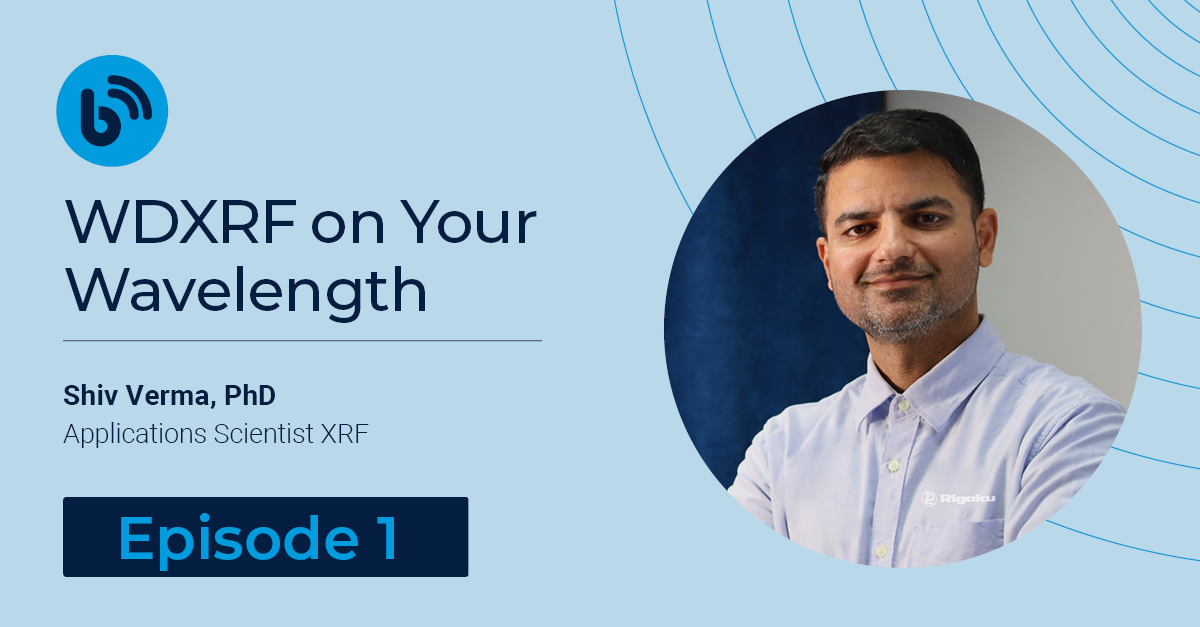

WDXRF on Your Wavelength Episode #1 Recap
Jun 16, 2026
Recap provided by Bridget Marriott
On May 18th 2026, we kicked off our series WDXRF on Your Wavelength! In this new monthly LinkedIn Live series, WDXRF users can drop in and ask questions directly to one of Rigaku’s XRF Application Scientists, Dr. Shiv Verma.
You can watch the full recording here. If you're new to WDXRF (Wavelength Dispersive X-ray Fluorescence), it is a technique used to measure the elemental composition of materials.
Episode Recap
-
WDXRF (Wavelength Dispersive X-ray Fluorescence) is a method that uses X-rays to identify the elements in a sample. First, the instrument directs X-rays at a sample, which excites the atoms inside it. When these atoms lose that excess energy, they emit characteristic fluorescent X-rays, each with a specific wavelength unique to each element. These X-rays are diffracted using crystals, which separate them by wavelength and are analyzed one at a time to determine which elements are present in the sample and their concentrations.
-
WDXRF is designed to detect the presence of elements ranging from beryllium to uranium in a material and in what amounts. It is used when there is uncertainty about what a material is made of, or when the exact composition needs to be confirmed to avoid quality, safety, or compliance issues. For example, it can verify that cement or metal alloys contain the correct ingredients before they are used or shipped. It is commonly used to ensure quality, meet regulatory requirements, and detect impurities in industries where knowing the exact elemental composition is critical.
-
WDXRF works well with a wide range of material types, including solids, powders, and liquids. Powders and solid samples are generally the easiest to analyze and provide very reliable results when prepared correctly (for example, pressed pellets or fused beads). Liquids can also be analyzed, but they can be more challenging due to absorption effects, especially for lighter elements. In these cases, alternative preparation methods can improve performance. Overall, the technique is flexible, but success depends heavily on using the correct sample preparation method for the material.
-
A key benefit of WDXRF is that it is non-destructive, meaning the sample stays intact after analysis and can still be used for further testing. It also requires relatively simple sample preparation compared to other methods and offers strong reproducibility and repeatability, which makes it reliable for routine testing. The technique can measure a wide range of elements, from parts per million up to high percentages. Another strength is its ability to separate signals from similar elements, which helps avoid overlap errors.
-
Compared to other elemental analysis techniques, such as ICP (Inductively Coupled Plasma), WDXRF is less sensitive for detecting extremely low concentrations of elements (such as parts per billion, or ppb). As a result, it has higher detection limits compared to ICP and may not be the best choice when trace -level measurements (ppb levels) are required. The system also requires a relatively large lab footprint, along with supporting systems like gases or vacuum conditions. The accuracy of the results also depends heavily on how well the sample is prepared, and some types of samples, such as liquids, can be more difficult to analyze.
-
Matrix effects occur when the elements in a sample influence each other during analysis. Instead of each element behaving independently, they can interact in ways that change the signals being measured. In WDXRF, the overall composition of the material affects how X-rays are absorbed and emitted, so the intensity measured for one element can be influenced by the presence of others. As a result, the signal is not always directly proportional to concentration, and corrections are required to ensure accurate results.
-
Fundamental parameters (FP) is a semi-quantitative method in WDXRF that uses physical constants and the sample’s matrix to model X-ray interactions, instead of relying only on matching calibration standards. The FP database provides the physical constants and interaction data used to convert measured signals into element concentrations. This makes it possible to analyze a wide range of materials without needing a large number of physical calibration standards for every possible composition.
-
In general, the accuracy of the FP method depends on how well the model and FP database represent the sample. While proper sample preparation is important, the composition of the sample itself also plays a major role. Because this method is matrix-based, accuracy can vary depending on the elements present and how they interact. In general, better accuracy is typically seen for heavier elements in lighter matrices.
-
WDXRF is widely used in many industries where it is critical to know exactly what materials are composed of. These industries include cement production, mining, metals and alloys, batteries, ceramics, environmental testing, petrochemicals, and pharmaceuticals, where accurate composition data is essential to maintain quality, meet regulations, and avoid costly errors.
Join us next time!
This was our first episode of WDXRF on Your Wavelength, and we’ll be back every month with more answers, tips, and insights from Shiv. If you use WDXRF or are curious about it, we hope you’ll join us live next time!
The live event information is posted on our LinkedIn event page.
Do you have questions in the meantime? Drop your question in the comment section of the most recent episode. Shiv will answer them, or we might answer them live during the next episode.
Subscribe to the Bridge newsletter
Stay up to date with materials analysis news and upcoming conferences, webinars and podcasts, as well as learning new analytical techniques and applications.
Contact Us
Whether you're interested in getting a quote, want a demo, need technical support, or simply have a question, we're here to help.