
WDXRF on Your Wavelength Episode #6 Recap
Oct 28, 2026
Recap provided by Bridget Marriott
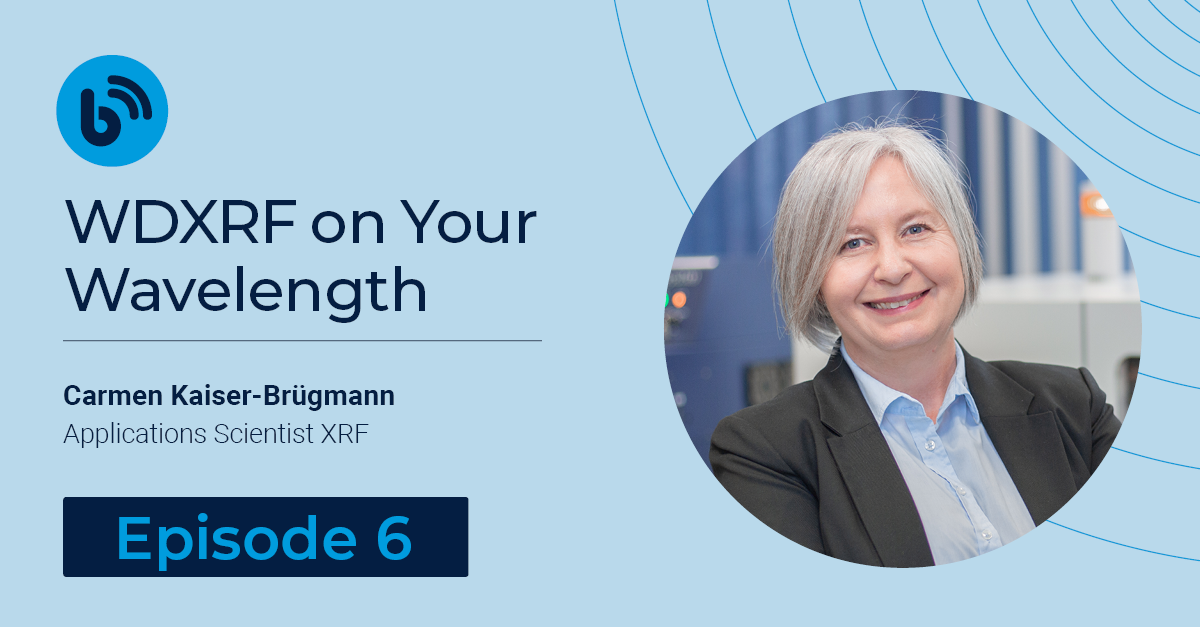
On October 22, 2026, we held episode 6 of WDXRF on Your Wavelength, where Rigaku XRF Applications Scientist Carmen Kaiser-Brügmann joined us to discuss the role of WDXRF in geological analysis and the broader world of elemental characterization. Topics included sample preparation, calibration best practices, accuracy versus precision, and how laboratories use multiple analytical techniques to better understand their materials.
The audience also contributed several questions to the discussion, including the impact of Loss on Ignition (LOI) and the value of complementary analytical techniques.
If you missed the live event, you can watch the full recording here.
Episode Recap
-
WDXRF is a stable and versatile analytical technique used in both industry and research laboratories to obtain accurate and precise elemental analysis results. One of its greatest strengths is its ability to rapidly measure multiple elements across a wide concentration range, from trace levels to major constituents, while requiring relatively simple sample preparation.
The technique can be used with solids, powders, and liquids, making it suitable for a broad range of applications. Because WDXRF is non-destructive, laboratories can often preserve samples for additional testing. It also offers good accuracy and precision, relatively low operating costs, and long-term stability when compared with many other analytical techniques.
For these reasons, WDXRF remains one of the most widely used methods for both qualitative and quantitative elemental analysis.
-
Geological samples are often complex materials containing both major, minor, and trace elements, making them challenging to analyze accurately.
WDXRF is widely used in geological and mining applications because it provides accurate elemental composition data that helps scientists and engineers understand, evaluate, and process geological materials. The technique can rapidly measure major, minor, and many trace elements, making it well suited for characterizing ores, drill cores, concentrates, and other geological materials.
In mining, elemental analysis plays an important role throughout the lifecycle of a deposit, from early-stage exploration and prospect evaluation to mine planning, ore blending, process control, and quality assurance.
WDXRF is often used alongside complementary techniques such as XRD. While WDXRF provides information about elemental composition, XRD identifies the mineral phases present in a sample. Together, these techniques provide a more complete understanding of geological materials, helping users make more informed decisions about exploration, mining, processing, and product quality.
-
Geological materials are rarely uniform. Differences in mineralogy, particle size, homogeneity, and elemental composition can all influence analytical results, making representative sampling and proper sample preparation essential.
One of the biggest challenges is selecting the appropriate sample preparation and calibration approach for the analytical goals of the laboratory. For major and minor element analysis, fused bead preparation is often preferred because it minimizes mineralogical and particle-size effects. This approach is generally best suited for elements that are not volatile during the fusion process, while pressed powder methods are used for elements that may be lost during fusion and for trace-element applications.
Another challenge is ensuring that calibration standards accurately represent the types of materials being analyzed. Because geological materials can vary significantly from one deposit to another, appropriate standards, sample preparation procedures, and analytical methods are critical for generating reliable and representative results.
-
WDXRF can provide highly accurate results when the method is properly developed and validated. However, accuracy depends on more than the instrument itself. Sample preparation, calibration quality, representative standards, and sample characteristics all play an important role in the final result.
Accuracy is typically evaluated by comparing measured results against certified reference materials or other known values. Even when using a high-performance instrument, reliable results require representative standards, appropriate matrix corrections, and consistent sample preparation practices. In other words, accuracy is achieved through the entire analytical process, not just the instrument.
-
Accuracy refers to how closely a measured value matches the true or certified value. It is often verified by analyzing certified reference materials that were not used during calibration and comparing the measured result to the known value.
Precision refers to how consistently a measurement can be reproduced. This is often evaluated through repeatability and reproducibility studies. Repeatability measures how consistently the same sample can be analyzed under the same conditions, while reproducibility evaluates whether similar results can be achieved under different conditions, such as by different operators or laboratories. Importantly, a method can be precise without being accurate, which is why both accuracy and precision must be evaluated when validating an analytical method.
-
Sample preparation is often one of the most important factors influencing accuracy. Grain size, mineralogy, moisture content, matrix effects, and sample homogeneity can all affect analytical results. Consistent grinding, blending, pellet preparation, or fusion practices help minimize variability and ensure that differences in reported results reflect actual sample composition rather than preparation inconsistencies.
While sample preparation is often the largest source of error, instrument-related factors can also influence results. These include counting statistics, source stability, electronic stability, spectral overlap, and other measurement-related effects. Modern WDXRF spectrometers are designed to minimize many of these factors and provide excellent long-term stability.
Calibration quality also plays an important role. Laboratories need an adequate number of representative standards covering the expected concentration range of the samples being analyzed, and the relationship between concentration and measured intensity should be well characterized.
Accuracy is typically verified using certified reference materials (CRMs) that were not included in the original calibration. The quality and accuracy of the reference values used to establish and verify the calibration are also important, as errors in the reference data can directly affect analytical results.
In simple terms, accuracy describes how close a measured result is to the true value. A method can be highly precise, meaning it produces very consistent results, but still be inaccurate if there is a systematic bias caused by calibration, sample preparation, or reference values. The goal is to achieve both high accuracy and high precision through proper sample preparation, representative standards, robust calibrations, and routine validation.
-
A great WDXRF calibration starts with a sufficient number of representative standards that cover the expected concentration range of the samples being analyzed. Most routine samples should fall within the calibration range, and additional standards should be added when new sample types or concentration ranges are encountered.
The standards should also be selected so that elemental concentrations vary independently whenever possible. This helps the matrix correction model more accurately account for elemental interactions and improves the robustness of the calibration.
Strong statistical performance is important, but a great calibration is more than a high correlation coefficient. It should accurately model matrix effects and consistently produce accurate results when validated against certified reference materials.
Ultimately, the best calibration is one that delivers accurate, precise, and reliable results for the application.
-
Loss on Ignition (LOI) measures the amount of material lost during heating, such as water, carbon dioxide, or other volatile components. LOI is particularly important in materials such as limestone, cement raw materials, and other carbonate-rich samples because it can significantly affect how analytical results are expressed.
Because WDXRF measures the elements that remain after these volatile components are released, failing to account for LOI can introduce errors when reporting concentrations. For this reason, measured LOI values are incorporated into analytical workflows to improve overall result accuracy and help ensure the reported concentrations accurately reflect the composition of the original sample.
-
No single analytical technique can answer every question. While WDXRF provides elemental composition, other techniques provide different types of information. For example, XRD can be used to identify mineral phases, while ICP-OES and ICP-MS are often used for ultra trace-element analysis. Specialized techniques such as Direct Mercury Analysis (DMA) may also be used when Hg must be measured at very low concentration levels, including parts-per-billion (ppb) or parts-per-trillion (ppt) ranges.
Each technique brings a different perspective. By combining complementary techniques, laboratories can validate results, investigate discrepancies, answer application-specific questions, and build a more complete understanding of their samples. The most effective analytical workflows often rely on multiple techniques working together rather than a single instrument providing all the answers.
Join us next time!
WDXRF on Your Wavelength will be back every month with more answers, tips, and insights from our team. If you use WDXRF or are curious about it, we hope you’ll join us live next time!
The live event information is posted on our LinkedIn event page.
Do you have questions in the meantime? Drop your question in the comment section of the most recent episode. Our team will either respond directly or address your question live during the next episode.


Subscribe to the Bridge newsletter
Stay up to date with materials analysis news and upcoming conferences, webinars and podcasts, as well as learning new analytical techniques and applications.
Contact Us
Whether you're interested in getting a quote, want a demo, need technical support, or simply have a question, we're here to help.