
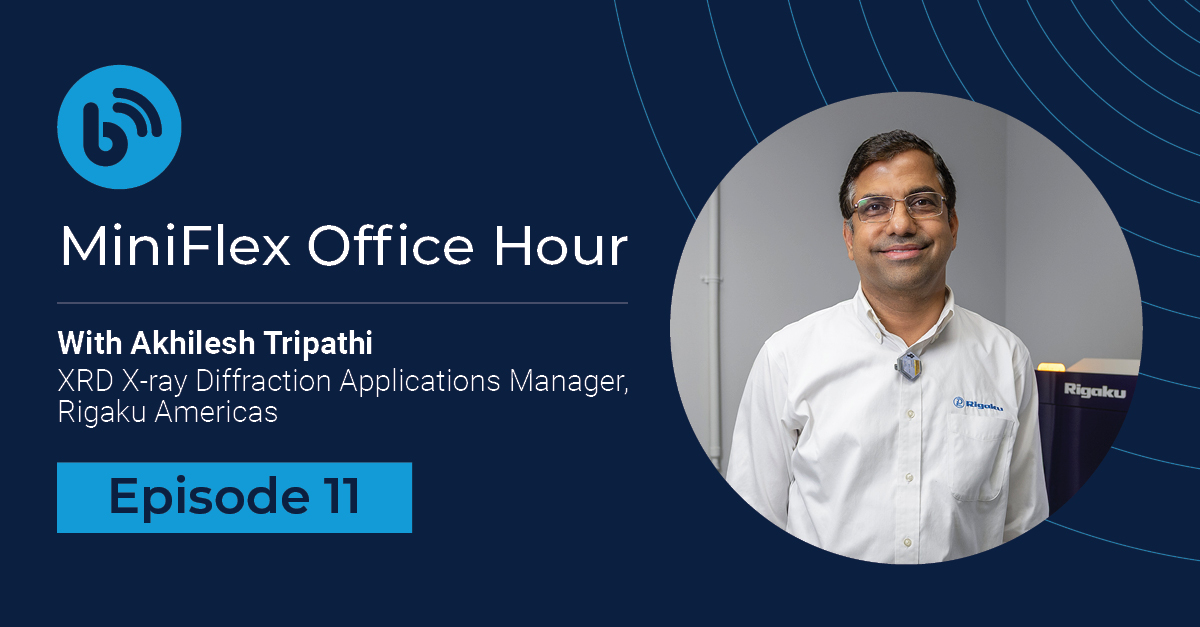

MiniFlex Office Hour Episode # 11 Recap

Apr 8, 2026

Recap provided by Bev Vincent

Thank you to everyone who joined us for Episode 11 of MiniFlex Office Hour! As always, our XRD expert, Akhilesh Tripathi, shared valuable insights and answered practical questions from MiniFlex users around the world. Below is a quick recap of the key topics we covered.

You can watch the full recording here. If you’re new to MiniFlex, it’s a benchtop X-ray diffractometer that researchers have trusted since 1973.

Episode recap

Here are some of the key questions Akhilesh answered during the session:

Because XRD can directly measure the crystalline phases in cement, which helps manufacturers control important properties such as strength, setting behavior, durability, and stability. This is becoming more important as producers add materials like calcite or slag to reduce cement-related CO₂ emissions while still maintaining performance.

It is important to measure the four major crystalline cement phases often referred to as the “four Cs”: C3S, C2S, C4AF, and C3A. Tracking the amounts of these phases helps manufacturers tune cement performance for different applications.

A calibration curve is especially useful when you need to measure a specific phase very precisely, such as free lime at low levels. Rietveld analysis is better when you want a broader quantitative view of multiple crystalline phases in the sample. Both methods are useful, but they serve different purposes.

It is critical. Poor sample preparation can undermine otherwise good measurements. Uniform particle size and consistent sample handling are essential for reliable quantitative results.

For the examples discussed, a good rule of thumb was a uniform powder in the roughly 40 to 80 micron range, often described as about 325 mesh. The main goal is consistency, because varying particle size can distort peak intensities and reduce quantitative accuracy.

Yes. Overgrinding can broaden peaks and in some materials may even damage crystallinity, which can make interpretation harder. On the other hand, undergrinding can create preferred orientation and packing problems. Find the “sweet spot” where the sample is fine and uniform but not damaged.

An XRF-prepared sample can sometimes also be used for XRD, provided the user understands what binder was added and verifies that the prep has not introduced preferred orientation or destroyed useful structural information. It can work, but it should be checked rather than assumed.

XRF tells you which elements are present, while XRD tells you which crystalline phases those elements are actually in. That means XRD can distinguish between different compounds or oxidation states that contain the same elements. SmartLab Studio can use complementary XRF information to help narrow phase candidates and improve interpretation.

Akhilesh Tripathi is the XRD Application Manager at Rigaku Americas, a division of Rigaku Americas Holding, located in The Woodlands, Texas. With 30 years of experience in materials characterization using powder and single crystal X-ray diffraction, Akhilesh has dedicated 20 of those years to his work at Rigaku. His expertise spans a range of X-ray techniques, including Rietveld analysis, small-angle X-ray scattering, thin-film characterization, and various quantitative phase analysis methods. Akhilesh is well-versed in conducting XRD-related training, both onsite and offsite, sharing his extensive knowledge with others in the field. He holds a Ph.D. in Chemistry and Material Science from Stony Brook University and completed postdoctoral research at Texas A&M University. Akhilesh has also contributed to the scientific community with over 28 papers published in peer-reviewed journals on these subjects.

Subscribe to the Bridge newsletter

Stay up to date with materials analysis news and upcoming conferences, webinars and podcasts, as well as learning new analytical techniques and applications.
Contact Us

Whether you're interested in getting a quote, want a demo, need technical support, or simply have a question, we're here to help.