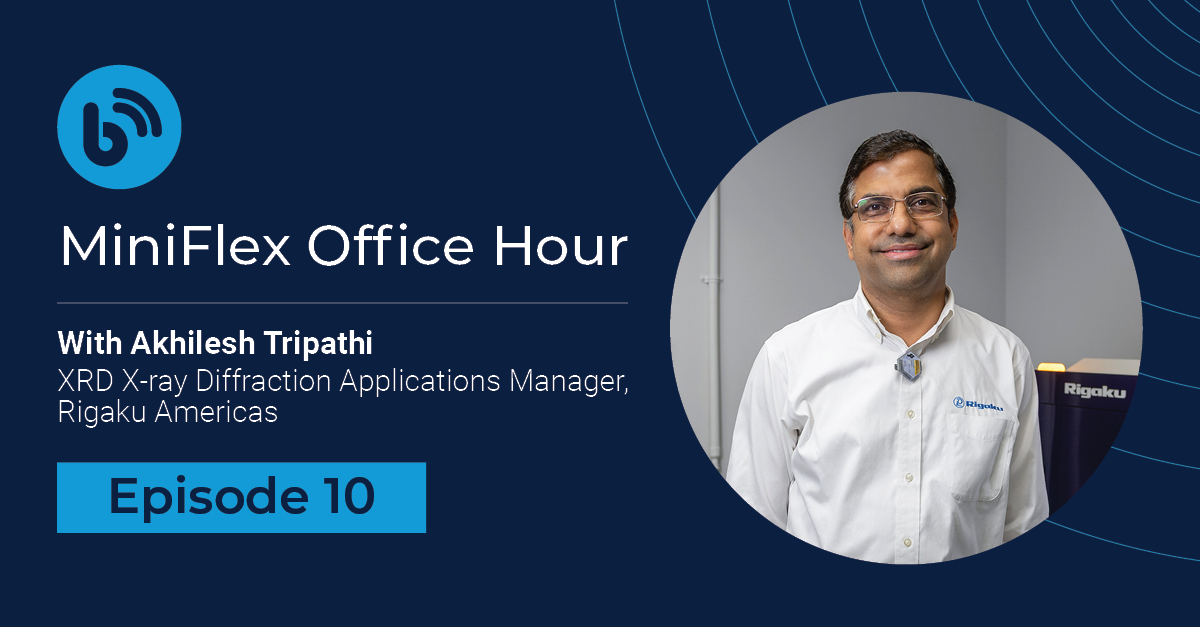

MiniFlex Office Hour Episode # 10 Recap
Mar 3, 2026
Recap provided by Bev Vincent
Thank you to everyone who joined us for Episode 10 of MiniFlex Office Hour! As always, our XRD expert, Akhilesh Tripathi, shared valuable insights and answered practical questions from MiniFlex users around the world. Below is a quick recap of the key topics we covered.
You can watch the full recording here. If you’re new to MiniFlex, it’s a benchtop X-ray diffractometer that researchers have trusted since 1973.
Episode recap
-
Yes—provided the data quality matches what your scientific claim requires. “Publication-quality” isn’t a label tied to instrument size; it’s demonstrated by results that are repeatable, have strong signal-to-noise, show reliable peak positions and intensities, and agree with known references or independent measurements when appropriate. For common powder diffraction tasks like phase identification and quantitative work, a well-configured benchtop system can produce publishable patterns routinely.
-
It typically comes down to three practical checkpoints. First, signal-to-noise: peaks should stand clearly above background, with enough counting statistics that noise doesn’t drive the interpretation. Second, resolution: peaks should be sufficiently narrow and separated to support the conclusions (often discussed via FWHM and peak separation in the region of interest). Third, reliability: the same sample and method should produce consistent patterns over time, and peak positions/intensities should behave as expected (for example, matching reference patterns for phase ID or producing stable refinements for quant/structure work).
-
For most routine powder applications (phase ID and many quantitative studies), the standard optical configuration is designed to be “ready to publish” without constant swapping of components. Where a tailored setup becomes valuable is when the measurement is atypical—very low angles, unusually demanding resolution, special sample environments, or nonstandard geometries (like transmission in capillaries). In those cases, accessories and configuration choices matter as much as the instrument itself.
-
Very low angles (for example, down to around 0.5° 2θ in some workflows) are achievable when the system is configured specifically for that geometry. The key is controlling beam divergence and minimizing parasitic scattering so the baseline stays clean at the lowest angles. Low-angle work is also more sensitive to sample and alignment effects than routine scans, so it’s smart to validate the setup using representative samples and confirm you’re truly resolving the expected low-angle feature rather than instrument/background artifacts. Once the low-angle configuration is in place, running the measurement can be as straightforward as defining the start angle and scan range in the method.
-
Yes—low-angle capability is typically enabled by swapping specific optical components rather than rebuilding the instrument. The practical point is to treat the swap as a controlled, repeatable change: use the proper mounting hardware, follow the same steps each time, and verify performance afterward (a quick check scan or standard reference pattern can confirm you’re back to the expected baseline and peak shapes). If your workflow alternates often, it’s worth establishing a short internal checklist so different users make the change consistently.
-
Capillary/transmission measurements are especially useful when the sample is air- or moisture-sensitive (because it can be sealed), or when preferred orientation is distorting intensities in reflection geometry. Spinning a capillary helps average crystallite orientations, which can produce more representative intensities for identification, refinement, or quantitative comparisons. Transmission can also be advantageous for certain organic or reactive materials where maintaining sample integrity matters as much as maximizing intensity.
-
It depends on what “thin-film XRD” means in your project. If you need specialized thin-film measurements—rocking curves, high-resolution reciprocal space mapping, very tight peak widths, and demanding angular precision—dedicated floor-standing HRXRD systems are usually the better fit. A benchtop powder XRD setup can still provide useful information for some coated or layered materials, but it’s not the ideal tool for the most demanding thin-film metrology. Matching the instrument to the question is the fastest path to publishable results.
-
For experiments that require changing conditions during collection, common add-ons include high-temperature stages (covering typical in-situ temperature ranges used for phase transitions, decomposition, or crystallization studies) and fixtures designed for operando work such as battery/coin-cell style configurations. The point of these accessories is not just “heating” or “holding a cell,” but maintaining stable geometry and reproducibility while conditions change—so the structural changes you report are defensible and not artifacts of shifting alignment or inconsistent sample presentation.
Subscribe to the Bridge newsletter
Stay up to date with materials analysis news and upcoming conferences, webinars and podcasts, as well as learning new analytical techniques and applications.
Contact Us
Whether you're interested in getting a quote, want a demo, need technical support, or simply have a question, we're here to help.