

How much does an X-ray diffractometer actually cost, and why is it so hard to get a straight answer? If you’re trying to plan your lab’s budget, justify a capital expense, or compare vendors, you’ve probably asked this question and come away frustrated. Maybe you’ve seen wildly different numbers tossed around. Or maybe every sales conversation turns into “it depends.” Sound familiar?
I’m the XRD Sales Manager for North America at Rigaku, and I’ve been helping labs like yours navigate these decisions for over 20 years. I work closely with researchers, QC managers, and lab directors across industries. I know that when you’re investing in an XRD system, you need clear, honest information tailored to your needs, not a wildly wide range or generic ballpark figures.
In this article, I’ll break down price ranges for different types of X-ray diffractometers, explain what drives the cost up or down, and share examples to show you how to avoid common mistakes and make the most of your investment.
Typical price ranges
When people ask, "How much does an XRD cost?" they’re often in one of two stages. Some are just exploring and trying to get a sense of what kind of budget they’ll need. Others are further along, configuring a system, comparing specific models, and trying to justify their choice internally.
The price of new XRD systems ranges widely depending on configuration and capability. Understanding this range at the early stage of consideration helps you avoid going down the wrong path.
Options such as non-ambient stages, high-power X-ray generators, and automation drive up the price.
What drives the price up or down?
System format is the first significant factor. Benchtop instruments are compact and affordable, ideal for routine phase identification or QC. Floor-standing systems, by contrast, use a higher-power X-ray source and provide more space for optics, attachments, detectors, and future upgrades. If you expect your lab’s needs to grow, a floor-standing model is often the more cost-effective long-term choice. The high level of upgradeability is key.
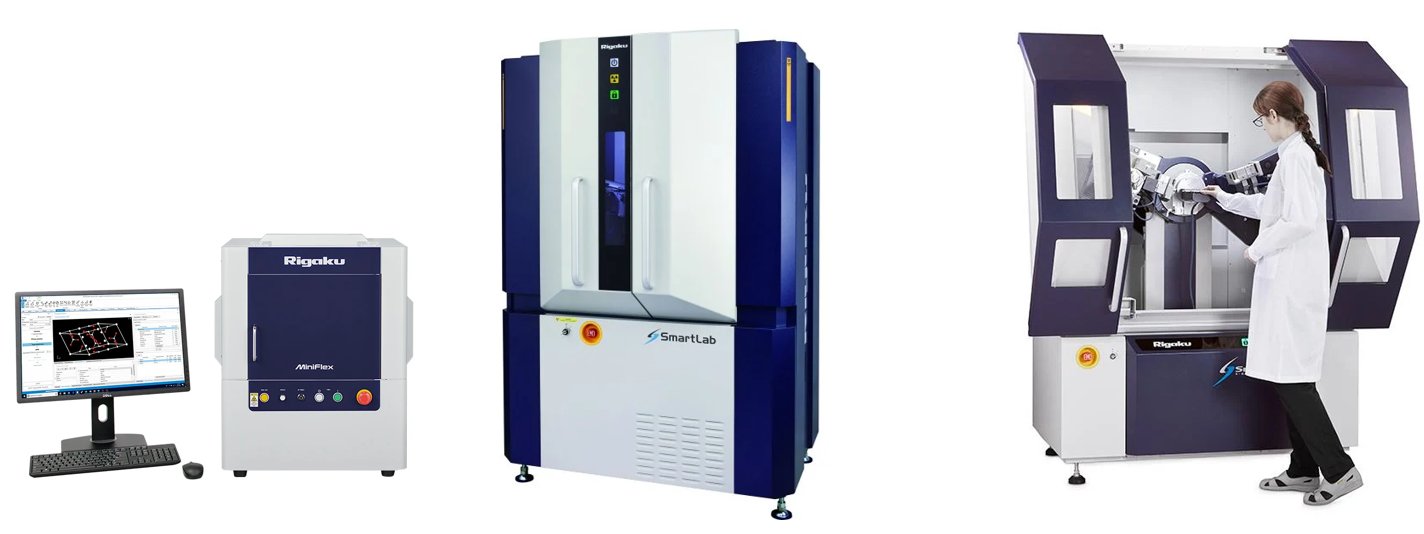 Various types of diffractometers (From left: Benchtop - MiniFlex, entry-level floor model - SmartLab SE, and mid-range to high-end model - SmartLab)
The X-ray source makes a big difference, too. A sealed tube, typically operated at 2 kW, is a cost-effective and reliable option for most applications. A rotating anode, typically at 9 kW or higher, while more expensive, delivers far higher intensity, making it perfect for high-throughput or weakly scattering samples. When everything else is the same, a 9 kW source can make a measurement five times faster than a 2 kW source, regardless of the measurement type.
Detectors are another major variable. A 1D detector is sufficient for standard powder diffraction, but a larger 2D or hybrid photon-counting detector can reduce scan times and enable advanced applications, such as texture analysis, high-speed in-situ/operando XRD, and reciprocal space maps.
Sample stages, automation, and environmental attachments, such as a non-ambient chamber, a battery operando stage, and a sample changer, all add flexibility and cost.
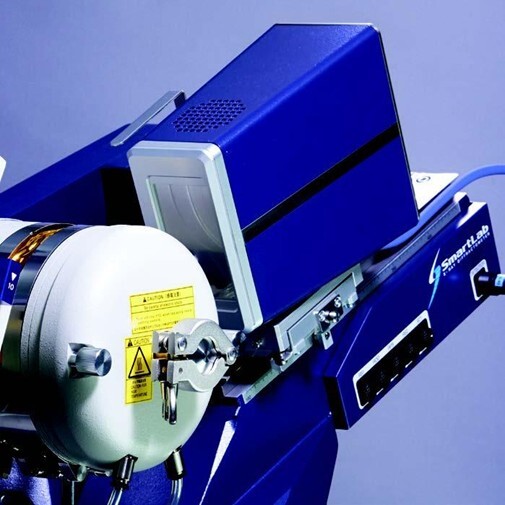 High-temperature attachment, HT 1500, and a hybrid pixel array detector, HyPix3000
The key to optimizing your investment is to separate what you need frequently from what you need occasionally, or what you need now from what you will need later. This will help you to focus on what you need frequently now and spend your limited budget wisely.
The additional costs people often miss
Many buyers focus on the system price but might overlook the cost of software, database, and maintenance.
The cost of software and databases also varies. Adding Rietveld/WPPF analysis tools can add cost. Additionally, adding commercial databases, such as the ICDD PDF, adds recurring licensing fees.
Let’s not forget about any facility upgrades that might be needed, whether it be electrical, water or air handling. These costs for a new lab should be thoroughly scoped as part of your budget process.
Most vendors include the installation, training, and the first year's warranty. However, you might want to continue service support coverage, including preventative maintenance and consumables, after the first year. If so, you need a plan to secure that budget next year. Alternatively, you can purchase a multi-year service contract upfront.
Planning for these future costs upfront prevents unexpected expenses later.
Common mistakes
One common mistake is picking the wrong platform. Here’s an example.
A research customer once configured a high-end benchtop system with every possible option—an advanced detector, sample changer, in-situ attachments, a full range of slit options, and advanced software. By the time we finalized the quote, they were close to the price of a floor-standing model.
I advised them, "If you can afford a loaded benchtop, you deserve a floor-standing model." Investing in a floor model will provide you with higher X-ray intensity for a wider range of applications and offer more flexible upgrade paths. It is a better investment. They ultimately chose a mid-range floor model, and it turned out to be the right decision. The extra flexibility allowed them to add non-ambient capabilities later without buying a new system.
Another common mistake is not to "test drive" the system to configure it correctly when you have a long list of applications. I have seen a researcher configure a diffractometer without running any test measurements by simply checking options on a piece of paper. They spent a lot of money and ended up not using half of the attachments.
How to optimize the configuration
Different industries approach XRD investment differently. Academic labs might seek flexibility within tight budgets, often in the $180,000–$350,000 range. Industrial QC labs might prioritize robustness and speed, opting for benchtop systems around $100,000. R&D facilities working with thin films or batteries may require high-flux sources and multiple optical configurations or attachments, resulting in costs of $300,000–$600,000 or more.
To configure a system within your budget, I recommend prioritizing your applications based on how critical they are or how often you need them. Then, aim to cover 80% of them. Trying to cover every possible scenario right away can lead to overspending. Applications you only need once or twice a year can be outsourced.
Read: How to Choose the Right X-ray Diffractometer
What about used systems?
Used or refurbished systems can cost 30–60% less than new, but they come with trade-offs, such as older detectors, discontinued software, limited warranty, or missing service support. For research or industrial production, where uptime is crucial, most customers find that the peace of mind from a new system easily justifies the difference.
Read: Used vs. New XRD: What Every Lab Needs to Know
Where to start
An X-ray diffractometer is a major investment, but also a long-term asset. The right choice depends on your applications, throughput, and how your needs might evolve. I recommend starting by speaking with a sales or application specialist from a vendor to initiate the process. They can help you navigate the process of prioritizing your needs to find the best system configuration. This step will help you choose the right base model or path and obtain the most accurate pricing.
If you’re unsure where to start, our team of XRD experts can help you. You can talk to one of them by clicking the “Talk to an expert” button at the top right of the page or send us a message at info@rigaku.com. We will help you identify configurations that make sense for your needs and budget—without spending a dollar more than you need.

Subscribe to the Bridge newsletter
Stay up to date with materials analysis news and upcoming conferences, webinars and podcasts, as well as learning new analytical techniques and applications.
Contact Us
Whether you're interested in getting a quote, want a demo, need technical support, or simply have a question, we're here to help.