
X-ray CT Scanner Buyer's Guide
May 1, 2024

Buying an X-ray CT scanner is a significant investment. The difficult part is often selecting the right instrument for your analysis needs. Deciding which combination of X-ray source voltage, resolution, field of view, scan speed, sample size capacity, and budget fits your work can be overwhelming.
I work with researchers and engineers comparing X-ray CT systems for new applications, replacing an older scanner, or adding capabilities their current system does not provide. My experience has led me to a simple approach: start with the application. What do you need to see, what samples do you need to scan, and how will you use the data? The instrument choice should follow those requirements.
I will walk you through the process in this blog article so you can feel more confident when you purchase a new CT scanner.
- What is an X-ray CT scanner?
- When is X-ray CT useful?
- What types of X-ray CT scanners are available?
- How do I choose the right CT scanner?
1. What is an X-ray CT scanner
X-ray CT (computed tomography) is an imaging technique that can non-destructively scan the three-dimensional density distribution of an object and reveal internal structures. You might be more familiar with the medical CT scanners that can reveal bones and organs in our bodies. The principles of medical and industrial CT scanners are essentially the same. However, while the resolution of the medical CT scanners is in the submillimeter to millimeter order, micro-CT and nano-CT scanners can achieve micrometer to tens to hundreds of nanometers of resolution. You can use this technique to study anything from composite fiber orientations, plant phenotypes, bone structures, sandstone grain sizes, or void and crack distribution in plastic and metal parts.
Read: What is micro-CT?
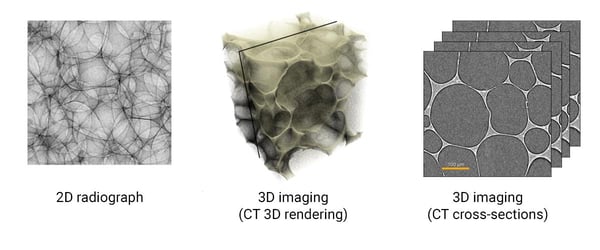
If you are already using radiography (two-dimensional X-ray imaging), you might be wondering, "What's the difference between 2D radiography and CT?" The example below shows a 2D radiograph and CT image (3D rendering and cross-sections) of a foam. In the 2D radiograph, all the pores in the foam are projected on top of each other. This makes it impossible to analyze individual pores. Meanwhile, the CT images show the foam as it is. You can see individual pores and analyze their shapes and sizes with no problem. In other words, CT removes all the difficulty of interpreting 2D radiographs.
Read: What is the difference between CT and radiography?
2. When is X-ray CT useful?
X-ray CT is useful when the feature or defect you care about is hidden inside the sample, and you want to inspect it without cutting the sample apart. Examples include pores and lack-of-fusion defects in additive-manufacturing parts; cracks or misalignment in electronics; winding or assembly problems in batteries; and cracks, pores, or density variations in pharmaceutical tablets. (See application examples in various industries.)
CT can also complement optical and electron microscopy when you need a three-dimensional view of a larger volume or want to avoid destructive sectioning and sample preparation such as drying, staining, coating, or polishing.
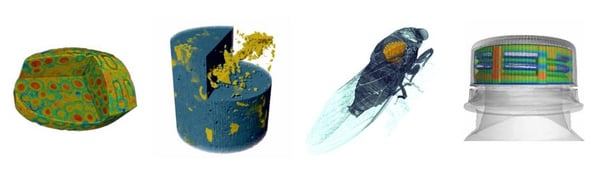 Application examples: from the left – drug tablet, calcite drill core, insect, bottle cap
CT is also widely used for failure analysis, allowing failed parts and devices to be examined without altering them and preserving the ability to test them further.
Explore: Decoding Defects: Failure Analysis Using X-ray CT
But X-ray CT has its limitations, and it is important to know its advantages and limitations:
Advantages
- Non-destructive
- Three-dimensional information
- Virtually no special sample preparation
Limitations
- Limited sample size and density
- Limited resolution
- No elemental information
- Slower than radiography
X-ray CT is an X-ray absorption contrast imaging. So X-rays need to get through the sample to generate a useful image. If the sample is high-density (heavy-absorbing) or very thick, X-rays will struggle to get through. An entire car engine is about the limit of the general industrial X-ray CT scan technique, to give you an idea.
The resolution of most laboratory X-ray CT scanners is limited to microns to submicron. By using special optics, such as Fresnel zone plates, often combined with synchrotron radiation, you can achieve about 20 nm resolution. You need to switch to electron microscopes to achieve nm resolution.
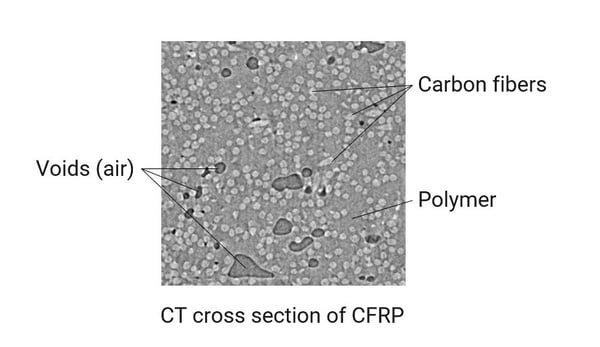
Also, it is worth noting that X-ray CT only gives us relative density information. So you cannot identify the chemical compositions or elemental makeup of the sample. If you know what types of materials are included in the sample, then you can match each gray level in the CT image to a corresponding material. For example, in CFRP (carbon fiber reinforced polymer), the lightest gray is carbon fibers, the middle gray is the binding polymer, and the dark gray is air.
3. What types of X-ray CT scanners are available?
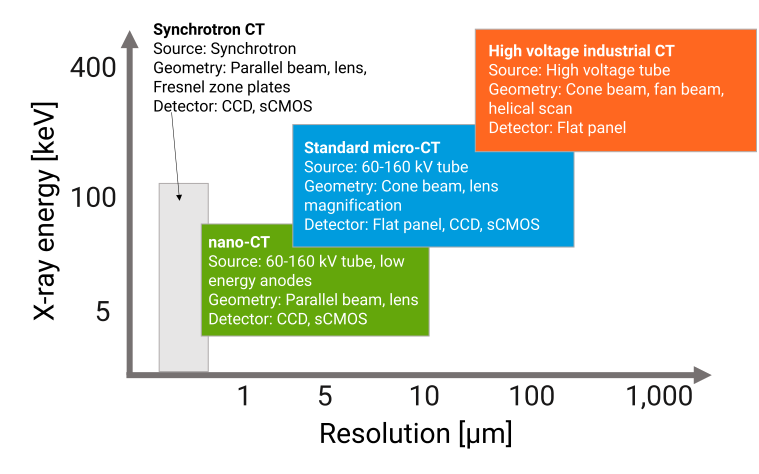
An X-ray CT scanner consists of an X-ray source, detector, sample stage, and radiation enclosure. Depending on the required voltage and X-ray focus size, different X-ray sources are used, including reflection or transmission microfocus sources, rotating anode microfocus sources, or synchrotron radiation. Generally speaking, high voltage means high energy for X-ray sources. For micron- to mm- resolution systems, a flat panel or linear detector is used. Standard micro-CT and high-voltage industrial CT scanners use either the cone beam or fan beam geometry, and the X-ray divergence magnifies the sample images. For higher resolution, a nano X-ray source, the parallel beam geometry with an optical lens, or Fresnel zone plates can be used.
High-voltage industrial CT scanners tend to be on the expensive side, about half a million to multi-million dollars, depending on the required voltage and level of automation. This is because of the high price of a high-voltage X-ray source and a large sample stage and radiation enclosure to accommodate large and heavy samples.
Standard micro-CT scanners are among the most affordable. For a research-grade micro-CT scanner, the price ranges anywhere from mid-200K to half a million dollars. Compact benchtop-type scanners are also available in this class.
Nano- to submicron- resolution scanners are relatively expensive and range from about half a million to two million dollars, depending on the required resolution. There are many CT manufacturers. For example, Rigaku makes submicron- and standard micro-CT scanners, including a high-voltage industrial scanner, companies like Comet Yxlong makes 450 kV CT scanners, and NSI has MeV X-ray sources.
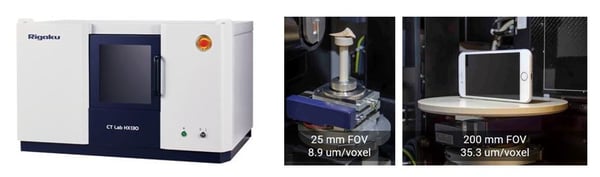 A benchtop micro-CT scanner: CT Lab HX exterior (left) and sample stage (right)
 A submicron 160kV CT scanner: CT Lab HR160
Read: How Much Does a Micro CT Scanner Cost?
Read: How Much Does a Benchtop X-ray CT Scanner Cost?
4. How do I choose the right CT scanner?
The right CT scanner type depends on the sample type and size of the features you want to image. There are three major specifications to consider: X-ray energy (or voltage), field of view (FOV), and resolution. The FOV is the area you can scan, and it is normally similar to the sample size. The table below summarizes the sample factors and X-ray CT specifications:
|
Sample factors |
CT specifications |
What does this mean? |
|
Density |
X-ray energy |
For example, a piece of 30 mm thick steel needs a high-energy/high-voltage X-ray source, 200 kV or above. Small to medium-sized aluminum, ceramics, plastic, etc., need only a standard voltage X-ray source, 60-160 kV. Organic materials can benefit from low-energy (5-20 keV) nano-CT. |
|
Sample size |
FOV X-ray energy |
FOV should cover the area you want to scan. It should be similar to the sample size. Large samples need a high-energy/high-voltage X-ray source, 200 kV or above. Smaller samples need only a standard voltage X-ray source, 60-160 kV. |
|
Resolution |
Spatial resolution |
The spatial resolution needs to be equal to or smaller than the size of the features you want to see. |
The optimum X-ray energy depends on the sample density and thickness the X-rays need to get through. Generally speaking, for larger or heavier samples, such as steel or copper thicker than a few mm, you will need high-energy (100 - 400 keV). Small to medium-sized (5~200 mm) plastics, polymers, composites, wood, etc., or small (a few mm) and light metals (aluminum, for example), medium-energy X-rays (20 - 100 keV) work well. For relatively small (1~10 mm) organic materials, foams, etc., low-energy X-rays (5 - 20 keV) work best.
For the FOV and resolution, keep in mind that the spatial resolution is limited to about 1/1000 of the FOV. This is because the number of pixels on commonly used X-ray detectors is limited.
Read: How to Choose kV and Filter for Your Micro-CT Experiment
Read: How to Improve the Resolution of X-ray CT Images
Regardless of the technical requirements, the instrument size and price are always important. If your lab space is limited, a benchtop system can save a lot of space. Always check the system's dimensions and weight. CT scanners can be heavier than they look because the thick metal radiation shield blocks high-energy X-rays. For the price, as summarized in the previous section, the standard micro-CT scanners are the most affordable. The higher the required X-ray energy or resolution, the higher the price.
Lastly, you should always ask the manufacturer to scan a few representative samples of yours to make sure that you are happy with the image quality. If you are new to CT and considering purchasing your first CT scanner, I would also recommend that you visit the manufacturers either in person or via a video conference to have a live demonstration to really understand what is involved in running the instrument.
If you have questions or would like to try one of Rigaku's CT scanners, talk to one of our CT experts by clicking the “TALK TO AN EXPERT” button at the top right of the page or contact us at info@rigaku.com.

Subscribe to the X-ray CT Email Updates newsletter
Stay up to date with CT news and upcoming events and never miss an opportunity to learn new analysis techniques and improve your skills.
Contact Us
Whether you're interested in getting a quote, want a demo, need technical support, or simply have a question, we're here to help.