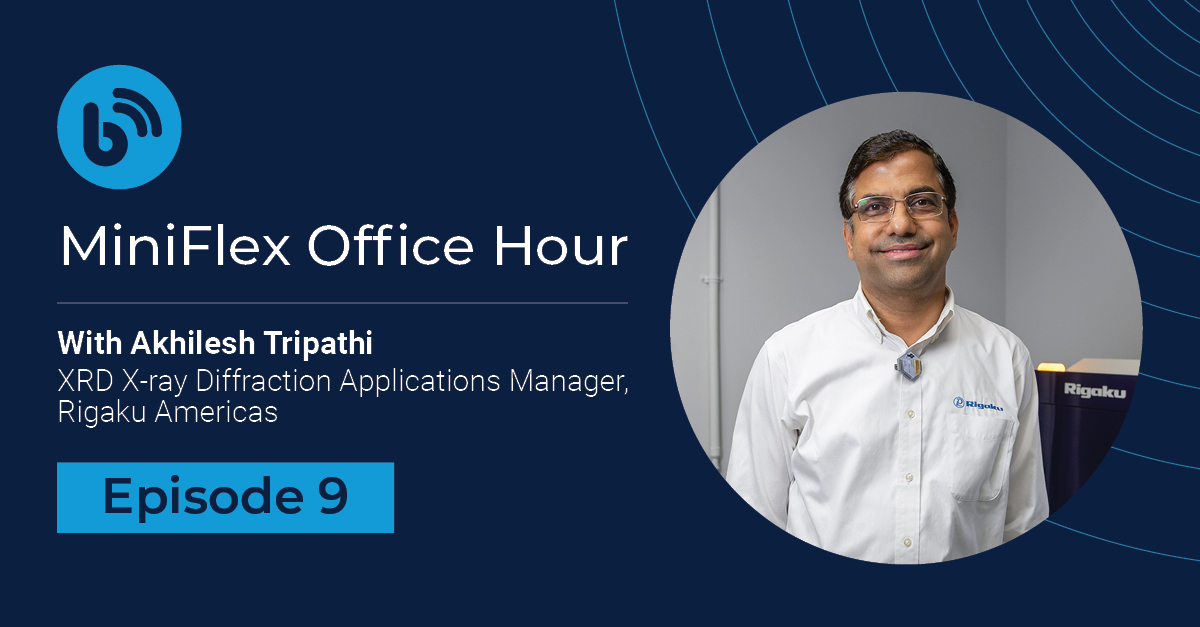

MiniFlex Office Hour Episode # 9 Recap
Dec 2, 2025
Recap provided by Aya Takase
Thank you to everyone who joined us for Episode 9 of MiniFlex Office Hour! As always, our XRD expert, Akhilesh Tripath, shared valuable insights and answered practical questions from MiniFlex users around the world. Below is a quick recap of the key topics we covered.
You can watch the full recording here. If you’re new to MiniFlex, it’s a benchtop X-ray diffractometer that researchers have trusted since 1973.
Episode recap
-
QC analysis often involves running the same analysis repeatedly, sometimes 100 times a day, particularly in industries that operate 24 hours, such as cement manufacturing.
- Templates: The key is to set up the proper analysis templates with optimized constraints. These templates include detailed steps and necessary constraints about the data analysis, typically Rietveld analysis, simplifying the operation into just two button clicks: one to collect the data and another to get the results. This not only saves time but also ensures consistent results independent of individual users.
- Industry examples (Cement): For example, in the cement industry, QC focuses on specific phases, including lime, basinite, anhydrite, gypsum, and the "four C's" (C3S, C4AF, C2S, C3A). The proportion of these phases determines the properties of the cement. Their quantities in weight percentage can be routinely and consistently determined for QC purposes using a well-designed template.
- Validating templates: The template results can be checked against other methods, like the BOG method or X-ray fluorescence (XRF), to ensure that they provide correct values.
-
While normal Rietveld analysis may involve identifying unknown phases from scratch and require the user to adjust how to refine parameters as they go, template-based QC uses a fixed set of phases and leverages historical data and strong constraints in the refinement process.
- Phases: It is crucial to select the correct potential phases to include in the template because all analyses during the QC process are done with the assumption that all phases in the sample have been identified and included in the analysis model.
- Constraints: When setting up a template, you utilize historical data (e.g., knowing you typically get 40% hematite) to put tight constraints on the ranges of the expected phases' percentages, ensuring the numbers remain consistent and within established ranges. Consider the out-of-spec samples from historical data and ensure their numbers are included in the constrained range so the template does not force everything within the specifications.
- Refinement order: Unlike normal refining, the template defines the specific order of refinement—which parameters are refined when—and the number of refinement cycles. For instance, a critical phase like lime might be refined near the end.
- The "Cooking Recipe" mindset: Setting up a good template is compared to following a food recipe; if the recipe is followed precisely (defining ranges, cycles, and refinement order), the results (the "dish") will be consistent and excellent over time.
- Template updates: Templates must be updated if the production process or main ingredients change (e.g., switching additives like calcite to gypsum).
-
Fine-tuning a template requires a strategy and consistency.
- Testing data: To build a reliable template, the expert typically asks the customer for at least 10 representative raw data sets.
- Testing extreme cases: It is vital to test the most extreme samples that represent the lowest and highest historical amounts of a certain phase, even those samples that might typically be rejected or are outside the acceptable range. This helps set the necessary constraints without missing the likely outliers (e.g., knowing that free lime cannot be 30%, but ranges between 0.5% and 5%).
- Catching errors: Testing multiple samples helps catch issues unrelated to the template, such as incorrect or inconsistent sample grinding, which can affect the peak shapes, leading to wrong quantitative numbers, or produce inconsistent analysis results.
- Spiking for validation: To check the validity and accuracy of a template, users can "spike" a sample by adding a known amount (e.g., 10% calcite or corundum) and confirming that the analysis yields results very close to the known additional percentage.
-
The performance of templates should be monitored regularly. They cannot be simply created and then used unattended for years. If you see abnormal results, investigate the cause and adjust the templates as necessary.
- If you use SmartLab Studio II: This software allows results over time to be projected onto line graphs to visualize trends. Spikes in the line graph indicate that those samples may be different or the results are incorrect, prompting further investigation. A gradual increase/decrease or an inflection point also indicates a drift either in the production or the analysis processes.
- If you use EasyX: This software is specifically designed for QC monitoring. Users can input expected result ranges (e.g., 9% to 11%). If a data point falls outside the defined range, the software automatically flags it by creating red lines or blocks.
-
Make sure the operation is easy and automatic for the busy operators. Meanwhile, those designing the template or managing the operation should check the results at a certain cadence to ensure consistency.
- Catching process issues: Managers must be ready to catch inconsistencies. For example, if results are unexpected, it may indicate a necessary adjustment in the production process, such as needing to raise the temperature in a kiln.
- Remember what is at stake: QC analysis is extremely critical. In industries producing millions of tons of product (like cement), generating a bad batch due to incorrect QC results leads to a huge loss of money, energy, and materials. Catching and fine-tuning issues quickly is essential.
-
Akhilish expressed thanks to the Office Hour audience for joining us, the people he interacts with, both customers and colleagues, and the continuous opportunity to learn new things every time he works with a new customer. He mentioned that a great source of satisfaction this year has been conducting these Office Hour sessions, feeling fulfilled in his role as a teacher and explainer.
Subscribe to the Bridge newsletter
Stay up to date with materials analysis news and upcoming conferences, webinars and podcasts, as well as learning new analytical techniques and applications.
Contact Us
Whether you're interested in getting a quote, want a demo, need technical support, or simply have a question, we're here to help.