Compound Semiconductor Hero Banner draft

Precision Materials Intelligence for Compound Semiconductors

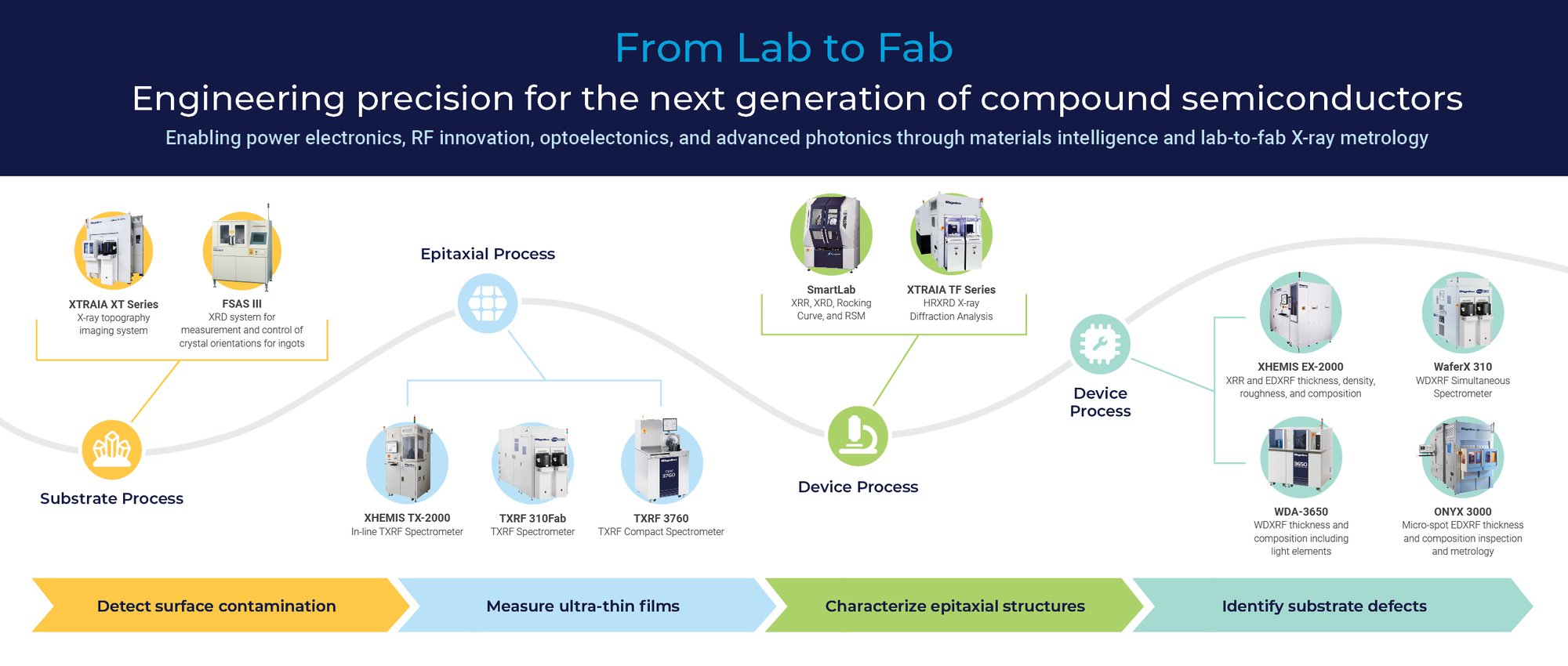
Advanced X-ray metrology connecting substrate preparation, epitaxy, and device fabrication, enabling faster ramp, improved yield, and reliable performance across GaN, SiC, and III–V technologies.

Accurate characterization of compound semiconductor structures requires non-destructive techniques capable of resolving buried layers, composition gradients, and crystalline quality.

Rigaku X-ray metrology solutions enable quantitative measurement of:

  • Thickness (sub-nm to µm)
  • Composition (Al, In, dopants)
  • Strain and relaxation
  • Crystal defects and dislocations
  • Interface roughness and density
  • Surface contamination

Why X-ray?

X-ray techniques probe buried structures and complex epitaxial stacks without sample preparation, enabling repeatable and production-relevant measurements.

What do you need to measure?

Thickness

Ultrathin layers (0.1–10 nm)
Multilayer stacks
Buried interfaces
Recommended: X-ray reflectivity (XRR)
Key advantage: Interference-based thickness sensitivity
Best suited for: Smooth, uniform films

Composition

Alloy fraction (AlGaN, InGaAs)
Dopant concentration
Recommended: XRF, HRXRD
Key advantage: Elemental (XRF) + lattice-based (XRD) insight
Best suited for: High quality epitaxial stacks and multilayers

Strain and relaxation

Epitaxial mismatch
Relaxation in thick films
Recommended: High-resolution XRD (HRXRD)
Key advantage: Direct sensitivity to lattice spacing
Best suited for: Films with spatially uniform mismatch or relaxation

Crystal quality and defects

Threading dislocations
Substrate defects (SiC micropipes)
Recommended: X-ray topography
Key advantage: Non-destructive defect imaging
Best suited for: High-resolution imaging and rapid screening

Interface roughness and density

Recommended: XRR
Key advantage: Sensitive to interface quality
Best suited for: Films and multilayers with nm-scale roughness

Surface contamination

Recommended: TXRF
Key advantage: Trace detection at surfaces
Best suited for: Smooth films, particulate contaminants

Applications

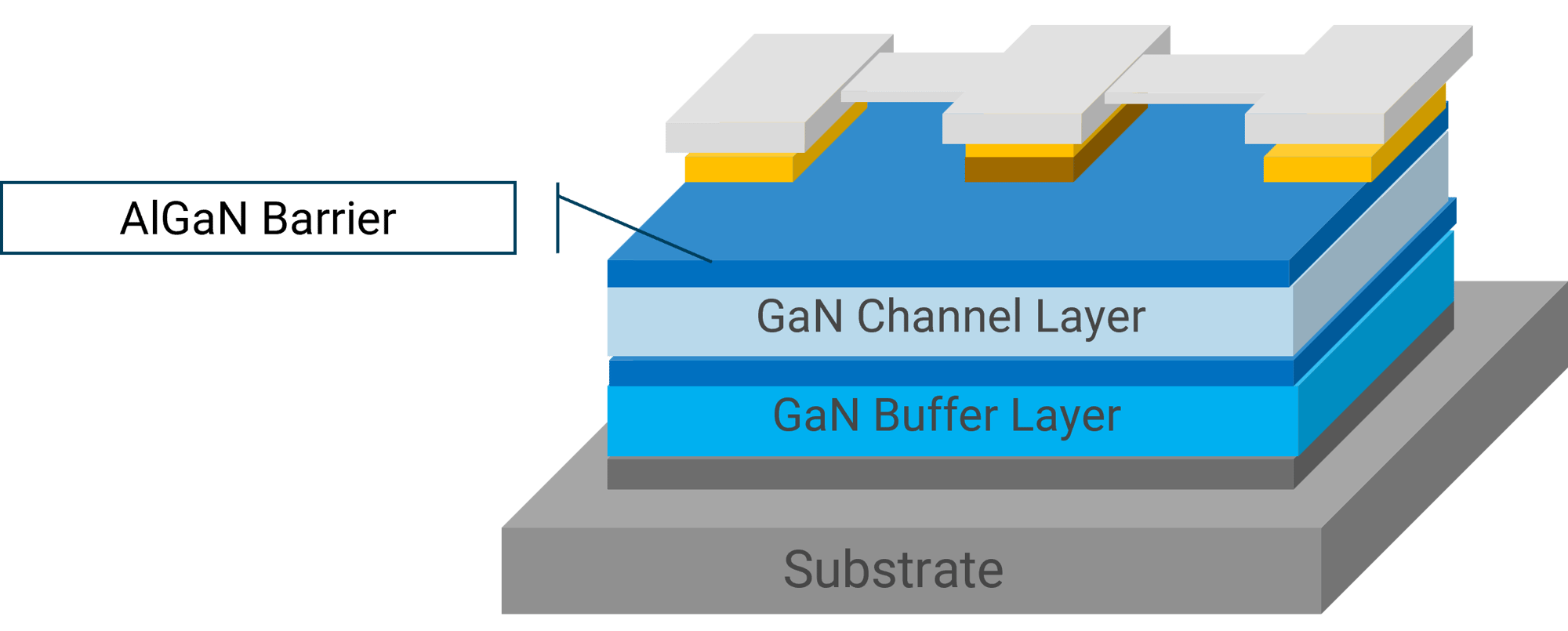
GaN HEMT structures

Key measurements:

  • AlGaN barrier thickness and composition
  • Strain vs relaxation
  • Interface roughness

Typical techniques:

  • HRXRD → strain + composition
  • XRR → thickness + roughness
  • XRF → elemental composition

Critical insight:

Electrical performance is strongly coupled to strain and interface quality; multi-technique fitting is required.

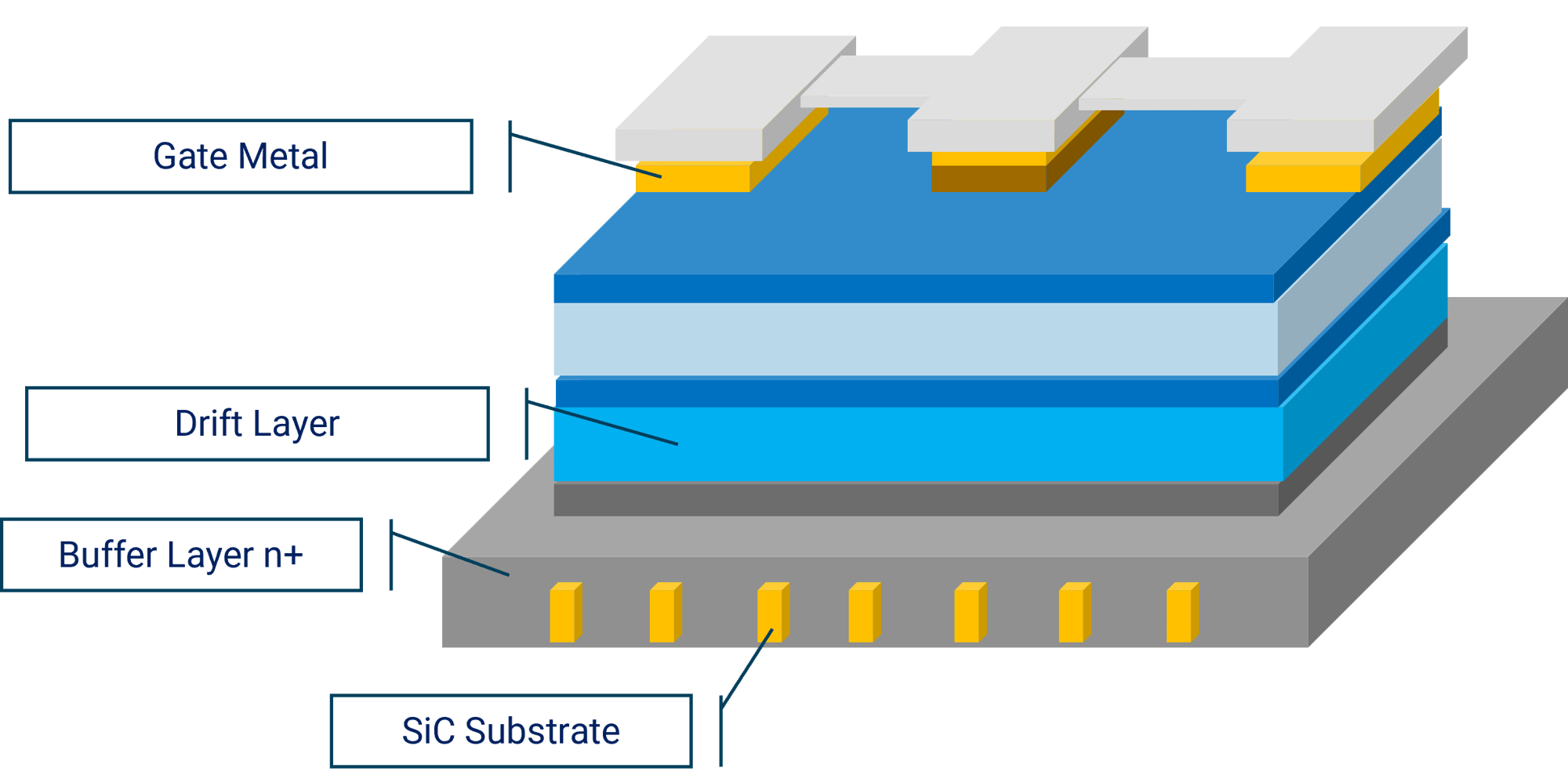
SiC power devices

Key measurements:

  • Substrate defect density
  • Epitaxial thickness uniformity
  • Polytype identification

Typical techniques:

  • X-ray topography → defects
  • HRXRD → crystal quality
  • XRF → composition

Critical insight:

Defect-driven yield loss requires non-destructive, wafer-scale inspection.

III–V epitaxy (InP, GaAs)

Key measurements:

  • Multilayer thickness
  • Lattice mismatch
  • Quantum well structures

Typical techniques:

  • HRXRD → strain and periodicity
  • XRR → thickness validation

Critical insight:

Inverse modeling becomes non-unique without constraints across multiple measurements.

Compound Semiconductor Optimization DARFT Image

Our metrology solutions


Substrate

Epi

Device

Advanced packaging

Contact Us

Whether you are interested in getting a quote, want a demo, need technical support, or simply have a question, we're here to help.