

Crystallography
Rigaku Oxford Diffraction specializes in three dimensional diffraction techniques including X-ray and electron crystallography.
Crystallography is a powerful scientific technique used to determine the three-dimensional structure of crystalline materials at the atomic level. It has widespread applications in various scientific fields, including chemistry, biology, materials science, and solid-state physics. It has been instrumental in elucidating the structures of proteins, nucleic acids, small organic molecules, inorganic compounds, and complex materials, contributing significantly to our understanding of molecular interactions, biological processes, and the design of new materials with tailored properties.
A single crystal of the material under study is typically required. This crystal is placed in the path of a monochromatic X-ray beam or an electron beam. The X-rays or electrons interact with the electron cloud surrounding the atoms in the crystal, leading to constructive interference between scattering from different atomic planes within the crystal lattice.
By analyzing the resulting diffraction pattern, researchers can reconstruct the electron density distribution within the crystal. From the electron density distribution, the positions of the atoms within the crystal lattice can be determined with high precision. This information provides insight into the spatial arrangement of atoms, the bond lengths, bond angles, and other structural parameters, enabling scientists to understand the chemical and physical properties of the material.
White papers
White paper: Unlocking Structural Discovery
This document outlines the operational principles of rotating anodes, their scientific advantages, and integration with modern instrumentation—highlighting why a rotating anode can change your research trajectory as essential tools for high-impact crystallographic research.
Learn more >
White paper: Small Crystals, Big Insights
This document details how electron diffraction (microED) is revolutionizing materials, life science, and chemistry research by determining crystal structures from powders, regardless of the size or quality of the crystallites. It features case studies in pharmaceutical and MOF research, along with over forty selected publications.
Learn more >Our product groups
Choose a product category and explore more.
X-ray diffraction
Three-dimensional atomic structures of small molecules and proteins may be unambiguously determined by single crystal X-ray diffraction. Such compounds, which may be of either chemical or biological interest, include new synthetic chemicals, catalysts, pharmaceuticals, and natural products.
Learn more >
Electron diffraction
Electron diffraction provides researchers with the ability to perform single crystal diffraction on samples smaller than those at the limit of X-ray diffraction, only a few hundred nanometers or less in size.
Learn more >-
The ability to study smaller crystals has changed our perspective on what is achievable within our facility. Indeed, some samples that previously required study at synchrotron facilities can now be studied in-house. Although
Read moreProf. Lee Brammer, Dr. Craig Robertson, Dr. Thomas RoseveareX-ray Crystallography FacilityChemistry Division, MPS School, University of Sheffield -
The XtaLAB Synergy-S has profoundly reshaped both our research capabilities and our approach to teaching. We are now able to analyze inorganic single crystals smaller than 5 µm in all dimensions. Thanks to the detector’s high sensitivity and zero electronic noise, the resulting data quality is remarkable.
Read moreDr. Olivier PérezCRISMAT Laboratory, Caen, France -
It is very common for these students to have some initial trepidation and anxiety about using valuable, high powered research equipment, but the approachability of the XtaLAB mini massively reduces this issue.
Read moreSimon Coles and Peter HortonUniversity of Southampton / National Crystallography Service -
I would definitively advise anyone to try a Cu Synergy-R diffractometer! I have already invited some colleagues in Spain to come to our lab with their own samples, because it can be difficult to believe unless you can see yourself the amazing data that can be obtained from weakly diffracting samples.
Read moreDr. Josefina Perles HernáezUniversidad Autónoma de Madrid -
We could dramatically increase our throughput and even attract new customer groups, as crystal quality & size became much less of a roadblock.
Read moreDr. Nils Trapp and Dr. Michael WörleSmall Molecule Crystallography CenterETH Zürich -
The single most important benefit that the instrument brings to the lab is the ability examine very small crystals in a short timeframe, whether that size constraint is forced upon you by the crystal availability, or whether you enforce it in order to isolate a single high-quality fragment from a larger (perhaps multiple) crystal.
Read moreProf. Kenneth ShanklandChemical Analysis Facility, University of Reading -
I'd strongly recommend the system: it truly is easy to get to grips with, even for a non-specialist. The software guidance and simple hardware fittings are a game-changer for hands-on use.
Read moreJoseph WrightUniversity of East Anglia
Featured products
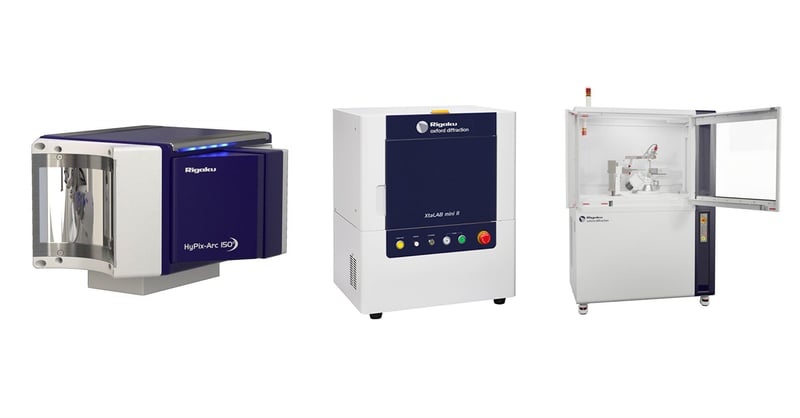
XtaLAB Synergy-S
Using a combination of leading-edge components and user-inspired software tied together through a highly parallelized architecture, the XtaLAB Synergy-S produces fast, accurate data in an intelligent fashion.
Learn more >
XtaLAB mini II
The perfect addition to any synthetic chemistry laboratory, the XtaLAB mini II single crystal X-ray diffractometer will enhance research productivity by offering affordable structure analysis capability without the necessity of relying on a departmental facility.
Learn more >
XtaLAB Synergy-ED
XtaLAB Synergy-ED is a new and fully integrated electron diffractometer, creating a seamless workflow from data collection to structure determination of three-dimensional molecular structures.
Learn more >
Contact Us
Whether you're interested in getting a quote, want a demo, need technical support, or simply have a question, we're here to help.