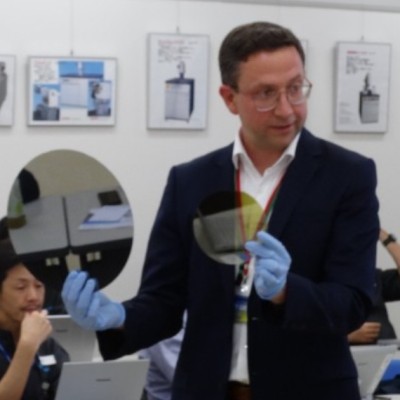
In this workshop, Dr.-Ing. Christian Reimann, Global Business Development Manager for XRTmicron at Rigaku, presents the latest advancements in non-destructive dislocation characterization of silicon carbide (SiC) substrates using X-ray topography (XRT) technology. In his role, Dr. Reimann is responsible for translating practical and analytical needs into actionable strategies and tactics for the XRTmicron product line.
The presentation outlines Rigaku’s collaboration with the Fraunhofer IISB (Institute for Integrated Systems and Device Technology) in Germany to establish a Center of Expertise for XRT, focusing on defect detection, measurement procedures, and tool development tailored to the semiconductor industry.
Dr. Reimann explains how XRT enables high-throughput, non-destructive quantification of threading screw dislocations (TSDs) and basal plane dislocations (BPDs)—critical defects affecting SiC device yield and reliability. By introducing techniques such as reflection and transmission topography, calibrated measurement approaches, and Rigaku’s X-ray Toolbox software, the workshop highlights how reproducibility, speed (down to 5 minutes per wafer), and industry-standard compatibility (SEMI M91 and M93) have been achieved.
This session demonstrates that the XRTmicron system is now production-ready, offering high accuracy, repeatability, and the scalability needed for fabs working with SiC materials. Attendees gain insight into the practical applications of XRT in both R&D and high-volume manufacturing environments.