
Introduction to Powder X-ray Diffractometry I: Overview

Keigo Nagao

Summer 2020, Volume 36, No. 2 , 19-24

Until the late 2000s, only scintillation counters (SC) were used as the detectors for general-purpose powder X-ray diffractometers. Thereafter, the core technologies that combine to create an X-ray diffractometer evolved dramatically. A one-dimensional (1D) detector—and subsequently a two-dimensional (2D) detector—came on the market, followed by new optical devices such as multilayer mirrors, in which layering technologies of super-thin film were applied. Analysis software functionality also improved remarkably. For instance, in addition to calculating crystallite size and lattice constants, programs implemented new algorithms and parameters, such as the application of whole pattern fitting, the Fundamental Parameter (FP) method, consideration of anisotropy and distribution in crystallite size.

The 1D and 2D measurement conditions described below are somewhat different from those with an SC.  The factors to which we should pay attention have changed when thinking about the optimal conditions to obtain high-quality data. Even in references in which only measurements using the focusing method and a zero-dimensional detector were described, useful hints to obtain high-quality data were rarely discussed. For this reason, in the series of articles making up this basic powder XRD course, we will explain the fundamentals of X-ray diffraction and expertise, sprinkled with the latest applications.

In this overview article, the principles and instruments used in the powder X-ray diffraction method, and what experiments can evaluate, are explained.
 

Highlights

  • Powder XRD identifies crystalline phases by using diffraction peak positions and intensities, so it can distinguish materials with the same chemical formula but different crystal structures.
  • Modern powder diffractometers have advanced far beyond scintillation-counter systems, with 1D and 2D detectors, improved optics, and more capable analysis software.
  • Powder XRD is non-destructive, requires relatively simple sample preparation, and measures average information over the irradiated region.
  • In addition to phase identification, powder XRD can be used for quantitative analysis, crystallinity, crystallite size and lattice strain, crystal structure refinement, in-situ analysis, texture, residual stress, PDF analysis, and particle or pore size analysis.
  • For routine powder work, 1D detection has effectively become the standard because it provides much higher intensity than 0D detection while maintaining strong angular resolution; 2D detection adds direct visualization of Debye rings and sample effects such as preferred orientation and coarse grains.

Summary

Powder X-ray diffractometry, or powder XRD, is a technique used to learn what crystalline materials are present in a sample and to get structural information from them. It works because X-rays interact with regularly spaced atomic planes in crystals. When the spacing and angle satisfy Bragg’s condition, the X-rays reinforce one another and produce diffraction peaks at specific angles. Those peak positions and shapes carry information about the material.

This makes powder XRD especially useful for telling apart substances that may have the same chemistry but different crystal structures. It can also identify mixtures, such as different oxides and hydroxides in rust. Because the method is non-destructive and usually does not require difficult sample preparation, it is widely used for both powders and many bulk materials.

A powder diffractometer has three main parts: the X-ray source, the goniometer that controls geometry, and the detector that records the diffracted X-rays. Instrument performance depends strongly on the optics and detector type. Modern systems may use parallel, divergent, or convergent beam optics, depending on whether the measurement is done in reflection or transmission geometry and what kind of sample is being studied.

Detector design matters a lot. Older 0D detection collects intensity point by point. A 1D detector collects data much more efficiently and is now the standard for powder measurements because it gives higher intensity and good resolution. A 2D detector captures a broader portion of the diffraction pattern at once, making it easier to observe ring patterns and recognize effects like preferred orientation or coarse grains.

Powder XRD is not limited to simple phase identification. It can also estimate how much of each phase is present, evaluate crystallinity, measure crystallite size and strain, refine crystal structures, study materials during heating or other changing conditions, and analyze texture or residual stress. The best choice of measurement setup depends on the sample type and the question being asked.

Frequently asked questions

Related products

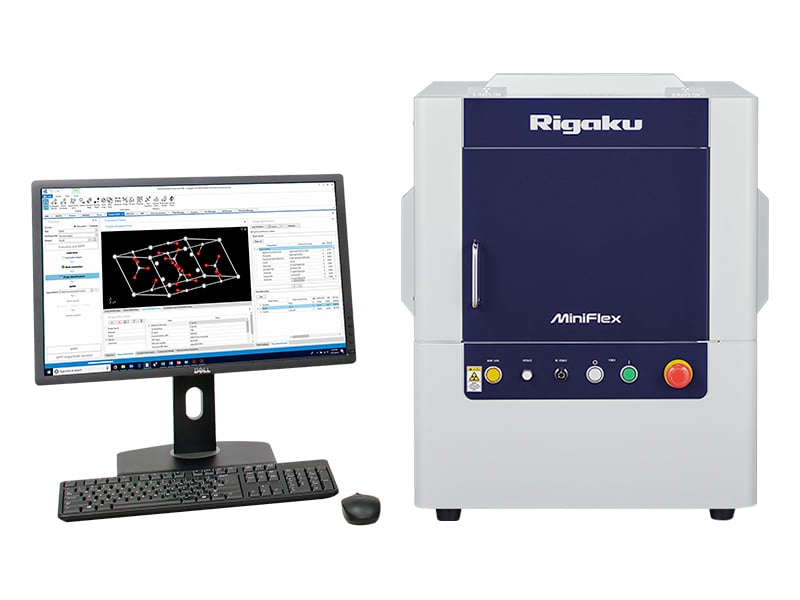
MiniFlex

Sixth-generation general purpose benchtop XRD system for phase ID and phase quantification

Learn more
SmartLab

Advanced, state-of-the-art, high-resolution XRD system powered by Guidance expert system software

Learn more


SmartLab Studio II

Windows-based software suite for Rigaku's X-ray diffractometers

Learn more

Subscribe to the Bridge newsletter

Stay up to date with materials analysis news and upcoming conferences, webinars and podcasts, as well as learning new analytical techniques and applications.
Contact Us

Whether you're interested in getting a quote, want a demo, need technical support, or simply have a question, we're here to help.