Application Note RAD9000
Introduction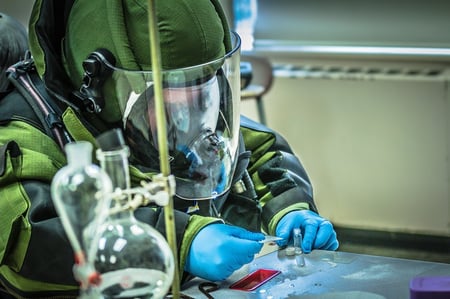
Homemade explosives (HMEs) are increasingly used in improvised explosive devices (IEDs) around the world, often with devastating consequences. These devices are designed to destroy, incapacitate, harass, or distract. As access to commercial explosives becomes more restricted due to regulations, criminal organizations and insurgent groups are turning to the production of HMEs. These explosives typically require a fuel and an oxidizer to sustain the explosive reaction, and many common chemicals, such as fertilizers, hydrogen peroxide, chlorates, and perchlorates, can be used to create these hazardous materials.
The growing threat posed by HMEs is significant, as they can be easily manufactured with readily available chemicals and materials, making them a preferred choice for terrorists, criminal groups, and other malicious actors. The identification of HMEs and their precursor chemicals is crucial in preventing attacks, securing borders, and ensuring public safety. In this context, handheld Raman spectroscopy offers a reliable and efficient tool for identifying not only the final explosive product but also the precursor chemicals involved in HME and IED production.
The role of handheld Raman for homemade explosive analysis
Raman spectroscopy is an ideal technology for the identification of chemicals involved in the creation of homemade explosives. Over the past decade, handheld Raman analyzers have been widely used by bomb technicians, law enforcement, military, and security forces for this purpose. One of the key advantages of Raman spectroscopy is its ability to scan through transparent packaging—such as plastic or glass containers—without the need to handle potentially dangerous substances directly. This capability keeps users safe from exposure to hazardous chemicals.
Furthermore, Raman spectroscopy can identify a broad range of chemicals, from the finished explosive material to the precursor chemicals and fuel components that are often used in HME formulations. This makes it an essential tool in detecting not only the end product but also the raw materials involved in the manufacturing process, providing vital information for investigators and security personnel.
Challenges in HME identification
While Raman spectroscopy is a powerful tool, the identification of homemade explosives can be challenging due to the complexity of the materials involved. HME formulations, degradation over time, precursor contamination, and chemical structure can all contribute to fluorescence interference when analyzing samples. Traditional Raman analyzers that operate at lower wavelengths, such as 532 nm, 785 nm, or 830 nm, are more prone to this interference, which can prevent accurate identification.
Rigaku's 1064 nm handheld Raman anslysis
Rigaku’s CQL Max-ID™ and CQL Gen-ID™ Raman analyzers, address these challenges by utilizing 1064 nm laser excitation. This longer wavelength significantly reduces fluorescence interference, allowing for more accurate chemical determinations. This reduction in fluorescence enables users to make reliable identifications of HMEs and their precursors, even in complex mixtures or degraded samples commonly encountered in the field.
Additionally, the Rigaku handheld Raman analyzers are capable of scanning through colored materials and containers, offering increased versatility in identifying explosives in a variety of situations. Whether scanning through evidence bags, containers, or other colored materials, Rigaku analyzers provide the flexibility and accuracy needed for rapid identification.
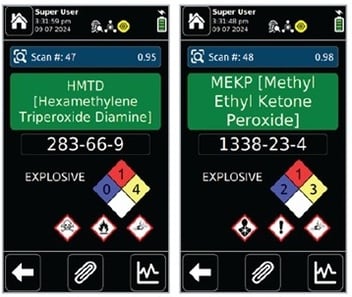
Result screens from the Rigaku CQL Gen-ID / CQL Max-ID using Identification scan mode.
Advanced features for effective homemade explosives analysis
• ThreatAlert™ Mode: available on the CQL Gen-ID and CQLMax-ID, this mode prioritizes HME identification ensuring that threats are quickly and easily recognized by the user.
• ChemGuard™ Mode: available on the CQL Max-ID, this mode provides prioritized information when alarm or threat substances are detected, offering critical data to inform next steps.
• QuickDetect™ Mode: adds an optional, on-board colorimetric capability for the detection of non-visible explosives.
Additionally, the Rigaku CQL portfolio includes 4C™ Technology, which continuously monitors the collected data and compares it to a lite of known chemical “recipes” for explosive combinations. When potential HME ingredients are identified, the user will be alerted. This proactive monitoring significantly improves the ability to identify and neutralize threats before they escalate.
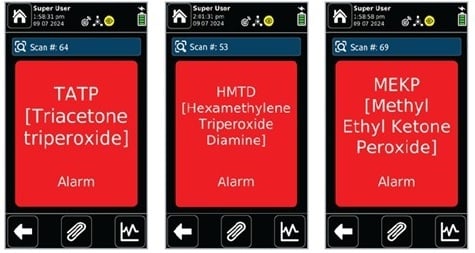
Result screens from the Rigaku CQL Max-ID using Chemguard scan mode.
Conclusion
The threat posed by homemade explosives (HMEs) continues to grow, with these improvised devices becoming more prevalent in terrorist attacks and criminal activities worldwide. The ability to accurately and safely identify these explosives, along with their precursors and components, is crucial for preventing attacks and ensuring public safety. Rigaku’s handheld Raman analyzers provide an essential tool for HME detection, offering advanced features like reduced fluorescence interference, scanning through colored materials, automated mixture analysis, and real-time chemical recipe monitoring. With the addition of the optional QuickDetect mode, Rigaku analyzers offer unparalleled flexibility and precision in the identification of HMEs, ensuring that users can respond quickly and safely to evolving threats.