
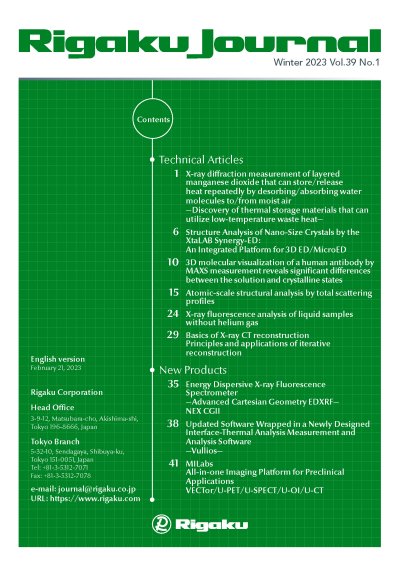
Atomic-scale Structural Analysis by Total Scattering Profiles

Masatsugu Yoshimoto

Winter 2023 Volume 39, No. 1 , 15-23

In the past, total scattering data was used to obtain the pair distribution function (PDF) G(r). However, it has become clear that it is also possible to calculate characteristic values related to the physical properties of materials from the total scattering data. In this paper, we introduce two applications using total scattering data. The first evaluates the atomic density of materials using total scattering data. The atomic density of SiO₂ glass obtained by applying the proposed method is consistent within 5% of the literature value. The other is a new application of the Reverse Monte- Carlo (RMC) method for non-crystalline materials. It does not require any additional parameters to calculate diffraction peaks. The proposed method is used to identify specific features of the MnO₆ octahedra of the spinel lithium manganese oxide (LiMn₂O₄) corresponding to each Mn valence.

Highlights

  • Total scattering data can be used to determine atomic density directly, providing accurate results even for porous or defect-containing materials where conventional density measurements are challenging.
  • A new Reverse Monte Carlo (RMC) approach reproduces total scattering data for crystalline materials without requiring ambiguous instrument-dependent fitting parameters.
  • The combined methodology reveals subtle local structural distortions, including differences between Mn³⁺O₆ and Mn⁴⁺O₆ octahedra in lithium manganese oxide that are closely linked to material properties.

Summary

Total scattering analysis is expanding beyond conventional pair distribution function (PDF) measurements to provide quantitative structural information that is directly related to material properties. One important advancement is a method for determining atomic number density directly from total scattering data and elemental composition. By iteratively correcting non-physical artifacts in the measured structure factor, the approach produces reliable density estimates without relying on assumptions about sample geometry, porosity, or packing. Validation using silica glass demonstrates agreement with established density values within approximately 5%, making the technique valuable for powders, porous materials, and other samples where conventional density measurements are difficult.

A second advancement extends Reverse Monte Carlo modeling for crystalline materials. Traditional RMC approaches often require additional fitting parameters to reproduce diffraction peaks accurately, introducing uncertainty into the structural model. The proposed method separates local structural contributions from long-range periodic order, allowing experimental total scattering profiles to be reproduced without instrument-specific parameters. This simplifies the modeling process while maintaining agreement with experimental data.

The technique is demonstrated using crystalline nickel and spinel lithium manganese oxide, an important lithium-ion battery cathode material. In nickel, the method accurately reproduces atomic displacements associated with thermal motion. In lithium manganese oxide, it distinguishes local structural differences associated with manganese oxidation states. Mn³⁺O₆ octahedra exhibit longer Mn–O bond lengths, broader bond-length distributions, and substantially greater octahedral distortion than Mn⁴⁺O₆ units, consistent with Jahn-Teller distortion. These capabilities enable detailed characterization of local atomic environments that influence electrochemical performance, phase transitions, and other functional material properties, making total scattering a powerful complement to conventional diffraction techniques.

Frequently asked questions

Recommended products

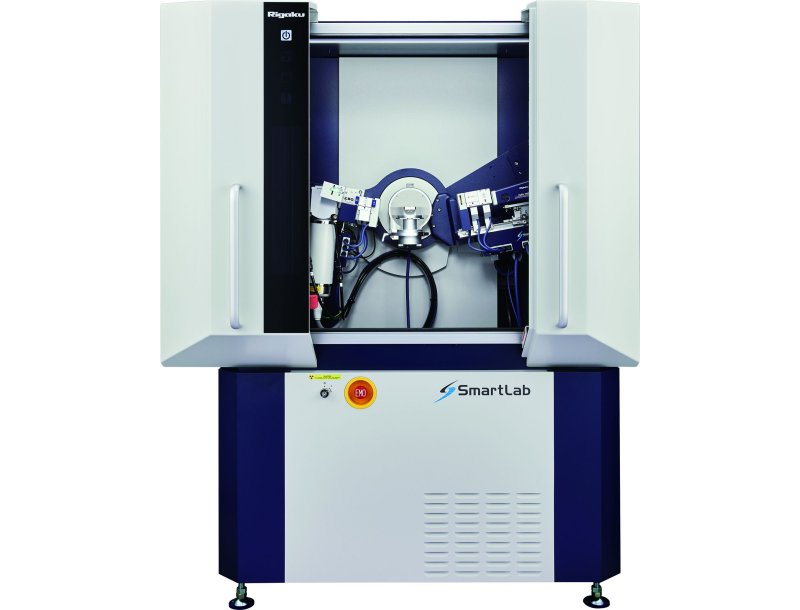
SmartLab

Advanced, state-of-the-art, high-resolution XRD system powered by Guidance expert system software

Learn more
SmartLab SE

Highly versatile multipurpose X-ray diffractometer with built-in intelligent guidance

Learn more


SmartLab Studio II

Windows-based software suite for Rigaku's X-ray diffractometers

Learn more

Subscribe to the Bridge newsletter

Stay up to date with materials analysis news and upcoming conferences, webinars and podcasts, as well as learning new analytical techniques and applications.
Contact Us

Whether you're interested in getting a quote, want a demo, need technical support, or simply have a question, we're here to help.