
Practical XRD with Confidence
4: SAXS and WAXS Explained: Probing Structure Beyond Bragg Peaks
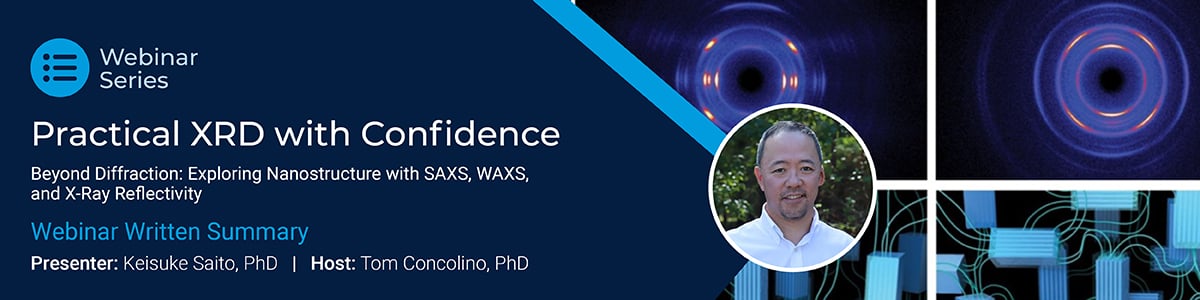
This is a written summary of a live webinar presented on June 17, 2026. The recording and resources are available on the recording page.
Presented by:

Webinar summary
In this webinar, the fourth and final in the series Practical XRD with Confidence, Keisuke explains small-angle X-ray scattering, wide-angle X-ray scattering, and X-ray reflectivity, which provide complementary ways to characterize structure at nanometer length scales.
SAXS measures low-angle scattering and is useful for studying particles, pores, aggregates, and other nanoscale features from roughly 1 to 1000 nm. It can provide information about particle size, shape, size distribution, and interparticle spacing. WAXS measures at higher scattering angles and provides information about smaller-scale atomic correlations, crystal structure, phases, crystallinity, and local order. X-ray reflectivity is used primarily for thin films and interfaces, providing thickness, density, and surface or interface roughness.
In SAXS, scattering intensity depends on the number of particles, the form factor, and the structure factor. The form factor describes the size and shape of individual objects, such as spheres, rods, disks, cubes, or core-shell particles. The structure factor describes how those objects are arranged relative to one another. For isotropic systems, hard-sphere approximations such as the Percus–Yevick model can be used to estimate particle spacing and packing fraction using a limited number of parameters.
Proper instrument setup and sample preparation are critical for reliable SAXS measurements. Low-angle scattering is weak and easily obscured by parasitic scattering from optics or air scattering, so anti-parasitic scattering slits and vacuum paths are important. Samples may be prepared in fused silica capillaries or between Mylar or Kapton foils, depending on whether they are powders, liquids, or gels. Sample concentration or loading should be adjusted so the X-ray transmittance is typically between about 20% and 80%; too much sample prevents transmission, while too little produces weak scattering.
Several approaches can be used to estimate particle size from SAXS data. A peak-search method can identify oscillation minima in a scattering profile, which can be used to estimate particle diameter when particles are uniform. A Guinier plot uses low-Q scattering behavior to calculate the radius of gyration and, for spherical particles, estimate the real particle diameter. Model fitting provides more detailed information, including average diameter, size distribution, mode diameter, and cumulative distribution values such as D10, D50, and D90.
Two-dimensional SAXS and WAXS are especially useful for textured or oriented materials, such as fibers, films, and polymers. In oriented polymer fibers, WAXS patterns can reveal crystalline phase information and preferred orientation, while SAXS patterns can reveal nanoscale periodicity associated with amorphous and crystalline regions. In one example, WAXS identified polypropylene, while SAXS showed a spacing of about 11.4 nm between amorphous regions. For mesoporous silica, two-dimensional scattering patterns showed ordered spot arrangements, and the spacing between spots corresponded to a real-space distance of about 5.2 nm between mesopores.
X-ray reflectivity is a nondestructive method for analyzing thin films and interfaces. It measures reflected X-ray intensity as a function of incident angle. Below the critical angle, X-rays are almost totally reflected; above it, they begin to penetrate the sample. The critical angle is related to density, the spacing of thickness oscillations is related to film thickness, the oscillation amplitude is related to density contrast, and the decay or slope of the profile is related to surface and interface roughness.
XRR can analyze films ranging from sub-nanometer thicknesses to hundreds of nanometers, and with high-resolution optics, potentially beyond one micrometer. Instrument resolution affects the maximum measurable thickness. A parabolic mirror configuration may measure films up to roughly 220 nm, while adding a germanium monochromator can extend this range to about 440 nm. Higher-resolution monochromators can extend the theoretical measurable range further.
XRR data analysis relies on modeling and fitting. A multilayer structure is defined with thickness, density, and roughness values for each layer, then the calculated reflectivity profile is compared with measured data. Scale and background are often adjusted manually first, followed by fitting of density, thickness, and roughness. Very thin surface layers may not show their own critical angle clearly, so density may need to be determined from fringe amplitude rather than the critical angle.
The webinar also clarified that the ‘roughness’ parameter in XRR simulations is not a direct measure of physical surface roughness. In XRR modeling, roughness describes the width of the electron-density transition at an interface, representing how gradually or abruptly the density changes rather than the actual topography.
Reliable XRR fitting is easier when some prior information is available. Cross-sectional imaging can provide starting thickness values, and larger samples help avoid footprint-related intensity loss. For multilayer stacks, characterizing each deposited layer step by step can simplify fitting, because known lower-layer parameters can be fixed while new layers are refined. Both SAXS and XRR do not require crystalline materials; the key requirement is sufficient electron density contrast between particles, pores, layers, or interfaces.
Frequently asked questions
-
SAXS provides nanoscale information about particle size, particle shape, size distribution, pores, aggregates, and interparticle spacing. It is especially useful for features in roughly the 1 to 1000 nm range.
-
WAXS measures scattering at higher angles and probes smaller structural length scales. It can provide information about crystal structure, phase identification, crystallinity, and local atomic order, while SAXS focuses on larger nanoscale features such as particles, pores, and periodic nanostructures.
-
No. SAXS does not require crystallinity. Scattering occurs when there is electron density contrast, so SAXS can be used with crystalline or amorphous particles, voids, pores, and other nanoscale structures as long as enough contrast exists.
-
Particle size can be estimated using peak positions or oscillation minima, Guinier analysis, or model fitting. Peak-search and Guinier methods provide relatively quick size estimates, while model fitting can provide more detailed information such as size distributions and cumulative values like D10, D50, and D90.
-
SAXS signals are weak and occur at very low angles, where background scattering from optics and air can easily overwhelm the sample signal. Anti-parasitic scattering slits reduce unwanted scattering from instrument components, and vacuum paths reduce air scattering before the signal reaches the detector.
-
Two-dimensional SAXS and WAXS can reveal anisotropy, texture, and preferred orientation. This is important for materials such as fibers, films, and polymers, where scattering may not be uniform in all directions.
-
X-ray reflectivity provides film thickness, density, and surface or interface roughness. It is a nondestructive technique for analyzing thin films, coatings, multilayers, and interfaces with nanometer-scale sensitivity.
-
Yes. XRR does not require crystalline materials. It can be used on amorphous films and substrates if there is sufficient density contrast between the film and substrate. If the densities are too similar, the interface may not produce clear thickness oscillations.

Subscribe to the Bridge newsletter
Stay up to date with materials analysis news and upcoming conferences, webinars and podcasts, as well as learning new analytical techniques and applications.
Contact Us
Whether you're interested in getting a quote, want a demo, need technical support, or simply have a question, we're here to help.