
AI Analysis Basic Course - First Installment: Neural Network Application to Phase Identification in Powder X-ray Diffraction

Toshihide Shibasaki, Takumi Ohta, and Akihiro Himeda

Summer 2025 Volume 41, No. 2 , 06-10

In recent years, there have been significant improvements in AI technology, especially in neural networks. We describe profile-based phase identification using neural networks, which does not require peak search. Using cements and excipients as examples, we report that neural networks can be used to identify crystalline phases more accurately even when analysis by the conventional method is difficult.
Highlights

  • Neural-network phase identification works directly from the full XRD profile, so it does not depend on peak search accuracy.
  • This profile-based approach performed better than conventional search/match for difficult materials such as cement and pharmaceutical excipients.
  • For cement test data, the neural-network method achieved a much higher F1 score overall, and it was especially better at detecting minor phases.
  • For excipient test data, the biggest improvement was in identifying micro-crystalline components, which are often hard to resolve because of broad peaks and poor crystallinity.
  • Amorphous-phase identification remained challenging even with neural networks, showing that background treatment is still a major limitation.

Summary

Phase identification is one of the most common uses of powder XRD, but it becomes difficult when peaks overlap, broaden, or are hard to separate clearly. Traditional search/match methods depend on finding peaks first and then comparing those peaks with a database. That works well in many cases, but it can miss the correct phases when the diffraction pattern is messy or poorly crystalline.

A neural-network approach can improve this by using the whole diffraction profile instead of relying only on a peak list. In this work, a vision transformer model was used to examine XRD patterns directly and estimate which phases were present. Training data were created from simulated diffraction profiles, including mixtures and variations in factors such as lattice constants, crystallite size, and preferred orientation, so the model could learn realistic pattern changes.

When tested on cement and pharmaceutical excipient data, the neural-network method produced more accurate phase identification than conventional search/match. It was especially strong for materials with overlapping peaks or poor crystallinity, although amorphous components were still difficult to identify reliably. Overall, the results show that AI-based profile analysis can make phase identification more robust in cases where conventional peak-based methods struggle.

Frequently asked questions

Related products

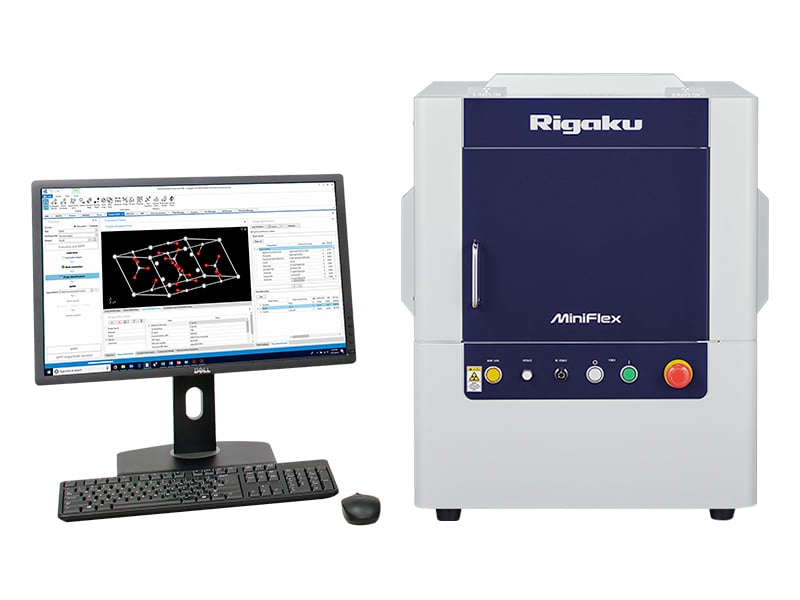
MiniFlex

Sixth-generation general purpose benchtop XRD system for phase ID and phase quantification

Learn more
SmartLab

Advanced, state-of-the-art, high-resolution XRD system powered by Guidance expert system software

Learn more


SmartLab Studio II

Windows-based software suite for Rigaku's X-ray diffractometers

Learn more

Subscribe to the Bridge newsletter

Stay up to date with materials analysis news and upcoming conferences, webinars and podcasts, as well as learning new analytical techniques and applications.
Contact Us

Whether you're interested in getting a quote, want a demo, need technical support, or simply have a question, we're here to help.