
Compare XRD Products

High-performance X-ray diffraction systems

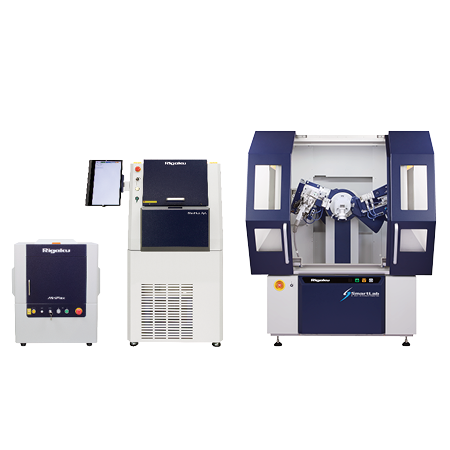
X-ray diffraction (XRD) systems are essential for determining phase composition, crystallinity, structure, and residual stress in a wide range of materials. Choosing the right system means balancing sample type, analytical goals, and throughput requirements, as well as considering factors like resolution, flexibility in optics and sample stages, and ease of use. Rigaku offers a comprehensive range of XRD configurations—from compact benchtop instruments to highly versatile multipurpose systems—to match different analytical needs and workflows.

Rigaku’s XRD lineup supports applications from advanced materials research and nanotechnology to routine quality control in industries such as metals, cement, batteries, semiconductors, pharmaceuticals, and more. Each model is engineered to deliver an optimal combination of data quality, speed, and configurability, helping your laboratory obtain reliable diffraction results while keeping operation and method development straightforward.
WU_26_XRDProductCollage_blank_12184420896_450 x 450_

Rigaku's XRD systems

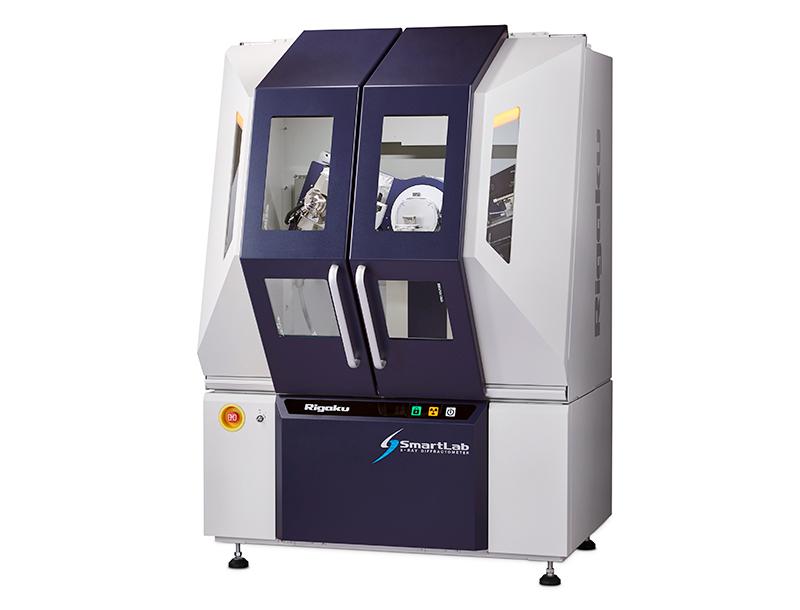
For the most demanding research and development applications SmartLab

The SmartLab is the best fit when the instrument must support the widest range of samples, techniques, and future configurations. It is the strongest choice for advanced materials research, thin films, nanomaterials, semiconductors, batteries, operando studies, in-plane scattering, micro-area work, mapping, and high-flux applications. Compared with SmartLab SE, the SmartLab offers more advanced expansion paths, including the optional PhotonMax 9 kW rotating anode source, optional in-plane arm, optional HyPix-3000 2D detector, and advanced triple-axis optics configurations.
Smartlab product photo with door closed

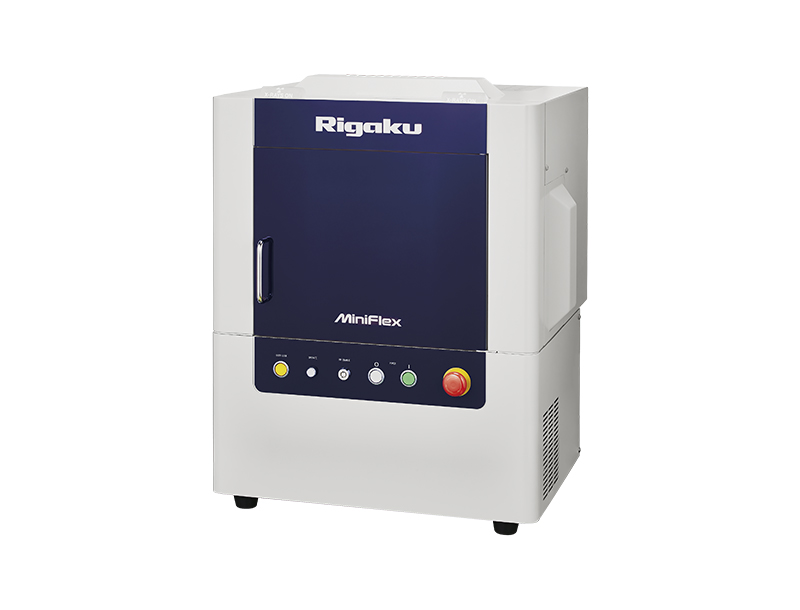
For routine powder diffraction in a compact lab environment MiniFlex

The MiniFlex is well suited for laboratories that need dependable XRD data without the footprint and infrastructure requirements of a full multipurpose diffractometer. It is a strong fit for phase identification, phase quantification, percent crystallinity, crystallite size and strain, lattice parameter refinement, and Rietveld refinement. It is especially appropriate for teaching labs, materials QA labs, and R&D groups that primarily analyze powders or polycrystalline solids.
MiniFlex angle view

For multipurpose capability with guided operation SmartLab SE

The SmartLab SE is an affordable options positioned between compact powder systems and the most advanced SmartLab configurations. It supports a much broader application range than MiniFlex or MiniFlex XpC, including powder diffraction, thin film diffraction, SAXS, pole figure analysis, residual stress, and non-ambient experiments. Using the same software platform as the SmartLab with intelligent Guidance software, component recognition, cross-beam optics, and self-alignment make it attractive for shared labs and industrial R&D teams that need advanced measurements without making every user an XRD expert.

SmartLab SE highly versatile multipurpose X-ray diffractometer (doors open)

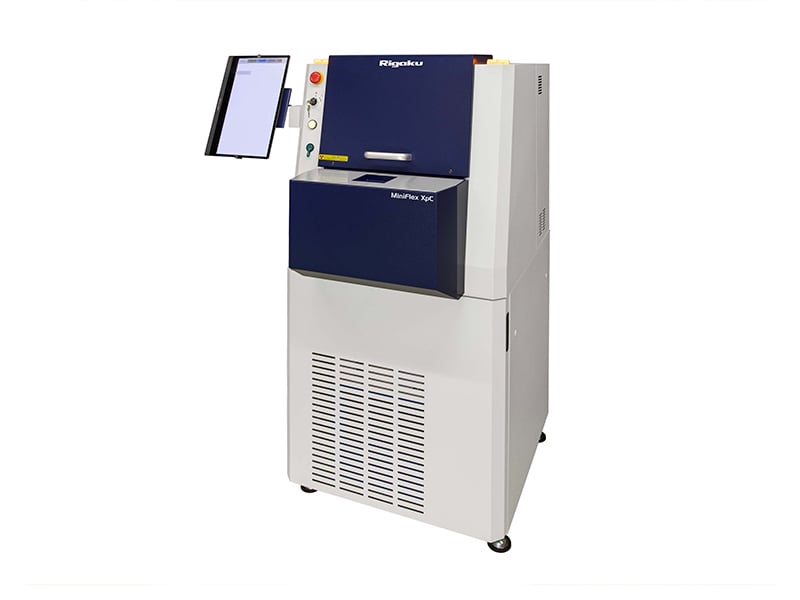
For manufacturing-floor or QC-driven XRD MiniFlex XpC

The MiniFlex XpC is the appropriate choice when throughput, repeatability, and operator-independent workflows matter most. Its EasyX software, touch-panel operation, pass/fail capability, 800 W source, D/teX Ultra250 detector, horizontal θ-θ goniometer, and automation compatibility make it well suited for production environments where XRD results must be generated quickly and consistently. It is a good fit for cement, battery materials, minerals, metals, pharmaceuticals, and other QC workflows where defined methods and routine decisions are more important than open-ended experimentation. Additionally, the MiniFlex XpC can be connected to automation equipment by combining it with a robot arm or a conveyor belt.
MiniFlex XpC angled left

How to select the appropriate XRD system

Choosing the right X-ray diffractometer starts with identifying the measurements that matter most for the lab’s work. Routine phase identification, quantitative phase analysis, crystallinity, crystallite size, and strain analysis can often be handled with a compact powder diffractometer. More specialized work may require additional capabilities: stress and texture analysis benefit from sample tilt and rotation, thin-film and epitaxial studies require high-resolution optics and precise alignment, and in situ or operando measurements need environmental control, stable hardware, and flexible sample stages.

Instrument selection should balance analytical performance with practical constraints such as budget, footprint, sample throughput, ease of use, maintenance, and operator experience. A benchtop XRD system may be the best fit for teaching, routine quality control, or laboratories with limited space. A multipurpose diffractometer is more appropriate when users need to analyze many sample types, switch between measurement geometries, or support both routine and advanced applications.

Specifications should be evaluated in the context of the actual application. Higher resolution, larger detectors, finer step sizes, or more advanced optics are valuable only when they improve the measurement outcome. In some cases, an impressive specification may add cost or complexity without improving results. For example, ultra-high-resolution configurations can reduce intensity when they are not needed, while large detectors may provide little benefit for certain high-resolution measurements.

Future flexibility is also important. A system that can accept upgraded optics, detectors, sample stages, or environmental attachments can adapt as research needs evolve. A practical approach is to choose an instrument that comfortably handles the core 80% of expected work rather than overbuying for rare edge cases. Occasional specialized measurements may be better handled through shared facilities, collaborators, or outsourced analysis. The best XRD system is ultimately the one that matches the lab’s primary applications, real-world constraints, and future growth plans.

Read the blog article How to Choose the Right X-ray Diffractometer.

At-a-glance comparison

Feature / selection factor MiniFlex MiniFlex XpC SmartLab SE SmartLab
Overall positioning Compact benchtop powder XRD system for routine materials analysis. Compact XRD system optimized for production, automation, and quality control environments. Affordable multipurpose XRD system with built-in intelligent guidance for advanced but accessible measurements. High-performance automated multipurpose XRD platform for advanced research, development, and complex applications.
Best fit Labs that need reliable phase analysis, quantification, crystallinity, crystallite size/strain, and Rietveld analysis in a small-footprint instrument. Manufacturing, process control, and QC labs that need fast, repeatable measurements with simplified operation and optional automation. Shared laboratories, applied R&D groups, and industrial labs needing powder diffraction plus thin films, SAXS, pole figures, residual stress, and non-ambient work. Advanced R&D labs requiring maximum flexibility, high flux options, in-plane scattering, operando measurements, mapping, thin films, SAXS, and complex sample environments.
Primary applications Phase analysis of polycrystalline materials. Quality control powder diffraction with fast and accurate measurements. Powder diffraction, thin film diffraction, SAXS, pole figure, residual stress, and non-ambient experiments. Powder diffraction, thin film, SAXS, in-plane scattering, and operando measurements.
Instrument format Benchtop / tabletop XRD. Compact floor-standing QC-oriented XRD. Floor-standing multipurpose XRD. Floor-standing automated multipurpose high-resolution XRD.
X-ray source 600 W X-ray tube. 800 W compact X-ray source. 3 kW sealed X-ray tube. 3 kW sealed X-ray tube; optional PhotonMax 9 kW rotating anode source.
Detector configuration D/teX Ultra2 silicon strip detector; optional XSPA200-ER 2D HPAD detector. D/teX Ultra250 high-resolution, high-speed 1D detector. D/teX Ultra 250 silicon strip detector; optional XSPA400-ER 2D HPAD detector. D/teX Ultra 250 silicon strip detector; optional HyPix-3000 or XSPA400-ER high-energy-resolution 2D HPAD detector.
Geometry / goniometer Vertical goniometer benchtop system.  Vertical θ-θ goniometer designed for quality control. Vertical θ-θ geometry. High-resolution θ-θ goniometer; optional in-plane arm / 5-axis goniometer.
Software / workflow SmartLab Studio II software for powder diffraction analysis, including phase identification, fundamental parameter methods, and structure-analysis tools. EasyX QC software with simplified measurement, automatic analysis, results display, and pass/fail judgment; touch-panel operation. SmartLab Studio II with intelligent User Guidance that suggests hardware configuration, settings, optics, and measurement sequence. SmartLab Studio II with intelligent User Guidance; designed to support automated configuration and advanced measurements.
Automation / sample handling Optional 8-position autosampler. Designed for automation; can connect with robot arm or conveyor belt, and supports online measurement workflows. Built-in component recognition, automated alignment, and intelligent guidance reduce configuration burden. Fully automated optics options, automatic alignment, optional auto sample loading, and advanced configuration flexibility.
Advanced measurement capability Primarily routine powder XRD; supports common powder analysis outputs such as phase ID, quantification, crystallinity, crystallite size/strain, lattice refinement, and Rietveld refinement. Primarily fast QC powder diffraction and process-oriented screening. Multipurpose capability for powder, thin films, SAXS, pole figures, residual stress, and non-ambient experiments. Highest capability among these four systems: powder, thin film, SAXS, in-plane scattering, operando, mapping, optional high-flux source, and optional advanced 2D detector.
Physical size 620 W × 722 H × 460 D mm. 700 W × 1490 H × 890 D mm, core unit. 1270 W × 1880 H × 1220 D mm. 1300 W × 1880 H × 1300 D mm.
Mass 80 kg, core unit. Approx. 250 kg, core unit. Approx. 800 kg, core unit. Approx. 750 kg with sealed tube; 850 kg with rotating anode.
Power requirements 1-phase, 100–240 V, 50/60 Hz. 1-phase, 200–230 V, 50/60 Hz, 6.5 A. 3-phase 200 VAC 50/60 Hz 30 A, or 1-phase 220–230 VAC 50/60 Hz 40 A. Sealed tube: 1-phase 200–230 V 40 A or 3-phase 200 V 30 A; rotating anode: 3-phase 200 V 60 A.
Simple selection guidance Choose MiniFlex when compact size, ease of use, and routine powder XRD are the main requirements. Choose MiniFlex XpC when the main need is fast, repeatable QC with simple operation and automation potential. Choose SmartLab SE when the lab needs a flexible multipurpose system but also values guidance, automated alignment, and easier operation. Choose SmartLab when the lab needs the broadest application range, highest configurability, optional high flux, advanced detectors, and research-grade automation.

Selection summary

Requirement Recommended starting point
Routine powder XRD in the smallest practical footprint MiniFlex
Production QC, pass/fail decisions, simple operation, and automation readiness MiniFlex XpC
Multipurpose XRD for powder, films, SAXS, residual stress, texture, and non-ambient work SmartLab SE
Advanced research platform with the broadest flexibility and highest-end configuration options SmartLab


Not sure which XRD system fits your application? Talk with a Rigaku expert about your samples, throughput requirements, and future measurement needs. 

Contact Us

Whether you're interested in getting a quote, want a demo, need technical support, or simply have a question, we're here to help.