
XRD Calculators

Rigaku’s XRD Calculation Tools provide quick, intuitive access to key parameters used in X-ray diffraction analysis.

They allow users to compute transmission, diffraction angle, d-spacing resolution, beam footprint, peak shift, peak-to-background ratio, and statistical uncertainties—all essential for optimizing measurement conditions and interpreting data.

These tools support efficient experimental design and deeper insight into XRD measurements across applications such as crystal structure analysis, thin-film characterization, and materials research.
XRDcalculations
Absorption I / I₀ and thickness t

Estimate X-ray absorption and transmission for a material using its composition, density, and thickness to calculate I/I₀ or find the thickness needed for a desired transmission level.

Diffraction angle 2θ and tilt angle α

Compute diffraction characteristics for crystalline materials by applying Bragg’s law to user-defined lattice parameters and Miller indices, determining interplanar spacing, diffraction angles, and surface tilt relative to chosen crystal orientations.

Diffraction angle 2θ and d resolution

Compute X-ray diffraction angles and d-spacing resolutions for crystalline materials based on lattice parameters, wavelength, and 2θ precision to analyze interplanar spacing and diffraction geometry relationships.

BB sample displacement peak shift

Quantify systematic peak position errors in powder diffraction caused by sample displacement, calculating angular deviations (Δ2θ) as a function of diffraction angle and goniometer radius to visualize their effect on measured peak positions.

Beam footprint (Bragg-Brentano geometry)

Calculate the beam footprint on a sample in Bragg–Brentano geometry as a function of incident angle, divergence slit size, and goniometer radius to evaluate how beam width varies with measurement conditions.

Beam footprint (Parallel Beam geometry)

Determine the X-ray beam footprint on a sample as a function of incident angle, slit geometry, and beam divergence in parallel-beam configuration to analyze how beam width varies across experimental conditions.

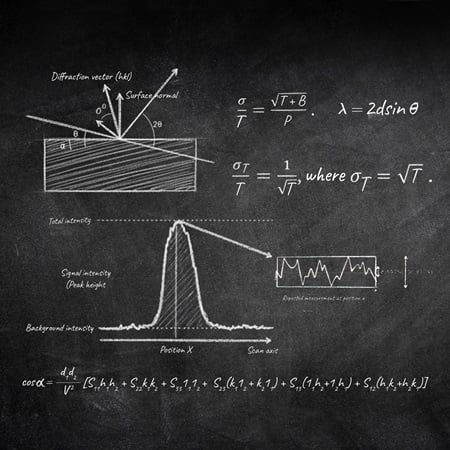
Peak-to-background and signal-to-noise ratio

Determine X-ray signal quality by calculating signal intensity, peak-to-background ratio, and relative standard deviations for both total and peak intensities, providing quantitative measures of detection precision and statistical reliability.