
About the calculator
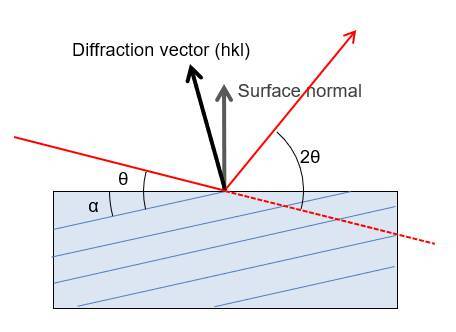
The calculator calculates d-spacings, diffraction angles (2θ), and tilts (α) from the surface of a flat sample for various diffraction indexes (h, k, l) using a given wavelength.
How to use it
- Select an X-ray wavelength
- Enter the lattice parameters
- Enter the surface orientation
- Initialize or manually enter the diffraction indexes
Theory
Variables
| Symbol | Meaning | Units |
|---|---|---|
| λ | X-ray wavelength (selectable) | Å |
| n | Reflection order (integer) | — |
| 2θ | Diffraction angle | degrees |
| θ | Bragg angle | degrees |
| α | Tilt between the sample surface and (h, k, l) plane | degrees |
| d | Interplanar spacing derived from Bragg’s law | Å |
| a, b, c | Lattice parameters | Å |
| α, β, γ | Lattice parameters | degrees |
| h, k, l | Diffraction (Miller) index (integer) | — |
The d spacing is calculated as follows:
\[ \frac{1}{d^2} = \frac{1}{V^2}\Bigl( S_{11}h^2 + S_{22}k^2 + S_{33}l^2 + 2S_{12}\,h k + 2S_{23}\,k l + 2S_{13}\,l h \Bigr) \]
\[ V = a\,b\,c\, \sqrt{\,1 - \cos^2\alpha - \cos^2\beta - \cos^2\gamma + 2\cos\alpha\cos\beta\cos\gamma\,} \]
\[ S_{11} = b^2c^2\,\sin^2\!\alpha \]
\[ S_{22} = a^2c^2\,\sin^2\!\beta \]
\[ S_{33} = a^2b^2\,\sin^2\!\gamma \]
\[ S_{12} = a b c^2\,(\cos\alpha\,\cos\beta - \cos\gamma) \]
\[ S_{23} = a^2 b c\,(\cos\beta\,\cos\gamma - \cos\alpha) \]
\[ S_{13} = a b^2 c\,(\cos\gamma\,\cos\alpha - \cos\beta) \]
\[ n\lambda = 2\,d\,\sin\theta \]
\[ 2\theta = 2\arcsin\!\Bigl(\frac{n\lambda}{2d}\Bigr) \]
The Bragg angle θ and diffraction angle 2θ are calculated from Bragg’s law:
\[ n\lambda = 2d\sin\theta \]
The tilt angle α is calculated as follows:
\[ \cos\alpha = \frac{d_{1}\,d_{2}}{V^{2}} \Bigl[ S_{11}\,h_{1}h_{2} + S_{22}\,k_{1}k_{2} + S_{33}\,l_{1}l_{2} + S_{23}\,(k_{1}l_{2} + k_{2}l_{1}) + S_{13}\,(l_{1}h_{2} + l_{2}h_{1}) + S_{12}\,(h_{1}k_{2} + h_{2}k_{1}) \Bigr] \]
Disclaimer
This calculator assumes monochromatic radiation, perfect optics alignment, and neglects all sample or instrument-related factors, such as refraction, sample displacement, transparency, and defocusing. Always confirm critical parameters through experimental calibration or full instrument modelling. Neither Rigaku nor the authors accepts liability for decisions made solely on these calculated results.