Application Note B-XRD1155
Introduction
Cathode materials for all-solid-state lithium-ion batteries using sulfide-based solid electrolytes usually contain trace amounts of coating components to improve the stability of the interface with the solid electrolyte(1). LiNbO₃, a typical coating component, has different lithium-ion conductivities depending on whether it is amorphous or crystalline, with amorphous materials having higher lithium-ion conductivity. Therefore, evaluating battery properties requires crystalline phase analysis, including that of the coating components. However, it is challenging to detect trace components with X-ray diffraction using a Cu source because the background intensity increases due to fluorescent X-rays from transition metals in the cathode material. The seamless pixel array detector introduced in this study, XSPA-400 ER, has higher energy resolution than conventional detectors, thus reducing the background intensity from fluorescent X-rays. Therefore, it provides data with a high peak-to-background (PB) ratio and highly sensitive detection of the diffraction peaks of trace components. In this study, we used XSPA-400 ER to measure Li(Ni₁/₃Co₁/₃Mn₁/₃)O₂ (hereafter referred to as “NCM111”) coated with LiNbO₃.
Measuremens and results
Fig. 1(a) shows the results of the X-ray diffraction measurement of NCM111 with a small amount of LiNbO₃ coated on the particle surface. The measurement was performed by 1D scan using both the XSPA-400 ER and the conventional 1D detector (D/teX Ultra250). XSPA-400 ER shows lower background intensity than D/teX Ultra250. In addition, the PB ratio calculated from the highest peak of NCM111 measured by XSPA-400 ER was higher than that of D/teX Ultra250. The enlarged image in Fig. 1(b) shows D/teX Ultra250 was unable to clearly detect the small diffraction peak attributed to Li₀.₅₈₅NbO₃ due to the increase in background intensity. On the other hand, XSPA-400 ER observed this peak with good sensitivity. Thus, XSPA-400 ER is the best solution for detecting trace elements in cathode materials due to its high energy resolution, which suppresses the increase in background intensity caused by fluorescent X-rays.
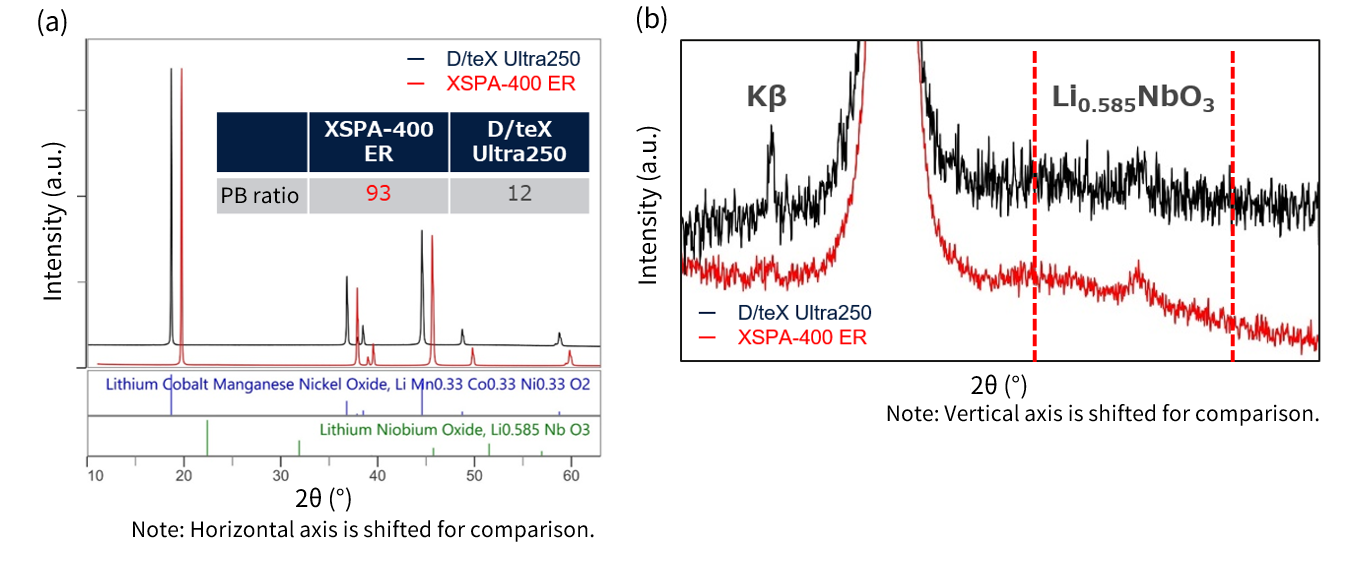
Fig. 1 : Measurement results of Li(Ni₁/₃Co₁/₃Mn₁/₃)O₂ coated with LiNbO₃ obtained by each detector
(a) X-ray diffraction patterns (b) Enlarged view around 2θ = 21°
References:
-
Ionic conductivity of quenched alkali niobate and tantalate glasses (1978) Glass A. M., Nassau K., Negran T. J., J. Appl. Phys. 49(9), 4808–4811.