

Application Note B-XRD1148
Introduction
NCM, a ternary cathode material, is primarily composed of nickel, cobalt, and manganese and is used in lithium-ion batteries (LIBs). The performance of LIBs varies depending on the NCM composition ratio. Thus, developing LIBs with superior characteristics requires the evaluation of many specimens with different composition ratios. In this situation, high-throughput screening tests are useful. Here, we introduce an example of NCM analysis using cluster analysis.
Measurements and results
Samples of NCM with different composition ratios were placed into sample holders and measured with the compact X-ray diffractometer MiniFlex XpC using the para-focusing method. The measurement conditions are as follows: CuKα radiation operated at 40 kV / 20 mA, scan range of 2θ = 10 to 140°, scan speed of 10°/min.
Fig. 1 shows the results of cluster analysis of the X-ray diffraction profiles (dendrogram). The sample names in the figure show the composition ratio of each sample. Cluster analysis allows the classification of similar diffraction patterns, with the degree of similarity displayed as correlation coefficients. The closer the correlation coefficient is to 1, the more similar the diffraction patterns. The correlation coefficient threshold was set between 0.9939 and 0.9989 and, as a result, the X-ray diffraction profiles were divided into three groups, which are classified by their composition.
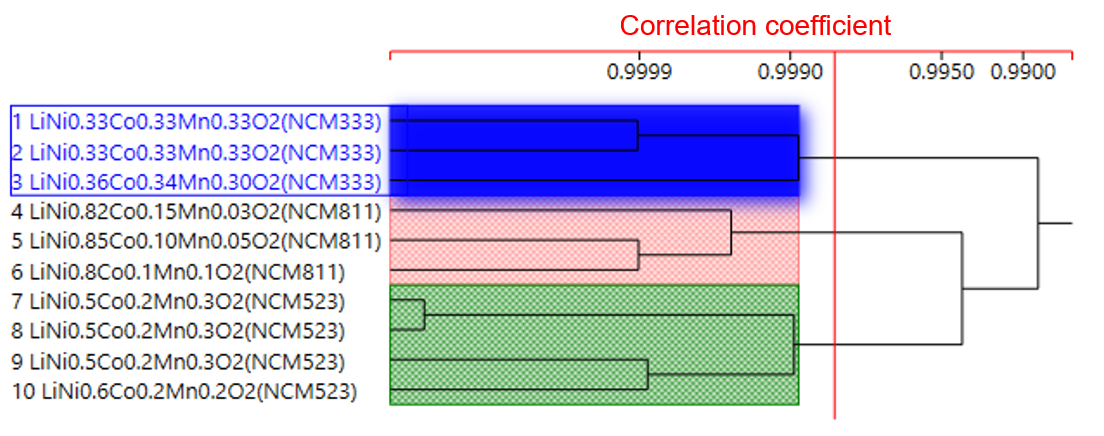
Fig. 1: Cluster analysis results
Fig. 2 shows the NCM lattice constants calculated by the WPPD method. The results showed that NCM811 and NCM523 have long a-axes and NCM333 and NCM523 have long c-axes. Cluster analysis allows the classification of profiles by composition ratio due to the difference in lattice constants (peak positions).
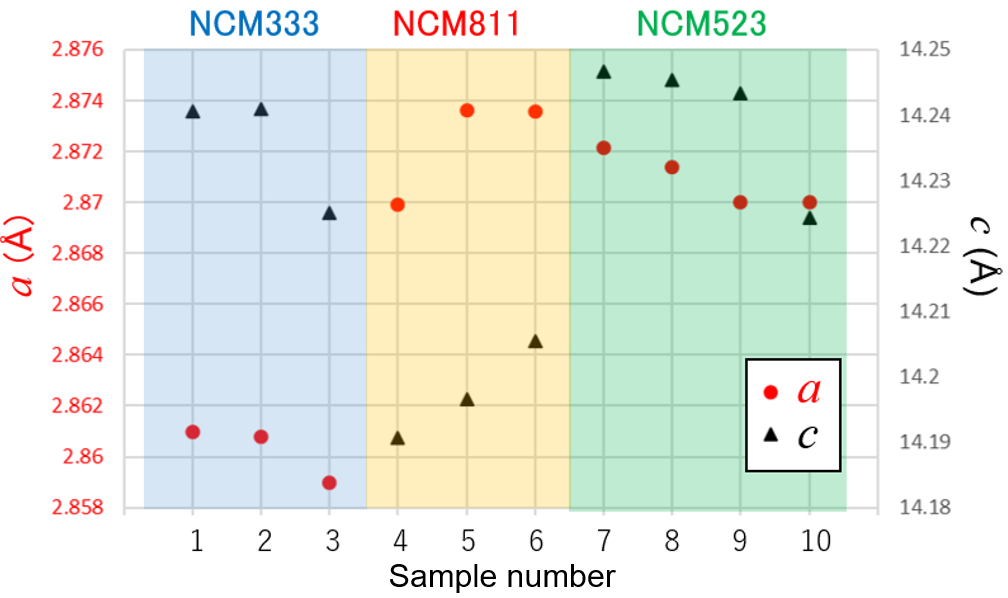
Fig. 2: Lattice constants a and c of NCM with different composition ratios
This example proves that cluster analysis enables quick classification of profiles according to NCM composition ratio without complex operations like those necessary for the WPPD method. This method can extract specimens with different characteristics from many specimens, which makes it useful in the field of quality control and quality assurance (QCQA).
Recommended equipment and software
- Compact X-ray diffractometer MiniFlex XpC + High-resolution and high-speed 1D detector D/teX Ultra250
- Integrated X-ray analysis software SmartLab Studio II (Powder XRD plugin)