
XRD for Chemicals & Polymers

X-ray diffraction and small-angle X-ray scattering (SAXS) provide complementary insight into chemical and polymer materials, linking atomic-scale structure and nanoscale morphology to real-world performance. XRD identifies crystalline phases, measures crystallinity, evaluates crystallite size and strain, and reveals texture or preferred orientation. SAXS extends the analysis to larger structural features such as particle size, pore structure, lamellar spacing, phase separation, fillers, domains, and nanoscale organization. Together, XRD and SAXS help researchers and manufacturers understand how synthesis, formulation, processing, and aging affect material behavior.

Rigaku X-ray diffraction and scattering solutions support chemistry and polymer workflows from routine phase identification and QC to advanced R&D involving crystallinity, morphology, thin films, coatings, catalysts, nanomaterials, and polymer structure-property relationships.

WU_26_XRDIndustryImages_CHEMISTRY_POLYMERS_12121431324

Connecting structure to performance in chemistry and polymer materials

 In chemical and polymer development, performance depends on both what phases are present and how those phases are organized. Crystal form, phase purity, crystallinity, particle size, pore structure, orientation, filler dispersion, lamellar structure, and nanoscale phase separation can all affect reactivity, strength, flexibility, barrier performance, thermal behavior, optical properties, chemical resistance, processability, and long-term stability. XRD and SAXS help reveal these structural details and track how they change during synthesis, compounding, extrusion, molding, annealing, coating, storage, or use. 

  • Chemical phase identification:  Use XRD to identify crystalline phases in catalysts, inorganic chemicals, specialty materials, pigments, fillers, salts, reaction products, and intermediates. This helps confirm successful synthesis, detect unwanted byproducts, and compare material lots. 
  • Quantitative phase analysis:  Measure phase composition in multiphase chemical systems using XRD methods such as Rietveld refinement. This is useful for catalyst materials, inorganic compounds, ceramic precursors, mineral-based additives, and process-development samples. 
  • Polymer crystallinity analysis:  Use XRD to measure percent crystallinity in semicrystalline polymers such as polyethylene, polypropylene, PET, PEEK, nylon, and fluoropolymers. Crystallinity affects stiffness, strength, barrier performance, chemical resistance, shrinkage, dimensional stability, and thermal behavior. 
  • Nanostructure and morphology analysis: Use SAXS to characterize nanoscale features in polymers, block copolymers, nanoparticles, colloids, porous materials, gels, membranes, and composites. SAXS can provide information about particle size distributions, pore size, domain spacing, lamellar structure, and phase separation.
  • Lamellar and long-period structure: Apply SAXS to semicrystalline polymers to evaluate lamellar spacing, long-period structure, and changes caused by processing, drawing, annealing, or thermal history. This helps connect polymer morphology with mechanical and thermal properties.
  • Filler and additive dispersion: Use SAXS to study nanoparticle dispersion, agglomeration, and structure in filled polymers, elastomers, nanocomposites, coatings, and adhesives. These measurements can help explain changes in modulus, toughness, conductivity, barrier performance, and aging behavior.
  • Orientation and texture analysis:  Use XRD and SAXS to evaluate preferred orientation in polymer films, fibers, molded parts, coatings, and composites. These methods can show how extrusion, stretching, rolling, annealing, and molding influence crystalline alignment and nanoscale morphology. 
  • Thermal and environmental studies:  Use non-ambient XRD and SAXS to monitor crystallization, melting, phase transitions, oxidation, degradation, dehydration, structural relaxation, and morphology changes under controlled temperature, humidity, or atmosphere. 
  • Catalyst and functional material research:  Characterize catalyst phases, supports, nanoparticles, zeolites, metal-organic frameworks, membranes, porous materials, and other advanced chemical materials where atomic structure and nanoscale organization both influence performance. 
  • Thin films and coatings:  Analyze polymer coatings, hybrid organic-inorganic films, deposited chemical layers, and surface-treated materials using XRD, grazing incidence diffraction, and grazing incidence SAXS methods. 

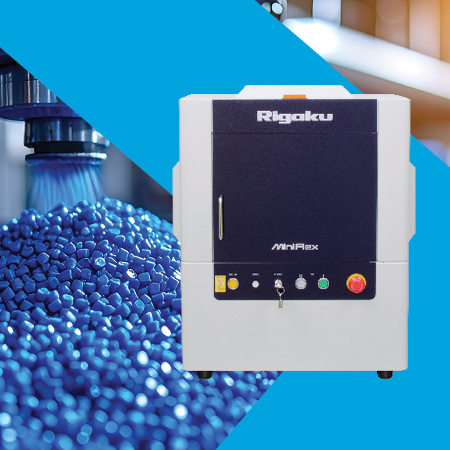
For routine chemistry and polymer analysis, MiniFlex provides benchtop XRD capabilities for phase identification, phase quantification, crystallinity, crystallite size and strain, lattice parameter refinement, and Rietveld analysis. For high-throughput or production-focused quality control, MiniFlex XpC can support fast, repeatable powder diffraction workflows where consistent material verification is needed. For advanced chemical, polymer, coating, and thin film research, SmartLab and SmartLab SE offer expanded XRD and scattering capabilities, including powder diffraction, SAXS, grazing incidence methods, non-ambient measurements, and texture/orientation analysis. 

Application notes

Recommended products

Subscribe to the Bridge newsletter

Stay up to date with materials analysis news and upcoming conferences, webinars and podcasts, as well as learning new analytical techniques and applications.
Contact Us

Whether you're interested in getting a quote, want a demo, need technical support, or simply have a question, we're here to help.