XRD for Pharmaceuticals

 X-ray diffraction (XRD) plays a central role in pharmaceutical development and quality control by linking solid-form structure to drug performance, stability, manufacturability, and regulatory confidence. From early API screening to finished dosage form analysis, XRD helps identify polymorphs, salts, cocrystals, hydrates, solvates, crystalline impurities, and amorphous content. Rigaku XRD solutions support pharmaceutical workflows ranging from routine powder analysis to advanced crystal structure determination and regulated QC environments. XRD for pharmaceutical analysis is important for elemental analysis, phase analysis, and molecular structure, supporting drug discovery and quality control. 
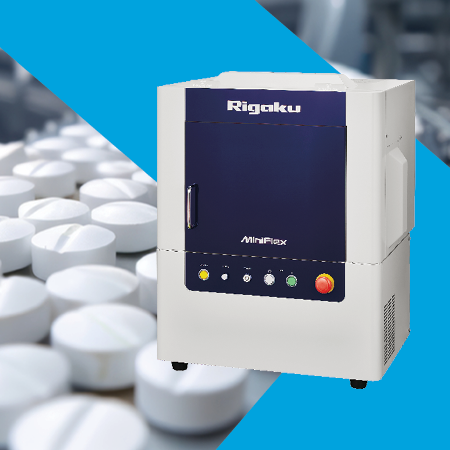
WU_26_XRDIndustryImages_PHARMA_12121431324

Supporting pharmaceutical development through XRD analysis

XRD provides direct structural information that cannot be obtained from chemistry alone. In pharmaceuticals, the same molecule can exist in multiple solid forms, and those forms can behave differently in solubility, dissolution rate, bioavailability, stability, compressibility, and processability. Powder XRD is especially useful because it can distinguish crystalline phases by their diffraction patterns and support both qualitative and quantitative solid-form analysis.

  • Polymorph screening and identification: Identify and compare crystalline forms of APIs, salts, cocrystals, hydrates, and solvates. Powder XRD is a method for evaluating polymorphic forms, where a single API can exhibit multiple crystal structures.

  • Crystallinity and amorphous content: Measure percent crystallinity and detect amorphous conversion caused by milling, spray drying, granulation, tableting, storage, or formulation changes. This is important for stability studies, formulation development, and process monitoring.
  • API and excipient compatibility: Evaluate whether formulation steps introduce phase changes, unwanted reactions, hydration/dehydration, or conversion between solid forms in API–excipient blends.
  • Finished dosage form analysis: Confirm the solid form of the API in tablets, capsules, powders, and intermediate blends; detect crystalline impurities; and support investigations when dissolution, potency, or stability results shift unexpectedly.
  • Process development and scale-up: Track how crystallization, drying, micronization, blending, compaction, and storage affect crystalline phase composition and material behavior. XRD helps bridge lab-scale solid-form selection with manufacturing-scale control.
  • Regulated quality control: Use repeatable diffraction methods for identity testing, phase purity, crystallinity, and batch-to-batch consistency. XRD is a non-destructive tool for analyzing amorphous, powder, and crystalline materials across research, production, and quality control.

For routine pharmaceutical powder diffraction, the MiniFlex benchtop XRD system is capable of phase identification and quantification, percent crystallinity, crystallite size and strain, lattice parameter refinement, Rietveld refinement, and molecular structure analysis. For production-oriented QC, MiniFlex XpC is relevant where fast, accurate powder diffraction measurements and simplified QC workflows are needed on or near the manufacturing floor. For advanced pharmaceutical R&D, SmartLab supports powder diffraction, SAXS, thin film metrology, in-plane scattering, and operando-style measurements, making it useful for more complex materials characterization and method development.

Application notes

Recommended products

Subscribe to the Bridge newsletter

Stay up to date with materials analysis news and upcoming conferences, webinars and podcasts, as well as learning new analytical techniques and applications.
Contact Us

Whether you're interested in getting a quote, want a demo, need technical support, or simply have a question, we're here to help.