
XRD for Mining and Refining

X-ray diffraction (XRD) helps mining, mineral processing, and refining operations understand the mineralogical composition of ores, concentrates, tailings, slags, process streams, and refined materials. While elemental analysis shows what elements are present, XRD shows which crystalline phases contain those elements. This distinction is essential for ore characterization, process optimization, impurity control, recovery improvement, and final product quality.

Rigaku XRD solutions support mining and refining workflows from routine phase identification and quantitative mineral analysis to advanced R&D, process troubleshooting, and method development.

WU_26_XRDIndustryImages_MINING&REFINING_12121431324

Improving recovery, process control, and product quality through XRD analysis

In mining and refining, material value and processing behavior depend heavily on mineral phase composition. Two samples with similar elemental chemistry can behave very differently depending on which minerals are present, how crystalline they are, and whether problematic phases are present. XRD provides direct mineralogical insight that can help improve decisions across exploration, beneficiation, extraction, refining, waste management, and quality control.

  • Ore characterization: Identify major, minor, and trace crystalline phases in raw ore samples to understand mineral associations, ore variability, gangue composition, and processing behavior.
  • Quantitative mineral analysis: Use XRD with Rietveld refinement to quantify mineral phases in ores, concentrates, tailings, slags, and process materials. This supports grade control, feed blending, metallurgical accounting, and recovery optimization.
  • Beneficiation and concentration: Monitor mineral phase changes through crushing, grinding, flotation, magnetic separation, leaching, and other beneficiation steps. XRD helps determine whether valuable minerals are being concentrated efficiently or lost to tailings.
  • Gangue and deleterious phase identification: Detect and quantify minerals that can negatively affect processing, including clays, carbonates, sulfates, oxides, silicates, and other gangue phases that influence reagent consumption, slurry behavior, acid consumption, scale formation, or downstream refining.
  • Tailings and waste analysis: Characterize tailings, waste rock, slags, and residues to support recovery studies, environmental monitoring, acid mine drainage assessment, reuse opportunities, and long-term storage decisions.
  • Refining and process troubleshooting: Analyze intermediate and final products from hydrometallurgical, pyrometallurgical, and chemical refining processes. XRD can identify unwanted crystalline byproducts, precipitates, scale, corrosion products, refractory phases, and incomplete reaction products.
  • Lithium, battery metals, and critical minerals: Characterize spodumene, lepidolite, brines-derived precipitates, nickel, cobalt, manganese, rare earth minerals, graphite, and other critical mineral streams. XRD supports phase identification, impurity tracking, conversion monitoring, and process optimization for battery-material supply chains.
  • Industrial minerals and final products: Verify mineral phases in products such as cement raw materials, limestone, gypsum, silica, alumina, graphite, talc, kaolin, feldspar, zircon, titanium minerals, and other refined mineral products where phase purity and consistency affect commercial value.

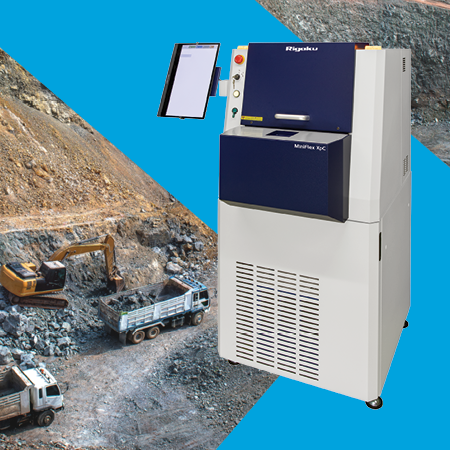
For routine mining and refining analysis, MiniFlex provides benchtop XRD capabilities for phase identification, phase quantification, crystallinity, crystallite size and strain, lattice parameter refinement, and Rietveld analysis. For production-focused environments, MiniFlex XpC supports fast, repeatable powder diffraction workflows where consistent mineralogical verification is needed. For advanced mineralogy, process research, and complex materials characterization, SmartLab and SmartLab SE offer expanded XRD capabilities, including high-resolution powder diffraction, non-ambient measurements, texture/orientation analysis, and flexible method development.

Application notes

Recommended products

Subscribe to the Bridge newsletter

Stay up to date with materials analysis news and upcoming conferences, webinars and podcasts, as well as learning new analytical techniques and applications.
Contact Us

Whether you're interested in getting a quote, want a demo, need technical support, or simply have a question, we're here to help.