XRD for Metals and Alloys
X-ray diffraction (XRD) helps metals producers, alloy developers, and manufacturers understand how crystalline structure affects strength, hardness, fatigue resistance, corrosion behavior, formability, thermal stability, and product reliability. While chemical analysis shows which elements are present, XRD shows which crystalline phases are present, how those phases are arranged, and how processing changes the material. This makes XRD valuable for alloy development, heat treatment optimization, failure analysis, residual stress measurement, texture analysis, and production quality control.
Rigaku XRD solutions and dedicated residual stress analyzers support metals and alloys workflows from routine phase identification to advanced crystallographic analysis, stress measurement, and process troubleshooting.
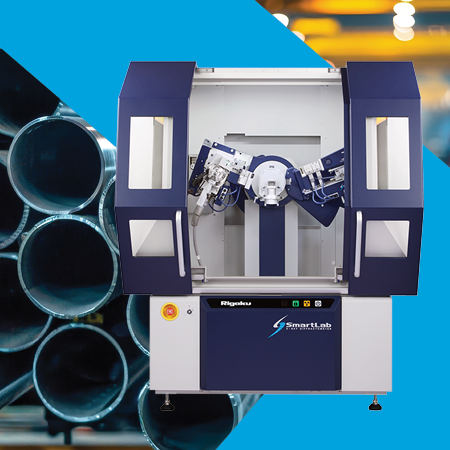
Connecting crystal structure to metals performance
In metals and alloys, performance is strongly controlled by phase composition, microstructure, residual stress, crystallographic texture, and surface condition. XRD provides direct structural information that helps connect casting, rolling, forging, additive manufacturing, welding, machining, heat treatment, coating, and service exposure to final material properties.
- Phase identification: Identify crystalline phases in steels, aluminum alloys, titanium alloys, nickel superalloys, copper alloys, refractory metals, solders, brazes, and specialty alloys. XRD can help confirm expected phases and detect unwanted intermetallics, oxides, carbides, nitrides, or transformation products.
- Quantitative phase analysis: Measure phase fractions in multiphase alloys using XRD methods such as Rietveld refinement. This is useful for monitoring retained austenite, ferrite, martensite, carbides, precipitates, intermetallics, and oxide phases.
- Residual stress analysis: Measure residual stress introduced by welding, machining, grinding, shot peening, additive manufacturing, forming, coating, or heat treatment. Residual stress data can help explain cracking, distortion, fatigue behavior, dimensional instability, and premature failure.
- Texture and preferred orientation: Evaluate crystallographic texture in rolled sheet, forged parts, wires, foils, coatings, and additively manufactured components. Texture analysis helps explain anisotropic mechanical behavior, formability, magnetic properties, and performance variation by direction.
- Heat treatment and phase transformation studies: Track phase changes caused by annealing, quenching, tempering, aging, solution treatment, carburizing, nitriding, oxidation, or thermal cycling. XRD can help optimize processing conditions and verify transformation behavior.
- Additive manufacturing analysis: Characterize phase composition, residual stress, texture, and process-induced structural variation in metal AM parts. XRD supports powder qualification, printed-part evaluation, parameter development, stress-relief studies, and failure investigations.
- Corrosion, oxidation, and surface analysis: Identify corrosion products, oxide scales, passivation layers, nitrides, carbides, and surface reaction products. Grazing incidence XRD can improve sensitivity to thin surface layers and coatings.
- Coatings and thin films: Analyze hard coatings, thermal barrier coatings, protective layers, metal films, diffusion coatings, and surface-treated materials. XRD supports phase identification, texture evaluation, stress analysis, and thickness-sensitive surface measurements.
- Failure analysis and troubleshooting: Compare failed and non-failed parts to identify unexpected phases, retained stress, oxidation products, transformation behavior, or processing-related differences that may contribute to cracking, wear, corrosion, or deformation.
For routine metals and alloy analysis, MiniFlex provides benchtop XRD capabilities for phase identification, phase quantification, crystallite size and strain, lattice parameter refinement, and Rietveld analysis. For production-focused quality control, MiniFlex XpC supports fast, repeatable powder diffraction workflows where consistent phase verification is needed. For advanced metals research, thin films, coatings, residual stress, texture, and non-ambient studies, SmartLab and SmartLab SE provide flexible XRD capabilities for detailed crystallographic characterization and method development. Dedicated residual stress systems are especially relevant where fast, targeted stress measurement is needed for manufactured parts, welded structures, machined components, and additively manufactured metals.
Recommended products
Subscribe to the Bridge newsletter
Stay up to date with materials analysis news and upcoming conferences, webinars and podcasts, as well as learning new analytical techniques and applications.
Contact Us
Whether you're interested in getting a quote, want a demo, need technical support, or simply have a question, we're here to help.