XRD for Environment
X-ray diffraction (XRD) helps environmental laboratories, researchers, and remediation teams identify the crystalline phases present in soils, sediments, dusts, aerosols, industrial residues, ash, sludge, scale, corrosion products, and contaminated materials. While elemental analysis shows which elements are present, XRD shows which mineral or crystalline compounds contain those elements. This distinction is important because environmental behavior depends heavily on phase form, not just chemistry. Mobility, toxicity, solubility, persistence, reactivity, and treatability can all change depending on the mineral phase present.
Rigaku XRD solutions support environmental workflows from routine mineral identification and contamination screening to advanced research, remediation studies, and process troubleshooting.
Understanding environmental materials through phase analysis
Environmental samples are often complex mixtures of natural minerals, anthropogenic particles, weathering products, reaction byproducts, and amorphous material. XRD provides direct structural information that helps identify these materials, track transformation pathways, and support decisions in monitoring, remediation, reuse, and regulatory investigations.
- Soil and sediment mineralogy: Identify and quantify minerals in soils, sediments, clays, and weathered materials. XRD helps characterize quartz, feldspars, carbonates, sulfates, oxides, hydroxides, clay minerals, and other phases that influence contaminant retention, pH buffering, permeability, and long-term stability.
- Contaminated site assessment: Determine the crystalline form of contaminants or contaminant-bearing phases in impacted soils, mine waste, industrial residues, and sediments. XRD can help distinguish between relatively stable minerals and more soluble or reactive phases that may require different remediation strategies.
- Asbestos and hazardous mineral identification: Identify regulated or hazardous crystalline minerals in environmental and industrial samples, including asbestos-form minerals, silica polymorphs, and other respirable mineral dusts. XRD supports screening, confirmation, and method development for occupational and environmental monitoring.
- Mine waste and acid drainage studies: Characterize tailings, waste rock, acid-generating sulfides, secondary sulfates, iron oxides, hydroxides, and neutralizing carbonate phases. This information supports acid mine drainage prediction, waste management, stabilization, and recovery studies.
- Fly ash, slag, and combustion residues: Analyze crystalline phases in coal ash, biomass ash, incinerator ash, metallurgical slags, and other industrial byproducts. XRD supports beneficial reuse studies, leaching investigations, cementitious applications, and waste classification.
- Water treatment and scale analysis: Identify mineral scale, corrosion products, precipitates, and treatment byproducts from water systems, desalination, wastewater treatment, cooling towers, pipelines, and industrial process streams. XRD can help determine whether deposits are carbonates, sulfates, oxides, hydroxides, phosphates, or mixed phases.
- Airborne particulate and dust analysis: Characterize crystalline phases in dust, aerosols, filter residues, workplace samples, wildfire ash, road dust, and industrial emissions. Phase identification can help source particles, assess exposure concerns, and distinguish natural mineral dust from process-derived material.
- Remediation and stabilization studies: Track phase changes during soil washing, neutralization, solidification/stabilization, thermal treatment, oxidation-reduction treatment, and mineral-based remediation. XRD helps confirm whether treatment converts contaminants into more stable, less soluble, or less bioavailable forms.
- Environmental materials research: Study clays, zeolites, biochar-mineral composites, sorbents, catalysts, membranes, photocatalysts, and other materials used for pollutant removal, carbon capture, water purification, and resource recovery.
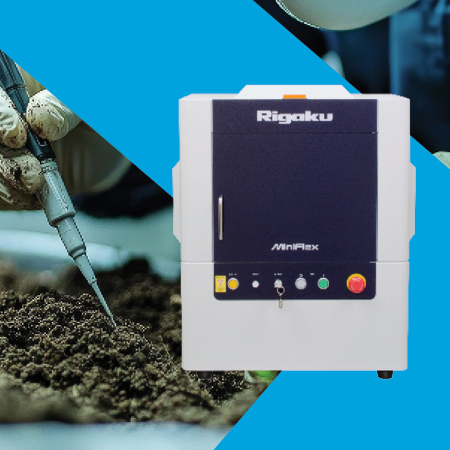
For routine environmental analysis, MiniFlex provides benchtop XRD capabilities for phase identification, phase quantification, percent crystallinity, crystallite size and strain, lattice parameter refinement, and Rietveld analysis. For production-style or high-throughput environmental QC, MiniFlex XpC supports fast, repeatable powder diffraction workflows where consistent phase verification is needed. For advanced environmental research, complex mineralogy, thin deposits, filters, non-ambient studies, and method development, SmartLab and SmartLab SE provide expanded XRD capabilities, including high-resolution powder diffraction, grazing incidence methods, non-ambient measurements, texture/orientation analysis, and flexible sample-stage options.
Recommended products
Subscribe to the Bridge newsletter
Stay up to date with materials analysis news and upcoming conferences, webinars and podcasts, as well as learning new analytical techniques and applications.
Contact Us
Whether you're interested in getting a quote, want a demo, need technical support, or simply have a question, we're here to help.