XRD for Cement

 X-ray diffraction (XRD) is a critical tool for controlling cement quality from raw materials through clinker production and finished cement. By identifying and quantifying crystalline phases, XRD helps cement producers monitor clinker mineralogy, optimize kiln performance, evaluate supplementary cementitious materials, and confirm product consistency. Rigaku XRD solutions support both routine plant quality control and advanced cement materials research. Rigaku specifically positions turnkey X-ray analysis solutions for cement, supporting fast, accurate, and reproducible analysis across the production process. 
WU_26_XRDIndustryImages_CEMENT_12121431324

Improving cement quality through XRD analysis

XRD provides direct mineralogical information that complements elemental analysis by showing what crystalline phases are actually present in raw meal, clinker, cement, SCMs, and hydrated cement systems. In cement production, this is especially important because performance depends not only on chemistry, but also on phase composition, crystallinity, polymorphs, and hydration behavior.

  • Clinker phase analysis: Quantify major clinker phases such as alite, belite, aluminate, and ferrite using Rietveld refinement; monitor free lime, periclase, alkali sulfates, and other minor phases that can affect strength development, setting behavior, and process control.
  • Finished cement quality control: Measure phase composition and crystallinity in final cement products to support lot-to-lot consistency, troubleshoot performance issues, and verify the impact of grinding, blending, and additive changes.
  • Supplementary cementitious materials: Characterize slag, fly ash, calcined clay, limestone, pozzolans, and other SCMs used in lower-clinker cement formulations. XRD with Rietveld refinement and amorphous-content methods can support decarbonization efforts by helping producers manage SCM variability and quantify amorphous/reactive content.
  • Hydration and durability studies: Track the formation and consumption of crystalline hydration products such as portlandite, ettringite, monosulfate, and carbonate-bearing phases to better understand setting, curing, sulfate balance, carbonation, and long-term durability.
  • Process optimization: Use XRD data to support kiln control, clinker quality improvement, raw mix adjustments, and rapid troubleshooting when cement strength, setting time, or consistency shifts unexpectedly. Rigaku notes that XRF and XRD are used in cement plants to analyze raw and alternative materials, raw meal, fuels, clinker, finished cement, and process efficiency.

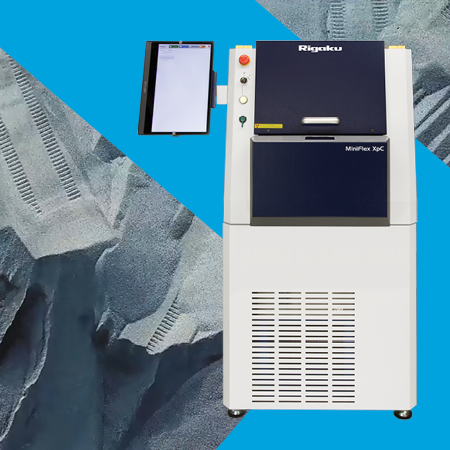
For routine cement plant analysis, MiniFlex XpC combines compact benchtop installation requirements with higher-performance capabilities for clinker applications. For broader powder diffraction work, MiniFlex supports phase identification, quantitative phase analysis, percent crystallinity, crystallite size and strain, lattice parameter refinement, and Rietveld refinement. For advanced cement research, SmartLab and SmartLab SE provide higher-end XRD flexibility for more complex studies, including detailed phase analysis, non-ambient work, and method development.

Application notes

Recommended products

Subscribe to the Bridge newsletter

Stay up to date with materials analysis news and upcoming conferences, webinars and podcasts, as well as learning new analytical techniques and applications.
Contact Us

Whether you're interested in getting a quote, want a demo, need technical support, or simply have a question, we're here to help.