XRD for Batteries

Crystalline structure analysis is essential for understanding battery materials—from electrode powder development to finished-cell performance and failure analysis. X-ray diffraction (XRD) provides non-destructive phase identification, phase quantification, lattice parameter analysis, crystallite size and strain evaluation, and operando measurements that reveal how cathode, anode, electrolyte, and solid-state battery materials change during charge and discharge. Rigaku XRD solutions support battery researchers and manufacturers with flexible tools for R&D, process development, and quality control. 
WU_26_XRDIndustryImages_BATTERY_12121431324

Advancing battery performance through XRD analysis

XRD is widely used across battery research, production, and failure analysis to connect crystal structure with performance, safety, lifetime, and manufacturability. Rigaku systems support routine powder diffraction, advanced in situ and operando measurements, and analysis of assembled cells using purpose-built battery stages for coin cells, pouch/laminate cells, and self-assembled cells.

  • Battery material powder analysis: Identify and quantify crystalline phases in cathode, anode, solid electrolyte, and precursor powders; monitor impurity phases; evaluate crystallinity, lattice parameters, crystallite size, and strain.
  • Electrode and cell development: Study structural changes in active materials during cycling, including phase transitions, lattice expansion/contraction, degradation pathways, and state-of-charge dependent behavior.
  • Operando and in situ battery analysis: Use specialized battery stages to observe structural evolution during charge/discharge without disassembling the cell.
  • Solid-state battery research: Characterize crystalline and amorphous components in solid electrolytes and electrode/electrolyte interfaces to support materials selection, stability studies, and performance optimization.
  • Quality control and production support: Use compact XRD systems such as MiniFlex or production-oriented systems such as MiniFlex XpC for fast, repeatable phase analysis of incoming materials, intermediates, and finished electrode materials.

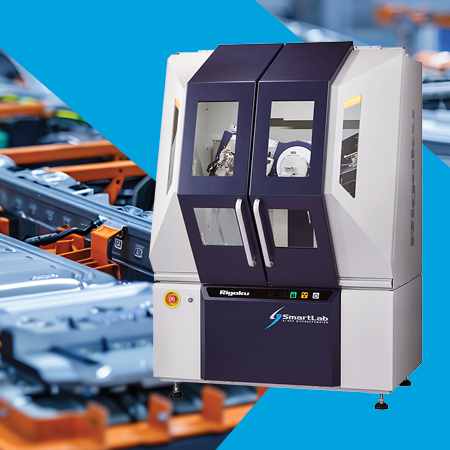
For higher-end battery R&D, SmartLab and SmartLab SE provide multipurpose XRD capabilities for powder diffraction, thin film diffraction, SAXS, non-ambient measurements, and operando studies. For routine battery material characterization and QC, MiniFlex offers benchtop powder XRD capabilities including phase identification, phase quantification, crystallinity, crystallite size/strain, lattice parameter refinement, and Rietveld refinement. For manufacturing environments, MiniFlex XpC is designed for fast, accurate quality control measurements with automation-friendly sample handling.

Application notes

Recommended products

Contact Us

Whether you're interested in getting a quote, want a demo, need technical support, or simply have a question, we're here to help.