


Application Note B-TA1074
Introduction
Fibers include natural fibers derived from plants and animals, as well as chemically synthesized fibers. To evaluate the mechanical durability of these fibers when used in clothing and related applications, the dependence of the expansion and shrinking behavior on the change in applied load was investigated.
Measurement and analysis example
Sheet samples of cotton, polyester, and rayon with 0.2 mm thickness were cut to a width of 5 mm and a length of 15 mm and maintained at a temperature of 22 °C. The tensile load was increased and decreased stepwise from 20 mN to 300 mN, held for 10 min at each load, and the expansion and shrinking responses were measured.
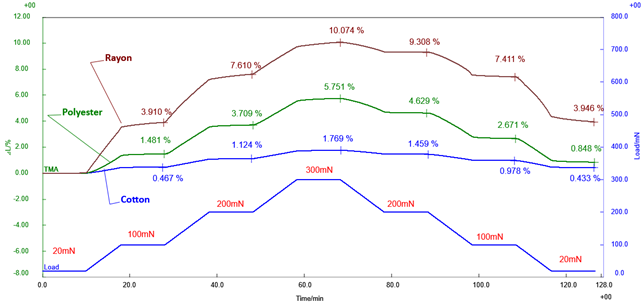
Figure 1: TMA measurement results
The table below compares the expansion rates (%) of the fiber samples under each load, with the expansion value based on 20mN.
| 20mN | 100mN | 200mN | 300mN | 200mN | 100mN | 20mN | |
| Cotton | 0 | 0.47 | 1.12 | 1.77 | 1.46 | 0.98 | 0.43 |
| Polyester | 0 | 1.48 | 3.71 | 5.75 | 4.63 | 2.67 | 0.8 |
| Rayon | 0 | 3.91 | 7.61 | 10.07 | 9.31 | 7.41 | 3.95 |
For all fibers, expansion was observed with increasing load. The expansion ratio at each load increased in the order of cotton, polyester, and rayon, indicating clear differences among fiber types. With rayon, which has a high expansion rate, a creep phenomenon was observed, whereby expansion progresses over time even under a constant load.
In addition, for all fibers, differences in the expansion ratio were observed during the load-up and load-down processes, even under the same load conditions. This behavior is considered to be similar to plastic deformation, where the fiber does not return to its original state even when the load is downed after it has expanded. This phenomenon was particularly noticeable in rayon.