Application Note B-TA1073
Introduction
Fibers can be classified into natural fibers derived from plants or animals and chemically synthesized fibers. In this study, the combustion characteristics of natural fibers (cotton and linen) and synthetic fibers (acrylic and polyester) were compared using STA.
Measurement and analysis example
As samples, sheets of cotton, linen, acrylic, and polyester were punched out to 4 mm diameter pieces, and approximately 3.5 mg of each was placed in a platinum pan. TG-DTA measurements were carried out in an air atmosphere at a heating rate of 10 °C/min up to the temperature at which the mass loss showed a constant value.
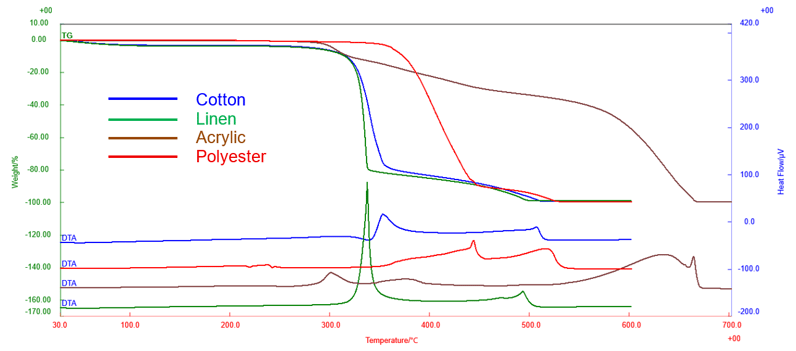
Figure 1: Measurement results of TG-DTA
For the natural fibers, cotton and linen, a mass loss attributable to dehydration was observed up to around 250 °C, whereas no corresponding mass loss was observed for the synthetic fibers, acrylic and polyester. These results suggest that natural fibers have higher moisture absorption. Cotton and linen exhibited similar thermal decomposition behavior, showing two-step mass loss and continuous exothermic peaks from around 250 °C to 550 °C, with the total mass loss reaching nearly 100%. In the first stage of mass loss (250 °C to 400 °C), linen completed decomposition at a lower temperature than that of cotton and showed a larger exothermic peak, assuming that combustion of linen progresses at a lower temperature.
For polyester, two step mass losses and continuous exothermic peaks were observed in the range of 350°C to 550°C, and the thermal decomposition behavior was shifted to a higher temperature by approximately 100°C compared to cotton and linen.
In contrast, acrylic exhibited thermal decomposition behavior that was significantly different from the other fibers, showing three step mass losses and continuous exothermic peaks between 300°C and 700°C. The mass loss up to around 500°C was small at approximately 38%, suggesting higher thermal stability with higher heat resistance than that of the other fibers.