

Desolvation as a Route to New Crystal Forms in Organic, Inorganic, and Hybrid Materials

In this webinar, we explore how desolvation techniques can be used to generate new crystal forms across a wide range of materials.

Understanding and controlling structural diversity—including polymorphs, solvates, and hydrates—is crucial in crystallography and has major implications for materials science and pharmaceutical development. Desolvation processes such as dehydration provide a powerful pathway to access previously unknown structures and phases.

This session brings together three experts from leading Polish research institutions, combining expertise in organic, inorganic, and hybrid systems, to present real-world examples of desolvation-driven transformations


What You’ll Learn:

  • How desolvation enables discovery of new crystal forms
  • Mechanisms of dehydration-induced structural transformations
  • Differences between SC-to-SC and non-single-crystal processes
  • Applications in organic, inorganic, and hybrid materials
  • Use of SC-XRD, variable-temperature PXRD, and 3D electron diffraction
  • How structural changes affect supramolecular organization and material properties

Meet the Speakers:

Slepokura

Katarzyna Ślepokura
Associate Professor and Head of Crystallography, University of Wrocław
An expert in supramolecular chemistry and phosphorus-based compounds, her research explores how structural variations influence chemical and physical properties in biologically relevant systems.


Kinzhybalo

Vasyl Kinzhybalo
Assistant Professor, Institute of Low Temperature and Structure Research, PAS
His work focuses on structural design and analysis of hypodiphosphates, with particular emphasis on dehydration-driven formation of new solid-state ionic conductors.


Kaszubowski

Oskar Kaszubowski
Ph.D. Candidate, University of Wrocław
Specializing in nucleosides and nucleotides, his research investigates structural transformations and phase behavior in complex organic systems, including pharmaceutical analogues.
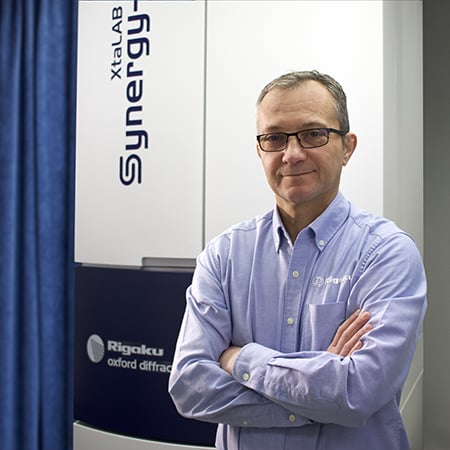

References

J. E. Šponer, J. Šponer, J. Výravský, R. Matyášek, A. Kovařík, W. Dudziak, K. Ślepokura
Crystallization as a selection force at the polymerization of nucleotides in a prebiotic context
iScience 26 (2023) 10760.
https://doi.org/10.1016/j.isci.2023.107600

K. A. Ślepokura'
Purine 3′:5′-cyclic nucleotides with the nucleobase in a syn orientation: cAMP, cGMP and cIMP
Acta Cryst. C 72 (2016) 465-479.
https://doi.org/10.1107/S2053229616006999

O. Kaszubowski, K. Ślepokura
Post-crystallization Rearrangement of Crystal Architecture, Intermolecular Interactions, and Nucleotide Conformation in Adenosine Monophosphates Crystals Induced by Single Crystal-to-Single Crystal Dehydration
Cryst. Growth Des. 25 (2025) 4586-4600.
https://doi.org/10.1021/acs.cgd.5c00490

O. Kaszubowski, K. Ślepokura, K.-N. Truong, J. Wojciechowski
Dehydration as a Preparative Tool in the Crystal Structure Landscape Investigations of Tenofovir
Cryst. Growth Des. 24 (2024) 8516-8527.
https://doi.org/10.1021/acs.cgd.4c01029

V. Kinzhybalo, M. Otręba, K. Ślepokura, T. Lis
Hypodiphosphoric acid and its inorganic salts (in Polish)
Wiad. Chem. 75 (2021) 423-466.
http://yadda.icm.edu.pl/baztech/element/bwmeta1.element.baztech-4009fba6-4e11-4f22-bb50-65d3f10b289a/c/Kinzhybalo_V_Kwas__WCH_3-4_2021.pdf

D. Budzikur, V. Kinzhybalo, K. Ślepokura
Crystal engineering and structural diversity of 2-aminopyridinium hypodiphosphates obtained by crystallization and dehydration
CrystEngComm, 24 (2022) 4417-4429.
https://doi.org/10.1039/D2CE00261B

D. Budzikur-Maciąg, V. Kinzhybalo, K. Ślepokura
Structural variety and dehydration in 3-aminopyridine–hypodiphosphoric acid–water system
CrystEngComm, 25 (2023) 3826-3836.
https://doi.org/10.1039/D3CE00186E

D. Budzikur-Maciąg, V. Kinzhybalo, K. Ślepokura
Structural landscape studies of aminopyridinium hypodiphosphates: dehydration and polymorphism in 4-aminopyridinium salts
CrystEngComm, 26 (2024) 6861-6872.
https://doi.org/10.1039/D4CE01048E

V. Kinzhybalo, J. Wojciechowski, P. Szklarz, A. Piecha-Bisiorek, M. Otręba, M. Siczek, K. Ślepokura
Sodium hypodiphosphate – a new ionic conductor. Synthesis, stability, conductivity and 3D electron diffraction crystal structure
J. Mater. Chem. C, 12 (2024) 11347-11351.
https://doi.org/10.1039/D4TC01216J

M. Otręba, V. Kinzhybalo, A. M. Sokołowska, R. Lipiński, P. Szklarz, A. Piecha-Bisiorek, K. Ślepokura
Dehydration, polymorphism and ionic conductivity of sodium hypodiphosphates
Acta Cryst. B, 82 (2026) 209-223.
https://doi.org/10.1107/S2052520626001514

M. Emami, K. A. Ślepokura, M. Trzebiatowska, N. Noshiranzadeh, V. Kinzhybalo
Oxyanion clusters with antielectrostatic hydrogen bonding (AEHB) in tetraalkylammonium hypodiphosphates
CrystEngComm 20 (2018) 5209–5219.
https://doi.org/10.1039/C8CE00880A

Contact Us

Whether you're interested in getting a quote, want a demo, need technical support, or simply have a question, we're here to help.

Crystallography times editor

Subscribe to the Crystallography Times newsletter

Stay up to date with single crystal analysis news and upcoming events, learn about researchers in the field, new techniques and products, and explore helpful tips.