





CrysAlisPro Tip
Advanced features in GRAL
In most cases, CrysAlisPro automatically determines the correct space group. However, challenging datasets may require the user’s crystallographic expertise. GRAL, the space-group determination module within CrysAlisPro, provides tools for this purpose. You can access GRAL by selecting manual space group determination during data reduction with options, or by enabling it before data refinalization (Figure 1).
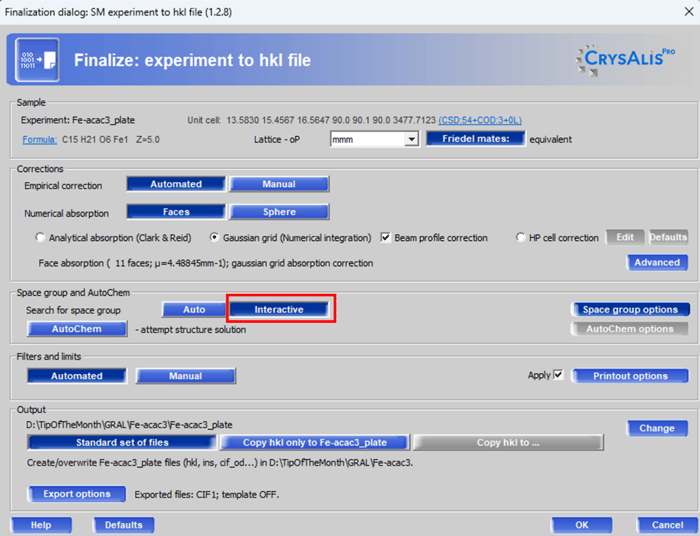
Figure 1: Finalization window. Select “interactive” in the Space group and AutoChem tab to start GRAL after refinalization.
When GRAL launches after data finalization, it first displays the loaded .hkl file. In the Settings tab, you can adjust parameters such as the number of forbidden reflections allowed, the weighting scheme for space group preferences and the error for lattice selection (Figure 2).
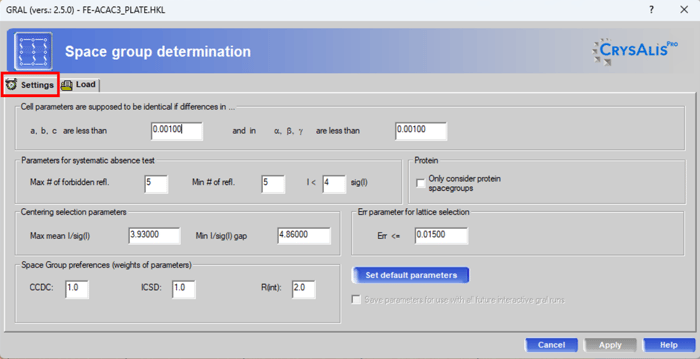
Figure 2: GRAL Settings tab.
Next, select the centering based on the number of lattice exceptions for each option. GRAL will then transform the dataset to the Niggli cell. After this step, you can choose the crystal lattice from either the best matches or the full list of possible lattices (Figure 3). The centering can then be readjusted in the following tab, if needed.
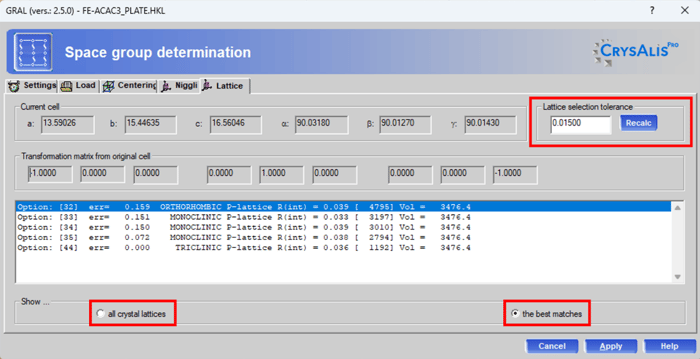
Figure 3: GRAL Lattice tab. The lattice tolerance can be readjusted.
In the next tab, GRAL compares the experimental <E²-1> values with the expected acentric and centric distributions to determine whether the space group is likely centrosymmetric (Figure 4).
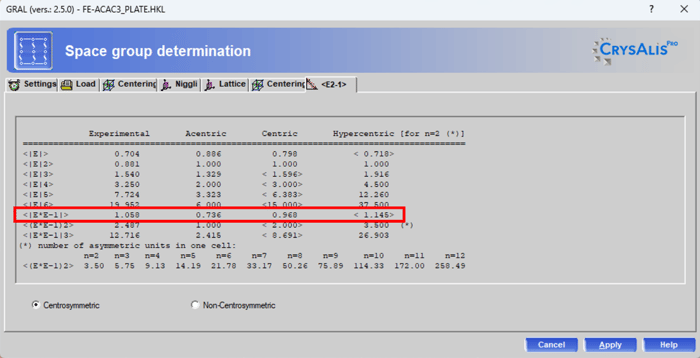
Figure 4: GRAL<E2-1> tab. The closest matches to the experimental values are indicated with <>.
The next tab is Space group selection. Here, systematic absence violations are listed according to both their number and whether their intensities fall below or above 3σ. GRAL suggests the most probable space groups based on the current settings. When the correct choice is not immediately clear, the Advanced space group selection tool can assist (Figure 5).
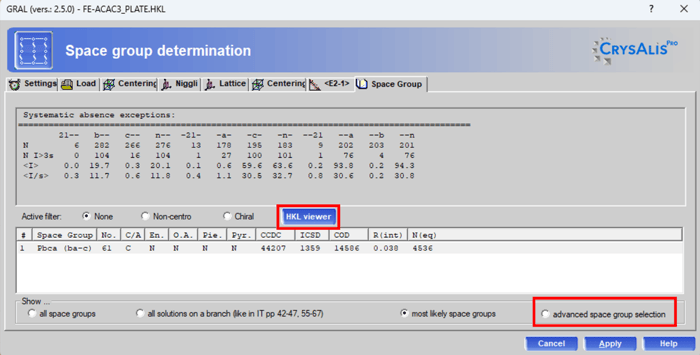
Figure 5: GRAL Space group tab with access to Advanced space group selection and the HKL viewer.
In the Advanced space group selection window, you can evaluate symmetry operations for each axis. GRAL displays all remaining compatible space groups, and the R(int) button calculates R(int) values for these candidates (Figure 6).
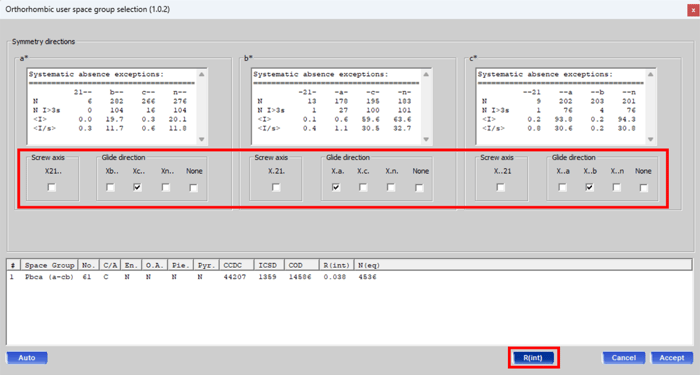
Figure 6: Advanced space group selection window.
For visual inspection of extinction conditions and their exceptions, use the HKL viewer. Selecting a space group overlays its expected systematic absences onto the diffraction data. This can be used to check if they agree with each other. If a space group is already chosen when opening the viewer, its absences automatically appear as red crossed, while violations are shown as yellow, orange or red squares depending on the intensity of the reflections. Different zones can be examined, color-coding thresholds adjusted, and symmetry elements manually toggled (Figure 7).
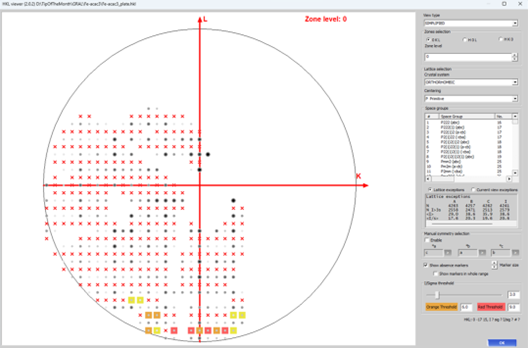
Figure 7: HKL viewer. Systematic absences from different space groups can be overlaid on the experimental diffraction data to assess consistency.
Once the space group selection is finalized and a chemical composition has been entered, the .ins file can be generated in the Ins-file tab.
Author

Rigaku Europe SE | Darmstadt, Hesse, Germany
Dr. Emilia Buchsteiner studied Geosciences at Albert-Ludwigs-University of Freiburg and completed her PhD in Geoscience at TU Darmstadt under the supervision of Prof. Dr. Ute Kolb. Throughout this time, Emilia specialized in electron crystallography, building extensive experience with three-dimensional electron diffraction. Her research has centered on the structural characterization of complex inorganic and mineral crystal structures using advanced electron-diffraction-based methods. In 2023, Emilia joined Rigaku as an Application Scientist, supporting the EMEA region in the fields of single crystal X-ray diffraction and electron diffraction. Want to learn more? Connect with Emilia Buchsteiner, PhD LinkedIn .
Subscribe to the Crystallography Times newsletter
Stay up to date with single crystal analysis news and upcoming events, learn about researchers in the field, new techniques and products, and explore helpful tips.
Contact Us
Whether you're interested in getting a quote, want a demo, need technical support, or simply have a question, we're here to help.