





CrysAlisPro Tip
Frame Masking Tools
What is the issue?
Certain areas of diffraction images can sometimes be masked to improve data analysis. Diffraction images from high-pressure experiments may exhibit features of the diamond anvil or the gasket material, which could hamper determination of the unit cell. Another case is when area detectors exhibit untreated bad pixels, which may happen, for example, in foreign datasets from synchrotrons.
How to apply masks
CrysAlisPro allows you to mask rectangular features and ring-based (d-value) features.
Rectangular features:
Drag a box around the feature you want to mask with your mouse by holding down the left mouse button. Click on the right mouse button and select Reject rectangle.
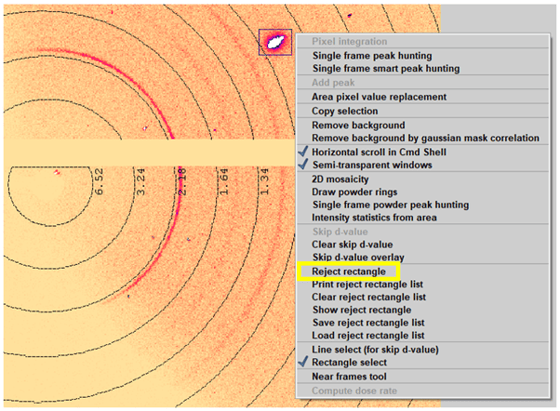
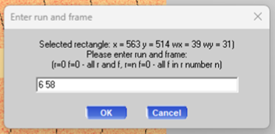
This feature can be used for single images (choose run and frame number) or for the whole dataset (choose run and frame number as zeros).
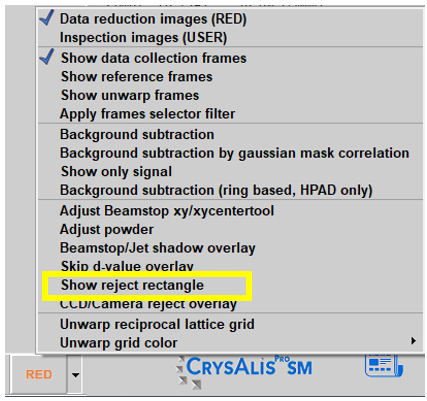
The masked area can be displayed by choosing Show reject rectangle in the submenu next to the RED/USER switch.
Ring-based features:
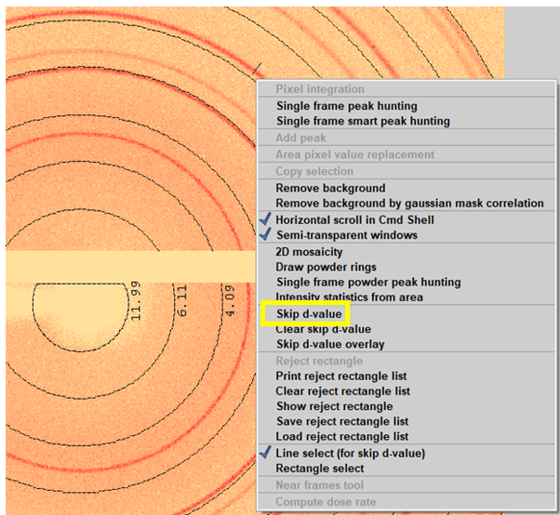
First select the Line select (for skip d-value) via a right mouse button click.
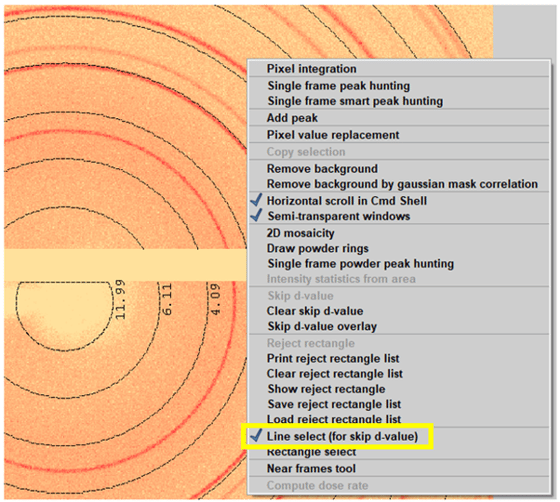
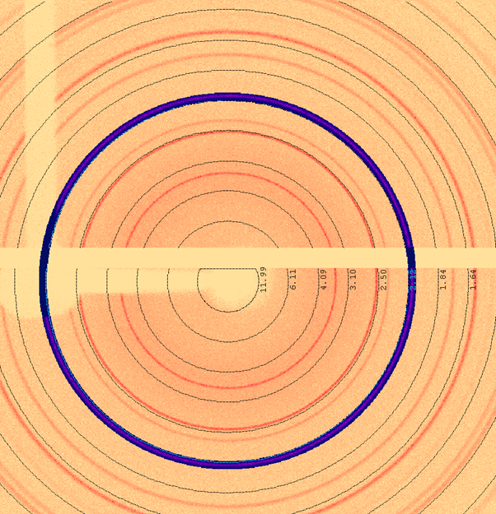
Then the range of d-values which should be excluded from data analysis can be selected on the diffraction image. Click the right mouse button and select Skip d-value.
The masked area can be displayed by choosing Skip d-value overlay in the submenu of RED/USER as before.
Author

Rigaku Asia Pacific PTE LTD | Singapore
Dr. Christian Göb joined Rigaku Europe as an application scientist for single crystal X-ray diffraction in 2019 after completion of his doctorate in synthetic supramolecular inorganic chemistry at RWTH Aachen University. Crystallography was his most valuable tool to determine the structures of his large capsule molecules and coordination polymers (MOFs). During a short research visit at Osaka University, he investigated self assembled molecular monolayer structures on graphite (HOPG) surfaces. After taking responsibility for the application lab in 2021, he works as Business Development Manager for Rigaku Asia Pacific in Singapore since 2025. In his current role he empowers the crystallographic community across the region, covering a broad spectrum of tasks and applications. Want to learn more? Connect with Christian Göb, PhD LinkedIn .
Subscribe to the Crystallography Times newsletter
Stay up to date with single crystal analysis news and upcoming events, learn about researchers in the field, new techniques and products, and explore helpful tips.
Contact Us
Whether you're interested in getting a quote, want a demo, need technical support, or simply have a question, we're here to help.