
CrysAlisPro Tip
The Gnomonic Projection and How to Use It
What is the issue?
During long exposures on weakly scattering samples, inelastic scattering may contribute noticeably to the diffractogram, making unit cell indexing challenging. This scattering may come from the sample holder and oils used to mount the sample or air scattering. Electron diffraction may also exhibit inelastic scattering signals from the carbon support of the TEM grids. A human eye might find periodicity in a crowded reciprocal space more efficiently than a computer algorithm—for now.
How to find the unit cell of the crystal?
In the polar zenithal gnomonic projection, all difference vectors between reflections are calculated, normalized, and projected onto a plane tangential to the Ewald sphere. These difference vectors appear as individual pixels in this projection and a line is formed when these vectors appear in a periodic manner; e.g., they are equally spaced and parallel.
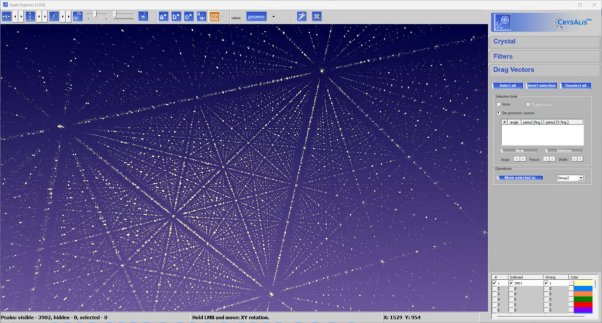
Figure 1:Gnomonic projection of the difference vectors in reciprocal space
The task of the user is now to define three of these lines by choosing “Set gnomonic vectors.” These lines cannot intersect each other at a single point and cannot be parallel. Figure 2 shows a histogram of the chosen reciprocal space direction. The abscissa shows the distance from the origin of reciprocal space and the ordinate shows the frequency at which the projected peaks appear.
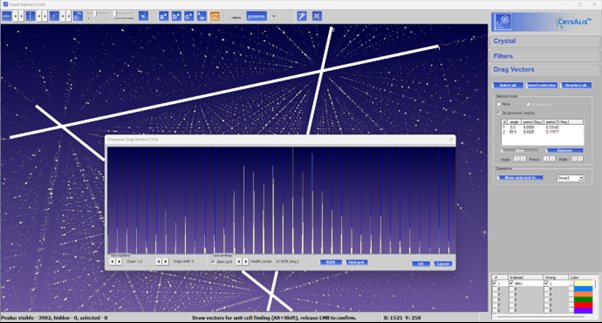
Figure 2: Three independent gnomic vectors set
In the next step, we are presented with the lattice reduction, and we choose the one with the most meaningful G6-projection distance; see Figure 3. Further information can be obtained here: B. Gruber, Acta Cryst. (1973), A29, 433-440.
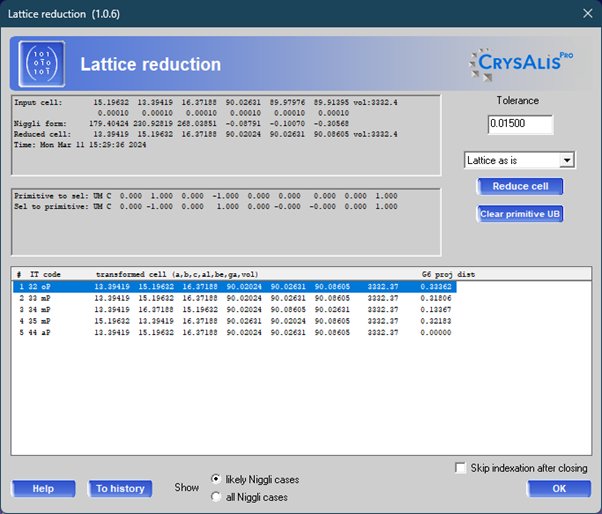
Figure 3: Lattice reduction with the most likely Niggli cases
Acknowledgements
We thank Dr. Wolfgang Herrendorf (Institute of Inorganic and Analytical Chemistry, Justus-Liebig-University Gießen) and STOE & Cie GmbH for the inspiration and fruitful discussions in creating this tool.
Author

Rigaku Asia Pacific PTE LTD | Singapore
Dr. Christian Göb joined Rigaku Europe as an application scientist for single crystal X-ray diffraction in 2019 after completion of his doctorate in synthetic supramolecular inorganic chemistry at RWTH Aachen University. Crystallography was his most valuable tool to determine the structures of his large capsule molecules and coordination polymers (MOFs). During a short research visit at Osaka University, he investigated self assembled molecular monolayer structures on graphite (HOPG) surfaces. After taking responsibility for the application lab in 2021, he works as Business Development Manager for Rigaku Asia Pacific in Singapore since 2025. In his current role he empowers the crystallographic community across the region, covering a broad spectrum of tasks and applications. Want to learn more? Connect with Christian Göb, PhD LinkedIn .

Subscribe to the Crystallography Times newsletter
Stay up to date with single crystal analysis news and upcoming events, learn about researchers in the field, new techniques and products, and explore helpful tips.
Contact Us
Whether you're interested in getting a quote, want a demo, need technical support, or simply have a question, we're here to help.