
XES Chimica
X-ray Emission Spectroscopy (XES) is a technique that enables quantitative analysis of the chemical states of elements. By examining spectral chemical shifts and profile variations, it provides information on valence states and compound forms.
XES is not limited to surface or micro-area analysis, therefore it is effective for evaluating the chemical and valence states of materials as a whole. In addition, XES enables chemical and valence state analysis in a standard laboratory environment without the need to use a synchrotron facility. This means that XES can be used for routine chemical state evaluation in research and development.
Rigaku’s X-ray emission spectrometer, XES Chimica, is equipped with a newly developed optical system that further enhances reproducibility and reliability. The system incorporates automatic spectroscopic crystal exchange, automated sample exchange, and software for quantitative analysis, combining operability with practicality.
XES Chimica supports a wide variety of applications, including battery materials and catalysts.
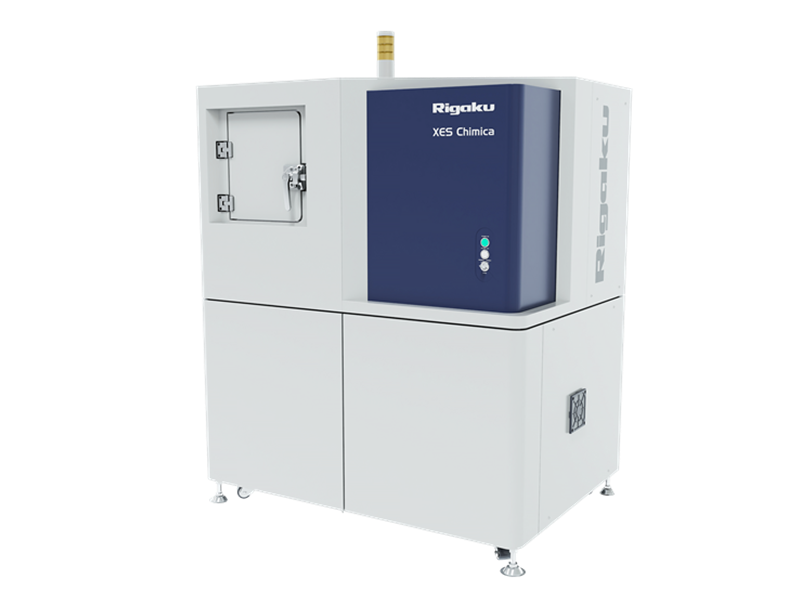
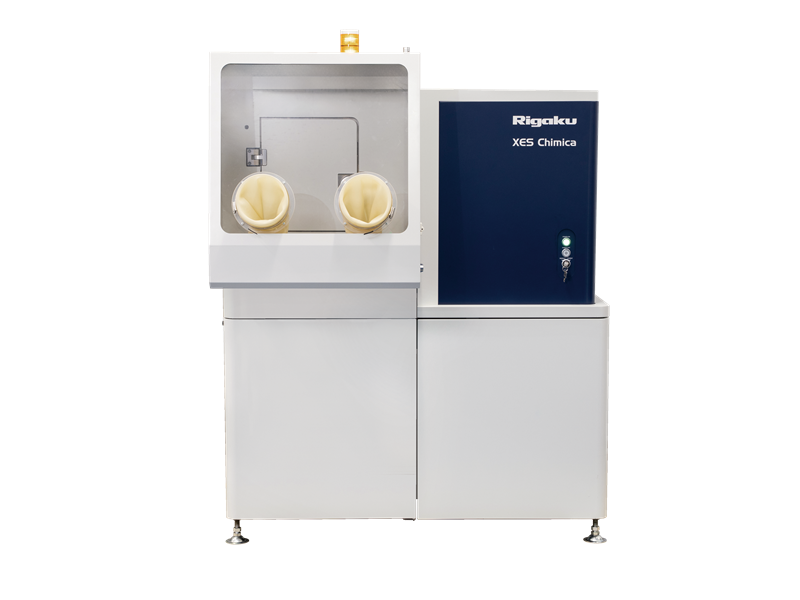
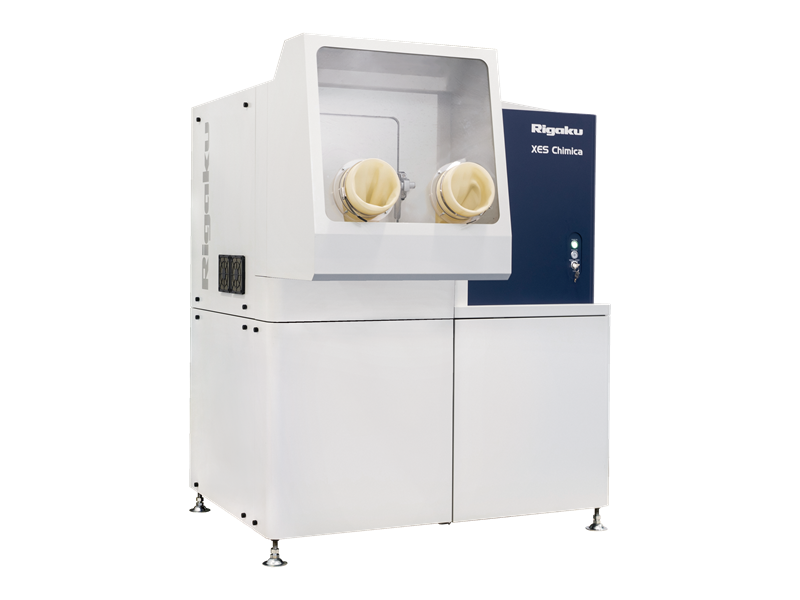
XES Chimica Overview
Easy, quantitative bulk chemical state analysis—anytime, in the laboratory
XES measures fluorescent X-rays with high energy resolution, capturing spectral variations arising from chemical bonding states. By analyzing chemical shifts and profile changes in the acquired spectra, XES enables the determination of valence states, chemical composition, and compound forms of elements.
XES is effective for evaluating the valence states and chemical states of materials as a whole, rather than being limited to surface or micro-area analysis. In addition, XES enables chemical and valence state analysis in the laboratory without the need to use a synchrotron facility.
Designed for high precision and efficiency
XES Chimica is equipped with a newly developed optical system that enhances reproducibility and reliability. The system incorporates automatic spectroscopic crystal exchange, automated sample exchange, and software for quantitative analysis, combining operability with practicality.
Integrated software supports measurement and analysis
Even without specialized knowledge, users can simply select the elements to be measured and the system performs the analysis. The dedicated GUI allows smooth, detailed data analysis.
Automated quantification system
Pre-configured quantitative applications, including measurement conditions, analysis parameters, and calibration curves, allow automatic quantification of analytical results such as valence states and compositional ratios.
This enables quantitative evaluation of changes in chemical states, rather than simply identifying changes in the spectra.
Lithium-ion battery applications
XES is an effective method for quantitatively evaluating changes in the chemical and valence states of lithium-ion battery materials. XES analysis has been applied to a wide range of battery materials, including:
- NCM (Lithium Nickel Cobalt Manganese Oxide) cathodes
- LFP (Lithium Iron Phosphate) cathodes
- Silicon-based anodes
- Lithium–sulfur batteries
- LPS sulfide-based solid electrolytes
XES Chimica Features
XES Chimica Specifications
| X-ray generator | X-ray tube | End window type, Rh target 4 kW |
| Spectrometer | System | Double-crystal spectrometer |
| Angular range (2θ) | 40–148° | |
| Step size | 0.0001, 0.0005, 0.001, 0.002, 0.005, 0.01, 0.05°/step | |
| Crystal exchanger | 3 crystal automatic exchange mechanism | |
| Analyzing crystal | Si (220), Ge (220), Ge (111), InSb (111), ADP (101), (TAP (001): Soft X-ray analysis option) | |
| Analysis area diaphragm | 20, 10 mm in diameter | |
| Measurement Environment | Vacuum | |
| Counting system | Detector | F-PC (Gas flow type proportional counter) SPC LE (Gas shield type proportional counter: No PR gas required) (Optional Features) |
| Sample size | Single-sample holder, 6-sample turret | 50 mm D x 50 mm W x 5 mm H 35 mm D x 35 mm W x 5 mm H |
| Power | 3 phase AC200 V 40A, Single phase AC220–240 V, 40A (Optional Features) Single phase AC100–240 V 15 A (PC) |
|
| Cooling water | Temperature: Lower than 30℃, Pressure: 0.29–0.49 MPa, Flow: More than 5 L/ min, Quality: Equivalent to drinking water | |
| Gas for F-PC | P-10 gas: Ar 90%, Methane 10%, mixture gas Gas pressure: 0.15 MPa, Gas flow: 7 ml/min |
|
| Room temperature | 23–27℃ (with daily variation within ±1 ℃) | |
XES Chimica Application Notes
The following application notes are relevant to this product
-
BATT1020 - Composition analysis of Li/Si Ratio and Silicate in Silicon Based Anodes
-
BATT1019 - Valence Analysis for Ni, Co, and Mn in NCM Cathodes
XES Chimica Resources
Webinars
Visit the Webinar resource page to access Webinars relevant to XES Chimica
Rigaku Journal articles
Visit the Rigaku Journal resource page to access articles relevant to XES Chimica
Publications
Visit the Publication Library to access articles relevant to XES Chimica
Contact Us
Whether you're interested in getting a quote, want a demo, need technical support, or simply have a question, we're here to help.