
Analysis of Hazardous Heavy Elements in Soil and Sediment
This is a written summary of a live webinar presented on April 17, 2024. The recording and resources are available on the recording page.
Presented by:

Webinar summary
The webinar focused on using wavelength dispersive X-ray fluorescence (WDXRF) for analyzing trace heavy metals in environmental matrices like soil and sediment. Although this field can appear highly technical, the session was structured to guide even those with limited familiarity through the principles, practices, and advantages of XRF as an alternative to more chemically intensive techniques such as ICP-OES and ICP-MS.
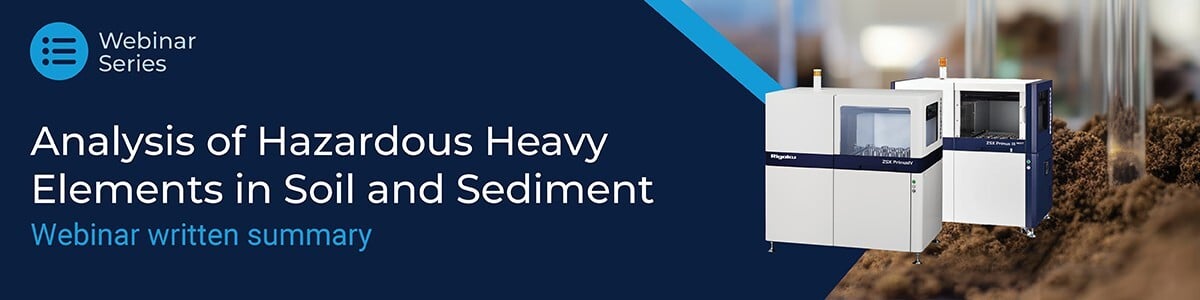
Carmen began by outlining Rigaku’s legacy in X-ray technology, emphasizing their development of robust, high-precision spectrometers including the ZSX Primus IV and ZSX Primus III NEXT, which are designed with the X-ray tube positioned above the sample to mitigate contamination risks from powdered samples. The focus of the presentation was on the company’s geological trace element calibration method, known as the GEO-TRACE-PAK, which comes preconfigured with instrumental conditions, quality control routines, and calibrations based on over 100 certified reference materials. The method is suited for 26 trace elements and nine major/minor oxides commonly found in geological samples.
A centerpiece of the method is the use of a Compton scattering ratio correction, which greatly enhances the accuracy of quantifying trace heavy elements in light matrices like soil and sediment. The technique measures the intensity of a scattered X-ray line (specifically, rhodium Compton scatter) and uses it in conjunction with the intensity of the element of interest to correct for matrix effects, which are distortions in XRF readings caused by the sample’s chemical makeup. This method is especially useful for handling organic-rich, heterogeneous materials where traditional corrections falter.
Through numerous examples and calibration curves, Carmen demonstrated the improved precision and accuracy this method provides for elements like arsenic, chromium, cadmium, and lead. Real-world measurements on certified reference materials showed close alignment with certified values, both with and without the use of binders in sample preparation. This highlighted the ruggedness of the ZSX Primus IV system, which can often skip binder usage without compromising accuracy due to its top-down X-ray tube geometry.
Carmen further addressed the practical side of running a reliable XRF operation. She stressed best practices such as regular preventative maintenance, ongoing verification of calibration via secondary standards, particle size control during sample prep, and the use of drift correction through stable glass standards. She also emphasized the statistical tools available in Rigaku’s ZSX Guidance software, including control charts and built-in quality checks, which allow labs to monitor instrument stability and method performance in real time.
To validate reproducibility across labs, she described an internal round robin test where identically prepared samples were analyzed by multiple laboratories using the same protocol. Results showed that most labs were within acceptable reproducibility limits, but deviations in a few highlighted the importance of rigorous standardization and maintenance.
In closing, Carmen reinforced that WDXRF—when combined with thoughtful calibration strategies, such as the Compton ratio correction—offers a fast, cost-effective, and safe alternative to traditional wet chemistry techniques for assessing hazardous elements in soils and sediments. The approach reduces reliance on chemical reagents, cuts down on sample prep time, and provides high precision and accuracy suitable for environmental monitoring. The session wrapped with a reminder that successful XRF analysis hinges not just on powerful instruments, but on consistent sample prep, method validation, and long-term calibration management.
Key questions answered in the webinar:
-
WDXRF is an analytical technique that uses X-rays to determine the elemental composition of a sample. It’s particularly well-suited for soils and sediments because it can detect a wide range of elements, from light to heavy, across various concentration levels. It’s also non-destructive, requires minimal sample preparation, and avoids hazardous chemicals, making it safer and more efficient than traditional methods like ICP-OES or ICP-MS.
-
GEO-TRACE-PAK is a pre-calibration package established with 101 certified reference materials, designed for pressed powder sample preparation. It calibrates for 26 trace elements and nine major/minor concentrations across various geological materials like sand, limestone, and clay. Its benefits include pre-defined instrumental conditions for immediate use, inclusion of quality control and drift correction samples for method accuracy and stability, and clearly defined sample preparation guidelines. This comprehensive setup ensures consistent and reliable analytical results for a wide range of geological samples.
-
The Compton scattering ratio correction method is a unique correction technique used in Rigaku's XRF software. It involves measuring the Compton scattered X-ray line (specifically the rhodium Kα Compton line) for each standard and ratioing it with the analytical line of the element being measured. This method is crucial because soils and sediments often contain significant organic material, creating a light matrix that can cause errors in conventional matrix correction methods. By using the Compton scattering ratio, the method effectively corrects for matrix effects, significantly improving the accuracy of analytical results, especially for heavy elements in these complex, light matrices.
-
XRF offers several key advantages over traditional methods like ICP-OES/MS for heavy element analysis. Firstly, it mitigates health and safety risks by eliminating the need for tedious and hazardous acid digestions and associated acid storage or fume hoods. Secondly, XRF calibrations can be drift corrected and maintained, removing the need for daily calibrations common with ICP-OES. Thirdly, XRF accommodates larger, more representative sample sizes and has simpler, faster sample preparation, leading to lower statistical error and reduced effort. Finally, XRF has significantly lower running costs due to reduced gas consumption compared to ICP instruments.
-
The ZSX Primus IV is designed with the X-ray tube positioned above the sample, which is a key advantage for pressed powder methods. This design eliminates the risk of powder or cracked material falling onto the X-ray tube, making it a robust industrial unit suitable for geological materials, soils, and sediments. This feature also allows for the analysis of pressed powder samples without the need for a binder, which can introduce dilution and weighing errors, thus further enhancing the accuracy and simplicity of sample preparation. The instrument also supports features like variable vacuum control, powder traps to reduce maintenance, and advanced software for quality monitoring and calibration correction.
-
To ensure consistent and accurate XRF results, several best practices are essential. These include: regularly checking the spectrometer's working condition and detector resolution (e.g., scintillation and flow proportional counters), performing stability checks using stable glass standards to monitor instrument performance, and utilizing built-in statistical process control charts to track the consistency of sample preparation and measurement over time. Additionally, consistent milling and grinding to achieve a particle size less than 45 microns are crucial for pressed powder methods, along with scheduled preventative maintenance for all equipment and regular backups of calibration data.
-
The accuracy and validity of an XRF calibration method are rigorously verified through several processes. This includes utilizing independent certified reference materials (not part of the initial calibration line) to compare analytical results against known standard values, thereby proving the method's accuracy. Additionally, internal round-robin studies, where identical samples are analyzed by different laboratories using the same preparation and calibration methods, assess reproducibility and highlight areas for improvement. Regular monitoring using control charts for both certified and secondary reference materials helps to continuously assess whether results remain within acceptable confidence and conformance limits (e.g., 2σ for warning, 3σ for unacceptable).
-
The key take-home messages are:
- XRF instruments can effectively analyze hazardous heavy elements in soils and sediments without the need for tedious acid digestions.
- Consistent sample preparation, including milling, grinding, and pressing, is paramount for accurate results.
- Utilizing a valid calibration range with a sufficient number of standards is crucial, and adding more standards might be necessary if unknown samples fall outside the established range.
- Continuous verification of the method's accuracy using certified and secondary reference materials is essential for ongoing quality control.
- Maintaining calibration through drift correction procedures using stable glass standards ensures long-term stability.
- Continuously assessing precision (repeatability, reproducibility) and accuracy is vital for reliable analytical performance.

Subscribe to the Bridge newsletter
Stay up to date with materials analysis news and upcoming conferences, webinars and podcasts, as well as learning new analytical techniques and applications.
Contact Us
Whether you're interested in getting a quote, want a demo, need technical support, or simply have a question, we're here to help.