
Ever wonder how we can rapidly and precisely detect elements invisible to the naked eye? Every day, millions of decisions, like checking the metal grade in critical parts or detecting toxic metals in consumer products, rely on knowing exactly what a material contains.
Imagine a device that can analyze a material’s makeup on the spot, delivering answers in just minutes. In a world where the right information at the right time can prevent costly mistakes or even save lives, the ability to uncover a material’s elemental composition isn’t just convenience; it’s a game-changer.
One of the most-used techniques to determine the elemental composition of a material is X-ray fluorescence (XRF). XRF is valued for its speed, versatility, and non-destructive nature.
Wavelength Dispersive XRF (WDXRF)
How does XRF work?
XRF is an analytical technique for determining the elemental composition of various materials without destroying them. It works by directing primary X-rays at a material, which causes that material to emit secondary (or fluorescent) X-rays. By analyzing these X-rays, specifically their intensity and energy or wavelength, an XRF analyzer can identify the elements in the material and calculate the concentrations of those elements.
The XRF technique is based on fundamental principles of atomic physics and can be described in a series of steps.
1. X-rays from the source hit an atom in the sample.
X-rays generated by an X-ray tube are directed onto the sample, where they penetrate the surface and interact with the atoms. By exciting atoms without destroying the sample, this interaction establishes the foundation for elemental analysis.
2. An inner shell electron is ejected.
When X-rays hit the atom, they transfer energy to its inner shell electrons (such as the electrons in the K or L shells). This energy surpasses the electron’s binding energy, ejecting it from the shell and creating a vacancy. This is known as the photoelectric effect and is fundamental to XRF, as it prompts the atom to become temporarily unstable.3. An electron from an outer shell drops down to fill the vacancy.
The vacancy left by an ejected inner shell electron places the atom in an unstable state. To reclaim stability, an electron from an outer (higher energy) shell drops down to the inner (lower energy) shell to fill the vacancy. Since outer shell electrons exist at higher energy states than inner shell electrons, this downward transition releases excess energy.
4. The energy difference between the two shells is emitted as secondary X-rays.
This energy difference between the two shells is released as a photon, specifically emitted as a secondary (fluorescent) X-ray. The energy, or wavelength, of these secondary X-rays (referred to as K, L, or M lines, depending on the shells involved) matches the energy difference between the shells, making it unique to each element. These X-rays act like a fingerprint, allowing for the determination of elements in the sample.
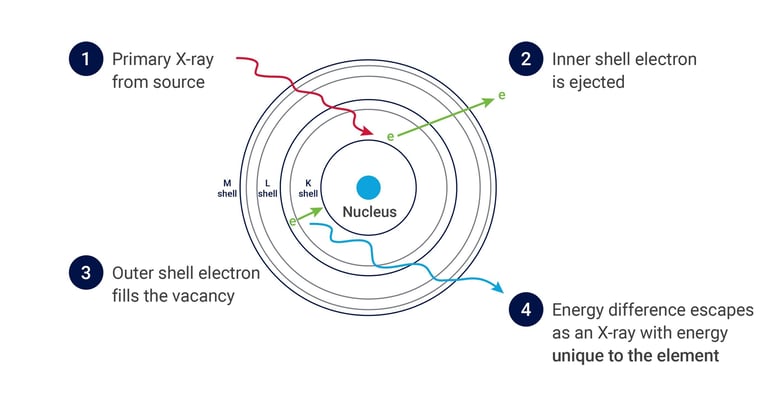
Figure 1: XRF Phenomenon
Some of the secondary X-rays that are emitted from the sample are then captured by a detector. The detector reads the intensity and energy, or wavelength, of the X-rays. This is how XRF can determine what elements are present and in what amounts. There are two commonly used XRF techniques: EDXRF and WDXRF. Each of these techniques has a different detection method.
Energy Dispersive XRF (EDXRF)
In EDXRF, the detector measures the energy and intensity of these secondary X-rays. As a result, you can quantify multiple elements concurrently. There are two excitation techniques used in EDXRF: direct and indirect.
Direct excitation
The primary X-ray beam from the tube, which passes through a filter to reduce the background, is used to directly excite the sample.
Indirect excitation
The primary X-rays from the tube are directed at a secondary target, which then emits X-rays to excite the sample. This geometry greatly suppresses background signals and enhances the peak-to-background ratio for improved sensitivity.
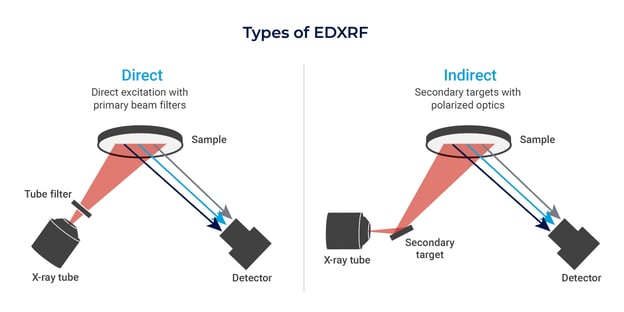
Figure 2: Direct vs indirect EDXRF
Benefits of EDXRF
EDXRF offers fast, non-destructive elemental analysis for a variety of materials. Its ability to detect multiple elements simultaneously, with minimal sample preparation, makes it both efficient and cost-effective.
Challenges of EDXRF
EDXRF has trouble telling apart elements that have similar X-ray energies. It can also struggle with ultratrace detection and some light elements (for example, oxygen).
To learn more about EDXRF, go to: About Energy Dispersive X-ray Fluorescence
Wavelength Dispersive XRF (WDXRF)
In WDXRF, the fluorescent X-rays emitted from the sample go through a collimator (Soller slit), which makes the X-rays more parallel. Then, one or more crystals are used to diffract the X-rays at a specific wavelength to detect the secondary X-rays from specific elements. A detector is placed at a particular angle to read the X-ray intensity from the targeted elements. There are two types of WDXRF: sequential and simultaneous.
Sequential WDXRF
Measures one element at a time by mechanically moving the crystal and detector to collect intensity for each wavelength, offering high precision for a wide range of elements.
.jpg?width=583&height=292&name=WDXRF%20Diagram%20(1).jpg)
Figure 3: Sequential WDXRF
Simultaneous WDXRF
Uses multiple fixed channels to measure several elements at once, enabling faster throughput, ideal for high-volume quality control environments.
Benefits of WDXRF
By using diffraction crystals to separate wavelengths, WDXRF minimizes overlaps between elements, which helps improve accuracy. It also offers high precision, excellent resolution, and lower detection limits, especially for light elements.
Challenges of WDXRF
These systems are generally larger, more expensive, and less portable. They also usually have longer analysis times because of precise crystal positioning, detector alignment, and sequential wavelength measurements. These improve resolution and accuracy but slow the process compared to faster techniques like EDXRF.
To learn more about WDXRF, read: What Is Wavelength Dispersive X-ray Fluorescence
XRF spectrometers
Models
Handheld
These portable analyzers are made for fieldwork and on-site XRF testing. They deliver fast results in a compact, lightweight form, making them ideal for tasks that require efficiency.
Benchtop
These analyzers offer greater accuracy and enhanced safety compared to handheld models. They are often used in production environments and laboratories that depend on increased precision.
Floor models
Floor models are ideal for high-throughput workflows and applications that demand exceptional performance, providing durability, precise measurements, and the ability to handle large amounts of samples efficiently.
To learn more about the different models of XRF spectrometers, visit this article: How Much Does an XRF Spectrometer Cost?
Key components
All XRF instruments share some key components.
X-ray tube
The X-ray tube produces the primary X-ray beam needed for analysis by accelerating electrons onto a metal target, producing the X-rays that excite the elements in the sample.
Primary beam filters
These filters are used to shape and refine the excitation beam before it gets to the sample, which helps to reduce the background noise.
Secondary targets (EDXRF optional)
These targets are materials placed between the X-ray tube and the sample to provide monochromatic excitation. This helps to eliminate background noise and enhances detection limits for some elements.
Analyzing crystals (WDXRF)
In WDXRF, these crystals are used to separate the fluorescent X-rays from the sample by wavelength, a process called diffraction. This makes it easier to distinguish between elements and allows for precise measurements of those elements.
Detector
The purpose of the detector is to collect the fluorescent X-rays from the sample, either by measuring the energy or wavelength. Then it converts these X-rays into signals that are analyzed to identify the elements in the sample and determine their concentrations.
Limit of quantification
The Lower Limit of Quantification (LLQ) is generally defined as three times the Limit of Detection (LOD or LLD). The LOD represents the smallest amount of an element that can be detected, but not necessarily quantified. The LLQ indicates the lowest concentration of an element that can be reliably quantified with acceptable accuracy.
Although XRF analyzers can perform quantitative analysis ranging from percentage levels to parts per million (ppm), the actual LLQ varies depending on the element, the sample matrix, and the XRF technique used.
Calibration
Empirical calibration
This calibration method uses reference materials to establish a relationship between the measured X-ray intensities and the known concentrations of elements in a set of standards. This provides accurate quantitative results.
Fundamental parameters
Fundamental parameters is a semi-quantitative XRF calibration method that uses physical constants and the sample’s matrix to model X-ray interactions. It estimates element concentrations without the need for matching standards, making it ideal for analyzing unknown samples. It can provide more accurate quantitative results when combined with known reference materials.
What can XRF analyze?
Sample types
XRF can analyze a wide variety of sample types, including solid materials like metals, ceramics, and plastics; powdered samples such as geological materials and cement; and liquids like oils and chemical solutions.

Figure 4: Sample types - Solid, powder, liquid
Elements
XRF can analyze a wide range of elements, typically from sodium (11Na) to curium (96Cm), depending on the instrument and its configuration. WDXRF instruments can often measure even lighter elements, starting with beryllium (4Be).
XRF performs best for elements with mid-to-high atomic numbers, since lighter elements, like boron (5B), produce lower-energy X-rays that are more difficult to detect. The quantifiable concentration range can vary significantly but is typically between parts-per-million (ppm) and 100%, making XRF convenient for trace analysis and bulk composition measurements.
XRF applications
XRF is widely utilized across numerous industries, primarily for applications such as quality control, process monitoring, regulatory compliance, and research. Some of these industries include mining & geology, cement & building materials, metals & alloys, coatings, environmental science, electronics & semiconductors, pharmaceuticals & healthcare, energy & battery materials, and petrochemicals.
To see more about what XRF can measure, check out What XRF Can and Can’t Analyze: A Guide for Beginners.
Advantages of XRF
Non-destructive
XRF preserves the sample’s integrity, allowing analysis without cutting, dissolving, or otherwise altering it. Unlike Inductively Coupled Plasma (ICP) spectroscopy and Atomic Absorption Spectroscopy (AAS), which often require dissolving the sample in acid or performing destructive digestion, XRF preserves the integrity of the sample for further testing or use.
Fast
Results with XRF are available within minutes, making it ideal for high throughput or on-site testing. In comparison, ICP generally involves much longer sample preparation; for example, sample digestion, which takes hours.
Easy to use
XRF systems come equipped with user-friendly software and automated workflows, allowing them to be operated with minimal training. This is much simpler compared to ICP and AAS, which often require more specialized knowledge to get the most out of the process.
Minimal sample preparation
The XRF technique requires little sample preparation, saving time and minimizing the chances of contamination or sample loss. However, ICP and AAS typically require more involved sample preparation, such as chemical digestion, precise dilution, and the handling of hazardous materials.
Affordability
XRF offers cost-effective elemental analysis, often at a lower price point than more complex methods like ICP. For more details about cost, read: How Much Does an XRF Spectrometer Cost?
Challenges and considerations
Sample homogeneity
Sample homogeneity poses a challenge in XRF analysis because only a small area is exposed to the X-ray beam. If the sample is not uniform in composition, such as powders with varying particle sizes, the results may not correctly represent the overall makeup. This can lead to inaccuracies in the data.
To reduce variability and improve accuracy, sample preparation methods, like grinding, mixing, or creating pressed pellets, can be used to make the sample more uniform.
Ultralight element analysis
Unfortunately, XRF is not able to analyze ultralight elements (like lithium) because the low-energy X-rays are easily absorbed by air and detector windows, which are often made from beryllium. In addition, the probability of fluorescence for these light elements is inherently low. These weak signals make detection challenging, often requiring alternative methods such as ICP or AAS.
Lower detection limits
XRF faces challenges when trying to measure very low concentrations, particularly at parts-per-billion (ppb) levels. While it is effective for many elements at parts-per-million (ppm) concentrations, detecting ultratrace amounts is difficult due to limitations in sensitivity and background interference. Alternative methods like ICP or AAS are commonly used for ppb-level analysis.
Crystal structure
While XRF excels at determining the elemental composition of a material, it is not able to show how those elements are arranged. X-ray diffraction (XRD), however, can be used to provide information about the material's crystal structure, enabling the identification of different crystalline phases, measuring lattice parameters, and estimating crystallite sizes. To learn more about the capabilities of XRF and XRD, read: What is the Difference Between XRF and XRD?
Is XRF for me?
If your work depends on making critical decisions based on what’s in your material, then XRF is for you. It offers fast, non-destructive analysis with little sample prep, making it a popular choice for many industries.
With configurations from portable handhelds to high-capacity floor systems, and using either EDXRF or WDXRF technologies, there’s an XRF model built for your environment and workflow.
Hopefully, this article gave you a better understanding of XRF principles, capabilities, and benefits, so you can better evaluate how it works best for you. Not sure where to start or want to learn more? Connect with one of our experts today!


Subscribe to the Bridge newsletter
Stay up to date with materials analysis news and upcoming conferences, webinars and podcasts, as well as learning new analytical techniques and applications.
Contact Us
Whether you're interested in getting a quote, want a demo, need technical support, or simply have a question, we're here to help.