
 What Is X-ray Diffraction?
X-ray diffraction (XRD) is one of the most important non-destructive tools to analyze all kinds of amorphous, powder and crystalline materials. From research to production and engineering, XRD is an indispensable method for materials characterization and quality control. Rigaku has developed a range of X-ray diffractometers, in co-operation with academic and industrial users, which provide the most technically advanced, versatile and cost-effective diffraction solutions available today.
X-ray diffraction techniques are used for the identification of crystalline phases of various materials and the quantitative phase analysis subsequent to the identification. X-ray diffraction techniques are superior in elucidating the three-dimensional atomic structure of crystalline solids.
The properties and functions of materials largely depend on the crystal structures. X-ray diffraction techniques have, therefore, been widely used as an indispensable means in materials research, development and production.
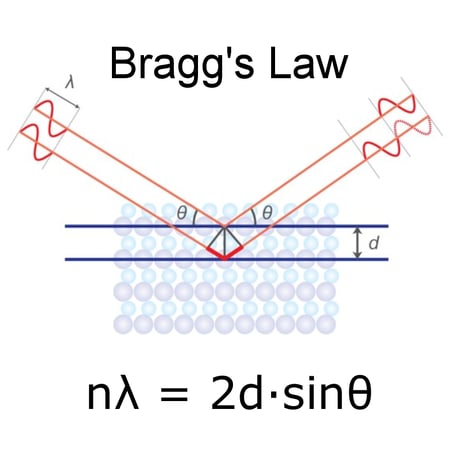
The Bragg equation, nλ = 2dsinθ is one of the keystones in understanding X-ray diffraction. In this equation, n is an integer, λ is the characteristic wavelength of the X-rays impinging on the crystallize sample, d is the interplanar spacing between rows of atoms, and θ is the angle of the X-ray beam with respect to these planes. When this equation is satisfied, X-rays scattered by the atoms in the plane of a periodic structure are in phase and diffraction occurs in the direction defined by the angle θ. In the simplest instance, an X-ray diffraction experiment consists of a set of diffracted intensities and the angles at which they are observed. This diffraction pattern can be thought of as a chemical fingerprint, and chemical identification can be performed by comparing this diffraction pattern to a database of known patterns.
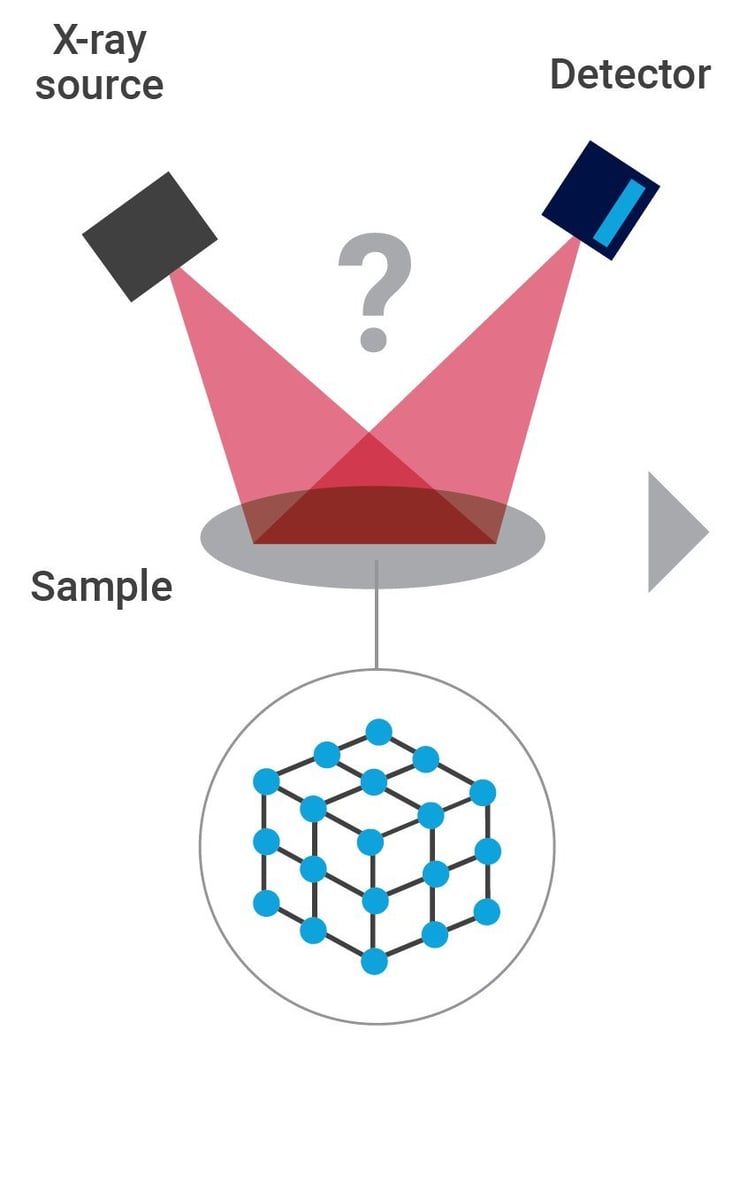
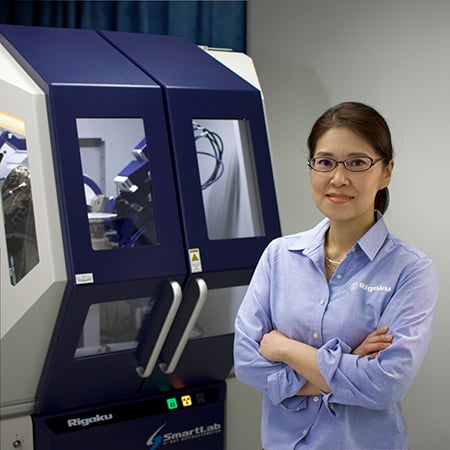
We measure interactions between X-rays and a sample using a diffractometer.
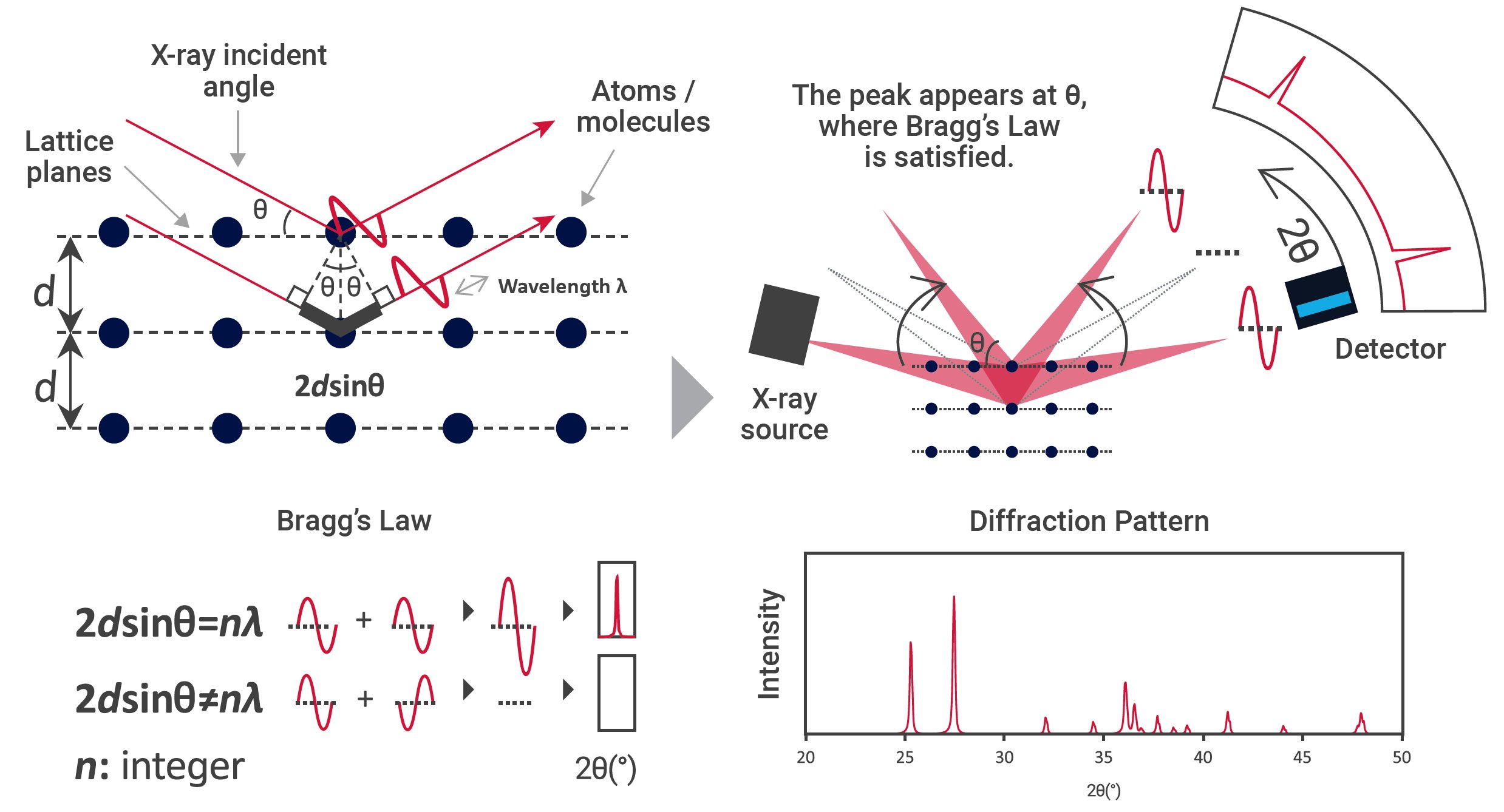
When the wavelength λ is known, the lattice spacing d of the constituents of the material can be determined from the diffraction angle θ.
What can XRD tell us?
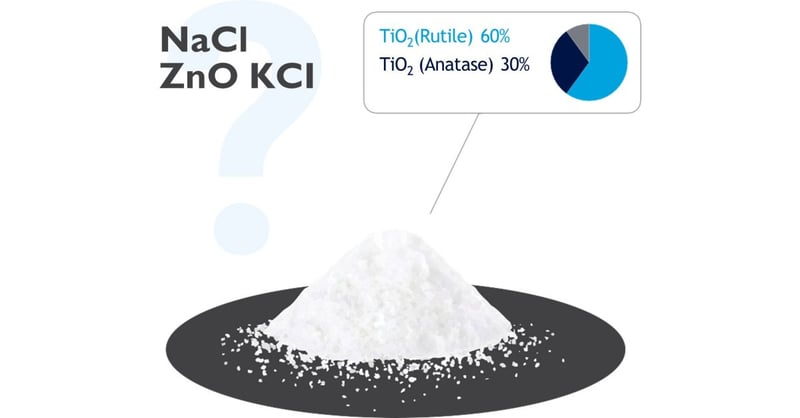
XRD can tell us what crystalline materials are included in powder or polycrystalline bulk samples.
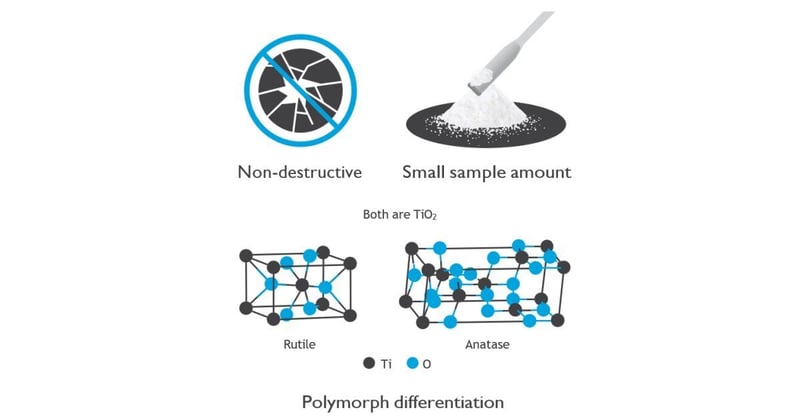
What are the benefits of XRD?
XRD is non-destructive, requires only a small amount of sample, and has the ability to differentiate between polymorphs
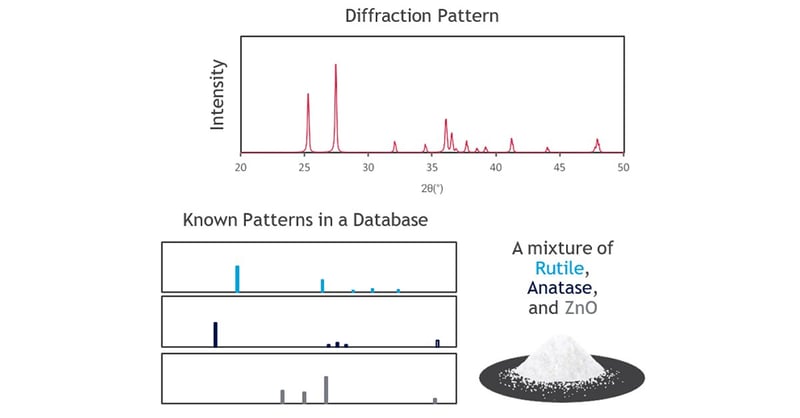
How can XRD identify materials?
We can identify the components by comparing the observed diffraction patterns to the known ones in a database, focusing on matching peak positions and relative intensities.
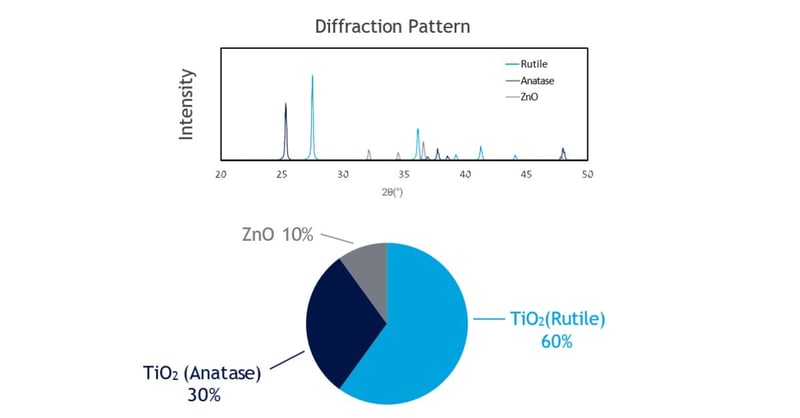
How can XRD quantify materials?
The total peak areas of a component are approximately proportional to its amount. Comparison of these total areas can provide the weight percentage of each component.

Cement industry
Example: identify components of cement, including crystalline and amorphous, and perform quantitative analysis of free lime (CaO) in raw materials.

Pharmaceutical industry
Example: Distinguish and control the amounts of polymorphs with different solubility and absorption rates in the body.
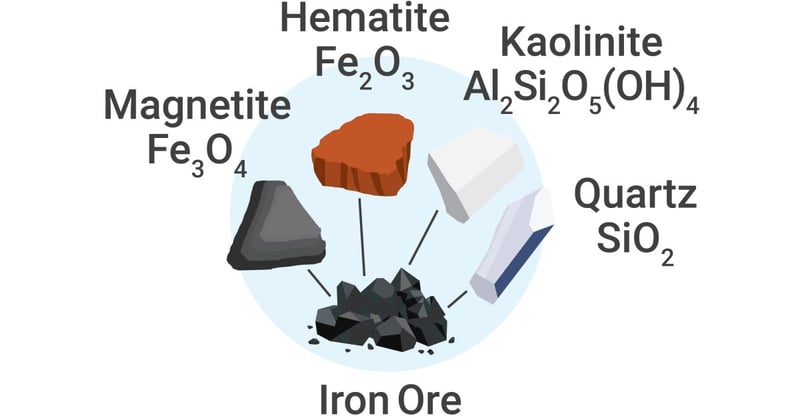
Geology and mining industries
Example: Identify crystalline phases of minerals in iron ores mined in different localities.

Battery industry
Example: Observe changes in crystal structure during the charging/discharging process.
Contact Us
Whether you're interested in getting a quote, want a demo, need technical support, or simply have a question, we're here to help.