About the calculator
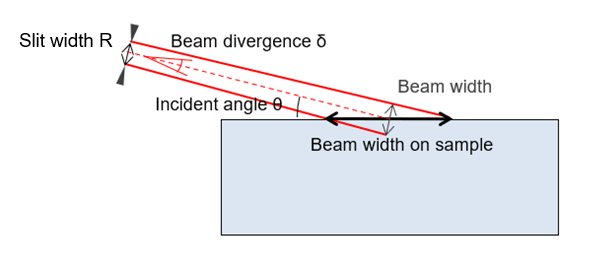
The calculator calculates the width of the incident X-ray beam on a sample for a given incident angle (θ), beam divergence (δ), slit width (R), and the distance from the slit to the sample surface (L).
How to use it
- Set the starting incident angle (θstart) and the step angle (θstep) to run the calculation.
- Enter beam divergence (δ) and the distance from the slit to the sample surface (Li).
- Enter the slit width (R) to calculate the beam footprint for different incident angles. You can set up to four slit widths.
Theory
Variables
| Symbol | Meaning | Units |
|---|---|---|
| θstart | Starting incident angle | degree |
| θstep | Incident angle step size | degree |
| R1 – R4 | Slit width(s) | mm |
| δ | X-ray beam divergence | degree |
| D | Distance from the slit to the sample surface | mm |
| L1 – L4 | Beam width at the sample surface | mm |
The beam width at the sample surface L is calculated as follows:
\(L_i = R_i + D \tan(\delta)\)
The beam footprint F at incident angle θ is calculated as:
\(F_i = \frac{L_i}{\sin(\theta)}\)