Application Note B-XRD2037
Introduction
Silicon (Si) substrates are widely used as the primary substrates for semiconductor devices. However, a native oxide layer with a thickness of approximately 0.5–2 nm readily forms on the substrate surface. This oxide layer contains defects and impurities (1), leading to an increase in crystal defects in the overlying layer and degradation of device performance. Particularly for large-diameter substrates, these effects become more pronounced, making the suppression and control of surface oxidation a critical issue. This study presents a nondestructive evaluation of the thickness, density, and surface roughness distributions of native oxide films on 300 mm Si substrates using the TFXRD Lab, a high-precision thin-film XRD for advanced research.
Measurements and results
The thickness distribution of native oxide films on a 300 mm Si substrate was evaluated by X-ray reflectivity (XRR). Figure 1 shows the profile fitting results for the center of the substrate using a layer structure model in which the native oxide film was assumed to be SiO₂, together with the calculated thickness, density, and surface roughness.
The obtained XRR profile exhibited clearly observable fringes originating from the thin film. The measured profile was in good agreement with the theoretical profile. Profile fitting revealed that the oxide layer was extremely thin, with a thickness of 0.745 nm, and exhibited a low surface roughness value of 0.303 nm. The density was calculated to be 1.388 g/cm³, which is lower than the theoretical value of SiO₂. This suggests that the oxide film has a less dense structure containing defects and impurities.
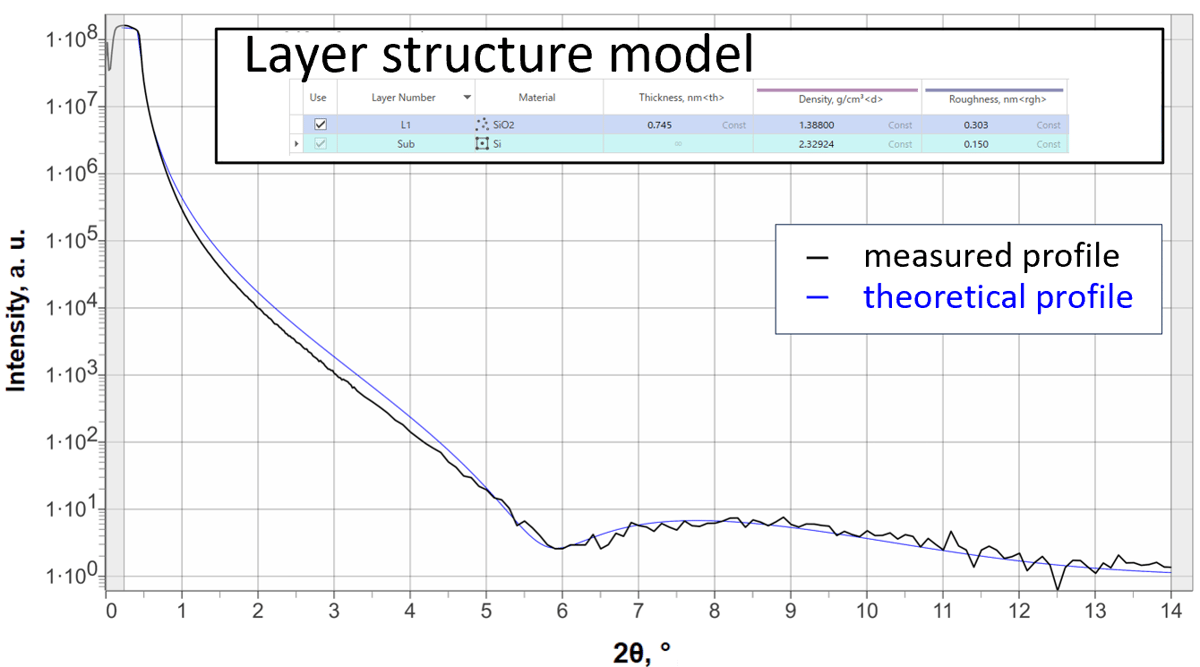
Fig. 1: Result of profile fitting
To investigate the in-plane distribution of the native oxide film, XRR mapping measurements were performed, and the results are shown as color maps in Figure 2. The results indicate that the thickness and surface roughness decrease from the center toward the notch direction, whereas the density is relatively low near the wafer edge. Using these results, the correlation between the film thickness and roughness was evaluated. It was found that the surface roughness increased with increasing film thickness up to approximately 1 nm, whereas it remained nearly constant for thicknesses above 1 nm. This suggests that, for thin oxide layers with a thickness of around 1 nm, local variations in the oxidation rate caused by the Si substrate surface roughness and defects are strongly reflected in the surface roughness (2), (3). In contrast, near the critical thickness, it is presumed that the increase in surface roughness becomes saturated because the growth of the oxide layer is dominated by oxygen diffusion through the oxide film and the subsequent reaction at the substrate and oxide interface.
Conclusion
As shown above, the TFXRD Lab enables the evaluation of the in-plane distribution of thin films with thicknesses of less than 1 nm films on larger-diameter substrates through XRR mapping measurements.
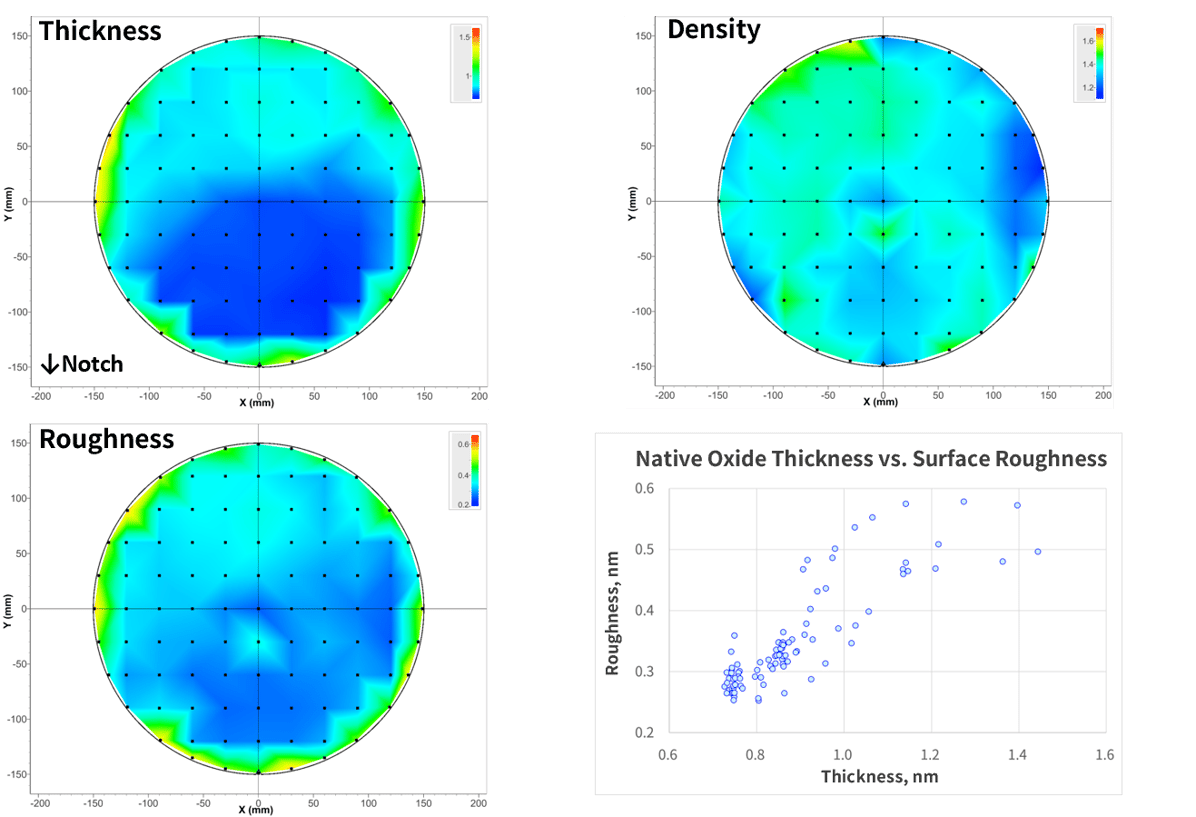
Fig. 2: In-plane distribution of the native oxide film and the relationship between film thickness and surface roughness
References
- Defects at the Si/SiO₂ interface: their nature and behaviour in technological processes and stress (1996)
W.Füssel, M. Schmidt, H. Angermann, G. Mende, H. Flietner; Nuclear Instruments and Methods in Physics Research A, 377, 177-183. - Roughness at Si/SiO₂ Interfaces and Silicon Oxidation (1999)
X. Chen and J. M. Gibson; Journal of Vacuum Science & Technology A, 17, 1269–1274. - Limiting Si/SiO₂ Interface Roughness Resulting from Thermal Oxidation (1999)
L. Lai and E. A. Irene; Journal of Applied Physics, 86, 1729–1735.
Recommended equipment and software
- TFXRD Lab 300 high-precision thin film XRD for advanced research
- SmartLab Studio II integrated X-ray analysis software (XRR and Data Visualization Plugin)