Application Note B-XRD1169
Introduction
In polymer research, in-situ observation and operando measurements are essential for understanding structural changes under realistic processing conditions. In particular, in-situ measurements performed during temperature changes or mechanical deformation can reproduce heating, cooling, and processing environments, allowing structural changes in polymer materials to be tracked under such conditions. Such experiments have traditionally been conducted at synchrotron radiation facilities; however, a wide angle X-ray scattering (WAXS; used here synonymously with Wide Angle X-ray Diffraction, WAXD) system combining a high-brilliance X-ray source with a fast, high-resolution, two-dimensional (2D) detector now enables laboratory-based in-situ measurements. This application note presents a high-speed, time-resolved study of structural changes in a polymer film during a crystallization-to-melting process under controlled temperature conditions.
Measurement and analysis
A polyethylene terephthalate (PET) film was heated from room temperature to 330°C at a rate of 20°C/min using a temperature-controlled stage, while 2D-WAXS images were continuously recorded in transmission geometry at 1 s intervals. Fig. 1(a) shows a representative 2D diffraction pattern, and Fig. 1(b) shows the corresponding 1D profile obtained by azimuthal integration (circular averaging).
During heating, diffraction peaks attributed to PET crystallization emerged and intensified around 160°C. Near 300°C, these peaks disappeared, clearly indicating melting of the crystalline phase (Fig. 1). Even with an exposure time as short as 1 s, subtle structural changes associated with crystallization were captured with high temporal resolution. This enables the crystalline state of polymer products to be monitored during thermal processing, providing practical insights for structural control. These results demonstrate that WAXS measurements combining a high-brilliance X-ray source with a fast 2D detector can be performed at the laboratory level to evaluate phase-transition behavior in crystallizable polymer materials.
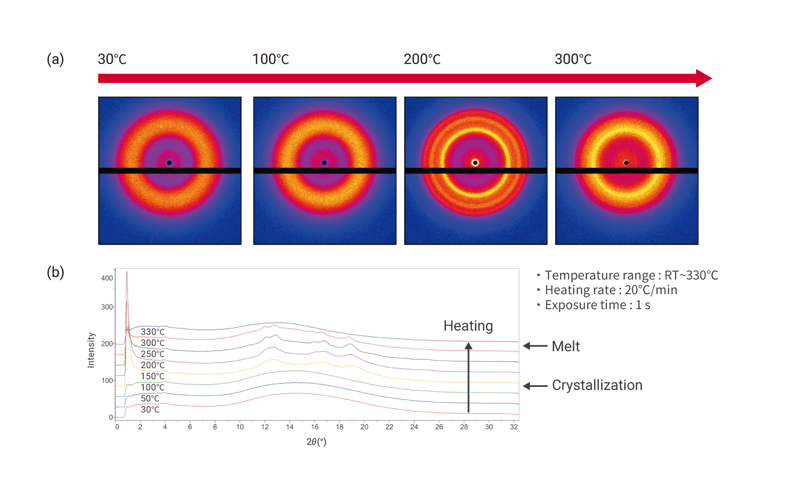
Figure 1: High-speed, time-resolved WAXS measurements of crystallization and melting in a PET film under temperature control: (a) 2D scattering pattern; (b) azimuthally averaged 1D profile.
Conclusion
By combining a temperature-controlled stage with a high-performance WAXS system, the phase-transition behavior of a PET film—from crystallization to melting—was evaluated in situ with a temporal resolution on the order of 1 s. This method is useful for characterizing crystalline states during heating and cooling processes and for establishing guidelines for structural control. It is expected to support materials development and process optimization in polymer science.
Recommended equipment and software
- DicifferX WAXS Edition wide angle X-ray scattering system with HyPix-6000 hybrid photon-counting detector
- HFSX350 Linkam heating stage
- SmartLab Studio II software suite for Rigaku X-ray diffractometers (Powder XRD plugin)