Application Note B-XRD1162
Introduction
The stretching process used in polymer film manufacturing has a major impact on the mechanical and optical properties of products. Real-time evaluation of changes in molecular orientation and crystallinity during stretching is important for materials design and process optimization. Wide Angle X-ray Scattering (WAXS; used here synonymously with Wide Angle X-ray Diffraction, WAXD) is a non-destructive technique that can be used to evaluate crystalline structure, orientation, and crystallinity in polymer materials. By combining high-brilliance X-rays with a high-speed, high-resolution, two-dimensional detector, WAXS measurements enable time-resolved tracking of crystallization and orientation changes during stretching, helping to clarify the relationship between polymer structure and properties. This application note introduces an in-situ WAXS study of structural changes in a polyethylene (PE) film during stretching.
Measurement and analysis
A PE film was stretched from a draw ratio of 1.0 to 3.22 at a stretching speed of 0.1 mm/s while two-dimensional diffraction patterns were continuously recorded at 1 s intervals. A Linkam MFS tensile stage was used for stretching control. The film sample was mounted horizontally and measured under uniaxial stretching conditions. The acquired 2D scattering data were azimuthally averaged to generate one-dimensional profiles, and representative results are shown in Fig. 1.
Crystalline orientation was almost isotropic at a draw ratio of 1.0, whereas it evolved into a uniaxial orientation at a draw ratio of 2.48. Above this draw ratio, no significant further change in the orientation state was observed (Fig. 1). These results demonstrate that changes in orientation during the drawing process can be captured relative to the draw ratio, and that high-speed WAXS measurements allow this behavior to be reproduced at laboratory scale.
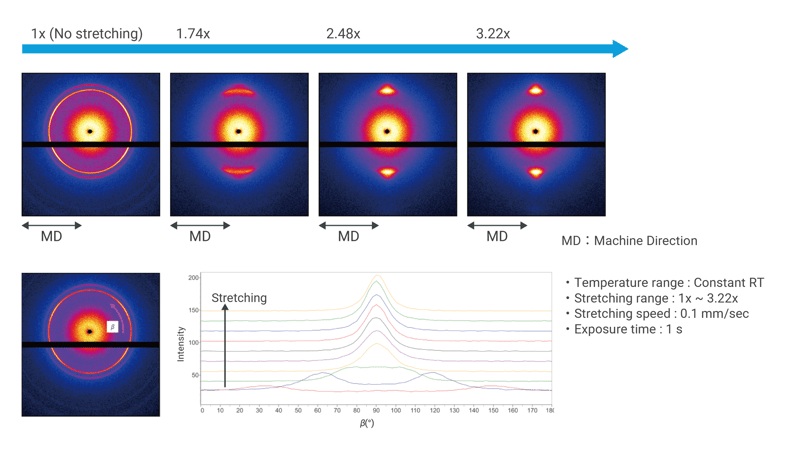
Figure 1: High-speed, time-resolved WAXS results showing structural changes in a PE film during isothermal stretching (1 s per frame).
Conclusion
Combining a high-brilliance laboratory WAXS system with a tensile stage enables in-situ evaluation of changes in the orientation state of a PE film at different draw ratios with a time resolution on the order of 1 s. This approach is useful for examining processing conditions and for elucidating structure–property relationships in polymer film development.
Recommended equipment and software
- DicifferX WAXS Edition wide angle X-ray scattering system with HyPix-6000 hybrid photon-counting detector
- Linkam MFS tensile/heating stage
- SmartLab Studio II software suite for Rigaku X-ray diffractometers (Powder XRD plugin)