Application Note B-TA1088
Introduction
Fibers include natural fibers derived from plants and animals, as well as chemically synthesized fibers. In this application, the effect of degradation on fibers used in clothing was evaluated by TMA based on their expansion and shrinkage behavior under varying load conditions.
Measurement and analysis example
For the samples, cotton and rayon sheets (thickness: 0.2 mm) were cut into strips 5 mm in width and 15 mm in length. Two types of samples were prepared: (1) original samples and (2) degraded samples (load 20 mN, air atmosphere, 90 °C, held for 24 h). The samples were held at 22°C, and the tensile load was stepwise varied from 20 mN to 300 mN, and the expansion ratio was measured after 10 min of holding for each sample.
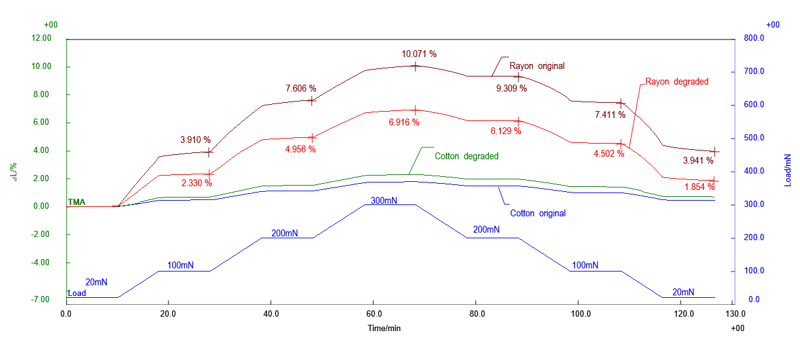
Figure 1: Comparison of TMA results at 22°C for sheets prepared under two different conditions
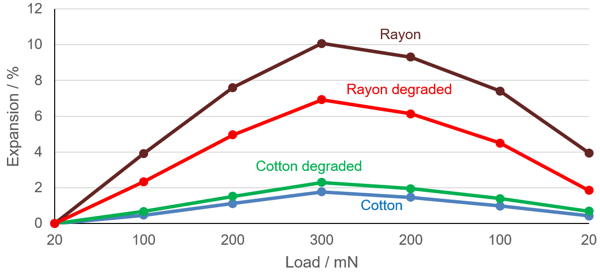
Figure 2: Load–expansion ratio plot
For both sheet samples, expansion was observed with increasing load and shrinkage with decreasing load. For cotton, the degraded sample showed slightly higher expansion and shrinkage ratios than the original sample. For rayon, in contrast, the degraded sample exhibited lower expansion and shrinkage ratios than the original sample. These results confirm that degradation treatment (load 20 mN, air atmosphere, 90 °C, 24 h) increased the rigidity of the rayon sample.
Comparing cotton and rayon, the change before and after degradation treatment was small for cotton, whereas a significant change was observed for rayon, indicating that the effect of degradation is more pronounced in rayon.
Measuring expansion and shrinkage rates of fibers using TMA in response to changes in load is a simple and effective method for evaluating the effects of degradation on mechanical properties.