


Application Note B-TA1087
Introduction
Fibers include natural fibers derived from plants and animals, as well as chemically synthesized fibers. In this study, the expansion and shrinkage behavior of fibers in response to humidity changes under a constant load was comparatively evaluated by TMA, as one of the performance characteristics relevant to clothing applications.
Measurement and analysis example
As samples, sheets of cotton, linen, polyester, and nylon (thickness: 0.2 mm) were cut into strips 5 mm in width and 15 mm in length and used for measurements. At a constant temperature of 23 °C under a tensile load of 20 mN, the relative humidity was stepwise increased and decreased from a dry atmosphere to 80 %RH in 20 %RH increments, held at each humidity condition for 30 min, and the expansion rate was measured.
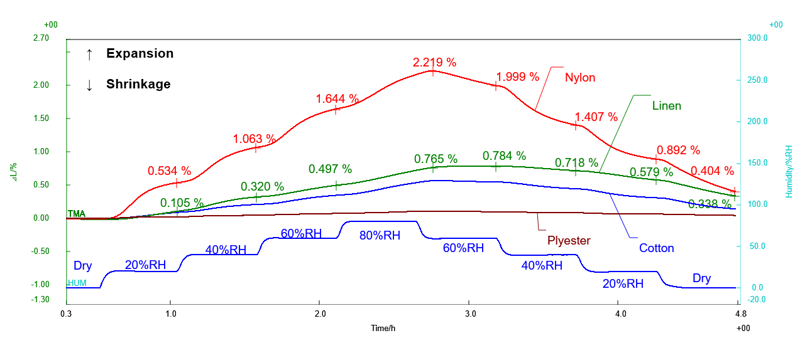
Figure 1: Comparison of TMA results obtained by varying relative humidity at 23°C and under a tensile load of 20 mN
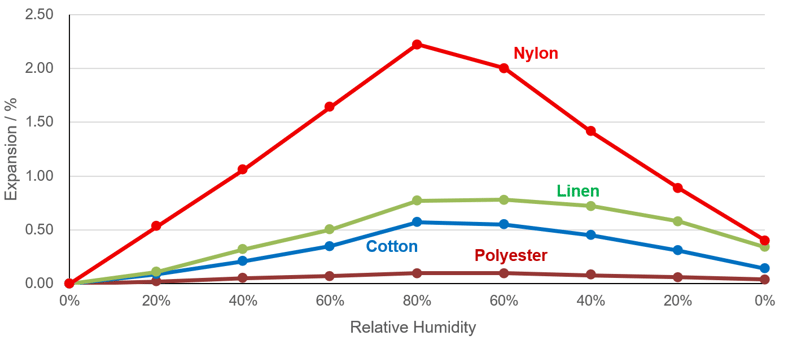
Figure 2: Comparison between different fibers based on expansion ratio–relative humidity plots
All fibers showed expansion with increasing humidity and shrinkage with decreasing humidity.
The natural fibers, cotton and linen, exhibited similar expansion and shrinkage behavior, with expansion ratios of 0.57 to 0.77 % at 80 %RH.
Among the synthetic fibers —specifically polyester and nylon—it was confirmed that while polyester showed almost no change in response to humidity variation, nylon exhibited expansion and shrinkage of approximately 2 %, and its humidity dependence regarding expansion and shrinkage under a constant load is higher than that of other fibers.