Application Note B-TA1068
Introduction
Heat-shrink tubing is manufactured by extruding thermoplastic polymers such as polyolefins, fluorocarbon polymers, and PVC into a tubular shape, followed by crosslinking. The tubing is subsequently heated, and subjected to internal radial pressure, followed by a cooling process.
Taking advantage of the property whereby a shape memory under heat and pressure returns to its original form when heated, causing radial contraction, this material is used for applications such as wire connections and the protection of insulation coverings. Using the TMA tensile load method, the sample was heated while subjected to a constant tensile load, and its expansion and shrinkage in both the radial and longitudinal directions were measured and compared.
Measurement and results
The samples were prepared by cutting 5 mm wide, 14 mm long pieces from heat-shrink tubing with an inner diameter of 12 mm. The samples were secured in the chuck fixture with a length of 10 mm, and measurements were performed under conditions of a 20 mN tensile load and a heating rate of 5 °C/min.
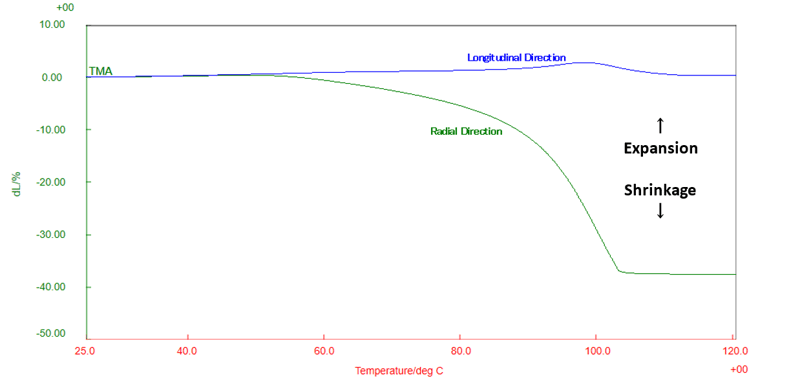 Figure 1 TMA Results
The table below shows the expansion % at various temperatures, with 25°C taken as the reference temperature.
| Temperature °C | Expansion(⊿L/L0) % | |
| Radial Direction | Longitudinal Direction | |
| 40.0 | 0.17 | 0.24 |
| 50.0 | 0.30 | 0.53 |
| 60.0 | -0.64 | 0.84 |
| 70.0 | -2.64 | 1.06 |
| 80.0 | -5.58 | 1.24 |
| 90.0 | -11.73 | 1.74 |
| 100.0 | -29.95 | 2.53 |
| 110.0 | -37.57 | 0.49 |
| 120.0 | -37.60 | 0.32 |
In the radial direction, the TMA curve showed repeated slight expansions up to around 50°C; shrinkage then began around 60°C, and a shrinkage of approximately 38% was observed at 120°C. Heat-shrink tubing is typically designed and manufactured to have a radial shrinkage of approximately 50%. However, according to the presented measurement results, it is presumed that the shrinkage was suppressed because a load of 20 mN was applied in the tensile direction (the direction opposite to shrinkage).
Similarly, in the longitudinal direction, repeated expansion was observed up to around 100°C, after which shrinkage began at 120°C, a shrinkage of approximately 0.3% was exhibited.