Application Note B-TA1052
Introduction
The expansion and shrinkage behavior of hardened cement materials used as construction materials were evaluated in response to changes in relative controlled humidity.
Measurement and analysis example
The samples were prepared by mixing commercially available ordinary Portland cement powder with water in 100:50 ratio (W/C = 50%), followed by mixing and curing for 168 hours (7 days). Cylindrical specimens with a diameter of 6 mm and a length of 18 mm were cut from the hardened material, and a compression load was applied along its length for TMA measurement.
The relative humidity was maintained at 23°C and increased stepwise to 20%, 40%, 60%, and 80%, each step held for 6 hours. Then, it was decreased stepwise to 80%, 60%, 40%, and 20%, holing each step for 6 hours.
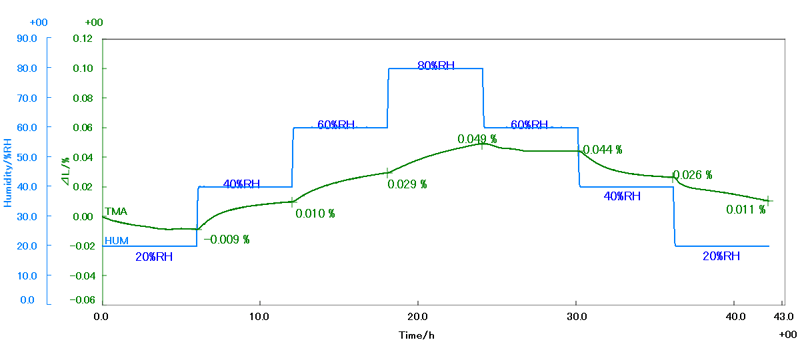
Figure 1: Expansion ratio with respect to changes in humidity
From the initial state, after 6 hours of holding at 20%RH, the shrinkage showed a nearly constant state of saturation. In response to an increase in controlled humidity, the expansion was 0.019% from 20%RH to 40%RH, 0.019% from 40%RH to 60%RH, and 0.02% from 60%RH to 80%RH, respectively. However, at 80%RH, the expansion did not reach a constant state of saturation after 6 hours of holding.
The results obtained during the stepwise decrease in controlled humidity showed the shrinkage of 0.005% from 80%RH to 60%RH, 0.018% from 60%RH to 40%RH, and 0.015% from 40%RH to 20%RH, respectively. At 20%RH, expansion did not reach a constant state of saturation during 6 hours of holding.
A system combining TMA and a humidity generator can measure the expansion due to humidity absorption and shrinkage due to drying for cement hardening materials of different types and mixes of cement, and under various hardening conditions, including different types and mixtures of cement; this is considered effective for evaluating the humidity characteristics of cement.