Application Note B-TA1075
Introduction
Portland cement used in construction materials is manufactured by finely grinding and mixing gypsum dihydrate (CaSO₄・2H₂O) with an intermediate product called clinker, which is produced from raw materials including limestone, clay, silica, and iron, etc.
In this study, the amounts of Ca(OH)₂ and CaCO₃ contained in cement were quantified using TG-DTA, and the results are presented below.
Measurement and analysis example
As a sample, approximately 40 mg of commercially available Portland cement was placed in an open platinum pan and measured at a heating rate of 10 °C/min under an air flow atmosphere.
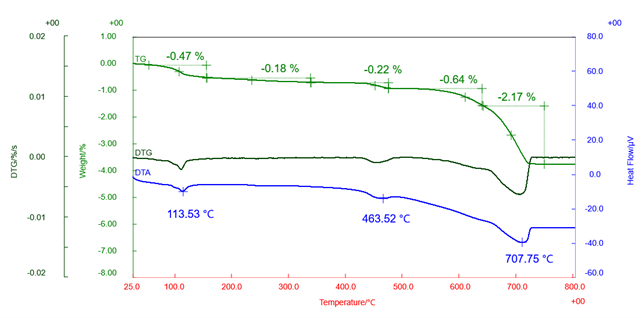
Figure 1: TG-DTA measurement results
The measurement results above show stepwise mass losses due to dehydration accompanied with multiple endothermic peaks up to around 300 °C.
Between 400°C and 500°C, a mass loss (0.22%) accompanied by an endothermic peak due to dehydration of Ca(OH)₂ was observed. Between 650°C and 750°C, a mass loss (2.17%) accompanied by an endothermic peak due to decarbonation of CaCO₃ was observed. The Ca(OH)₂ and CaCO₃ contents calculated from these mass loss rates were 0.9% and 4.9%, respectively.
The CaCO₃ content correlates with the degree of carbonation and will be applicable as a simple indicator for evaluating the durability of hardened cement (such as reinforcement corrosion and shrinkage cracking).